Verse 51852arkhulaa
G1
1 a
in the thought of beauty, is a {pertaining-to-beauty-of-action}-ish thought
1 b
in the thought of beauty, is the thought of something like beauty of action
2
a single/particular/unique/excellent door of Paradise, inside my grave, has {opened / become revealed}
'Thought, opinion, surmise, suspicion, conception, idea, notion, fancy, imagination, conceit. whim, chimera; consideration; regard, deference; apprehension; care, concern; --an imaginary form, apparition, vision, spectre, phantom, shadow, delusion'.
'One, single, sole, alone, only, a, an; the same, identical; only one; a certain one; single of its kind, unique, singular, preëminent, excellent'.
| References | |
|---|---|
| Arshi, Imtiyaz Ali | Ghazal# 45 |
| Raza, Kalidas Gupta | 423-424 |
| Hamid Ali Khan | Open Image |
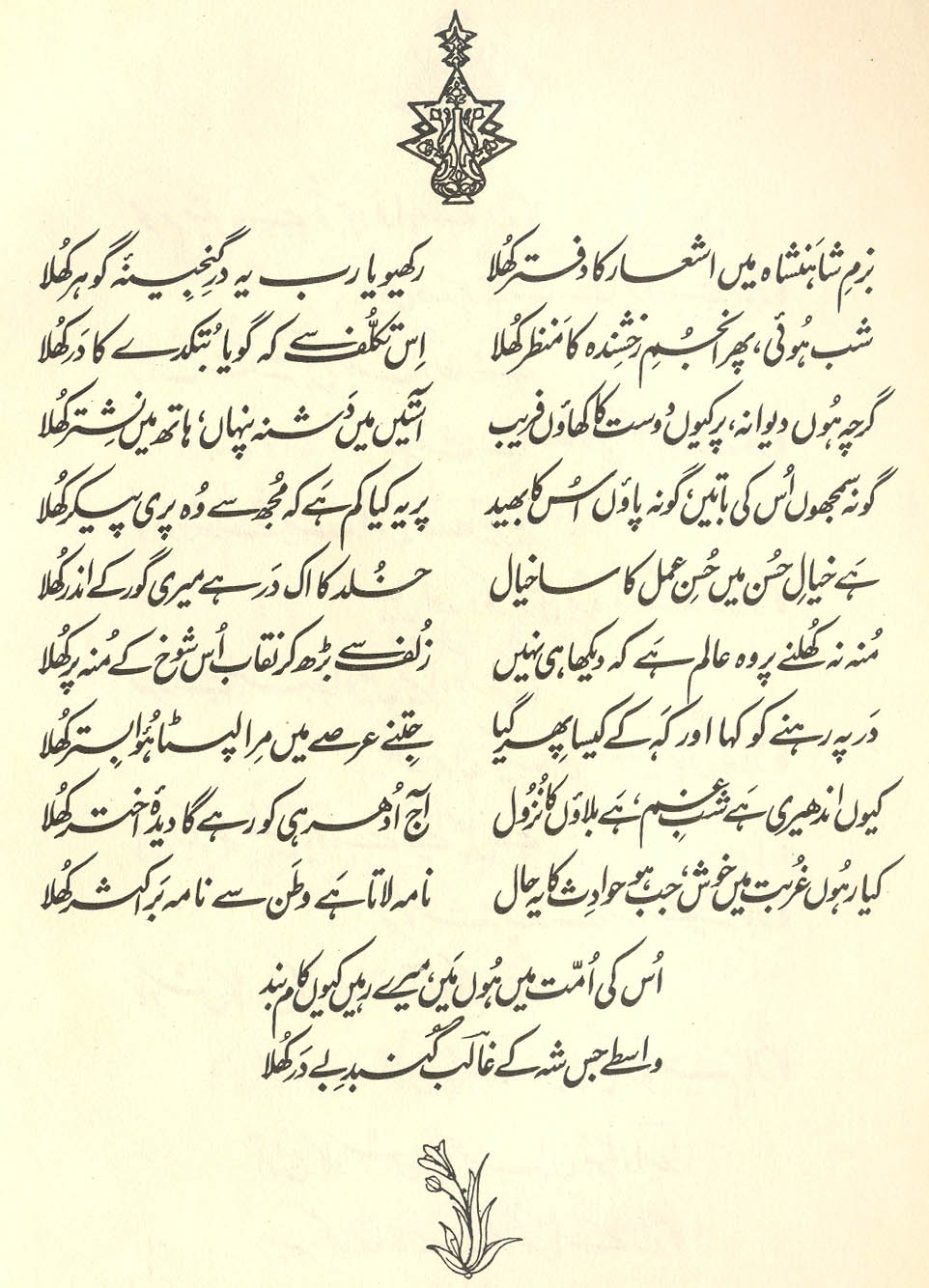
From the thought of beauty, that is, from the image of the beloved's face, a door to Paradise shows itself in the grave. Because her face is colorful like a garden; so it's if the image of beauty and the beauty of actions have one single fruit. (14-15)
== Nazm page 14 ; Nazm page 15


Urdu text: Vajid 1902 {14}
The perfect vision of the True [divine] Beloved has done the work of worship for me. (30)
The face of the beloved in itself is Paradise. (32)
Compare 87,7 . (228)
Even if a thought of beauty translates into a 'thought' of doing good deeds (or more literally, and even more abstractly, 'a pertaining-to-goodness-of-deeds-ish thought'), does such a thought actually get one into Paradise? A careful look at the wording of the verse suggests that the 'door' that has opened might well lead only to a highly metaphorical 'heaven' in the mind-- a heaven that has the same relation to the religious one as 'a pertaining-to-beauty-of-action-ish thought' has to actual virtuous deeds.
And 'thought' [] itself is nothing if not uncertain and untrustworthy, with meanings that include fancies, apparitions, and delusions (see the definition above). The use of to convert 'pertaining-to-beauty-of-action' into 'pertaining-to-beauty-of-action-ish' also seems to point to further layers of distancing-- but without enabling us to discern what they might be.
And of course, this is only 'one' door, and there may well be others. Or it might not be exactly 'one' door, but a 'single' door, or a 'sole' door, or a 'certain' door, or a 'unique' door, or even a 'preeminent, excellent' door (see the definition above). And it might be an imagined, imaginary door, a door created by 'thought'-- so that the speaker in the grave can't actually go through it. In such an abstract and open-ended verse, the possibilities of are on remarkably fine display; as usual, it's left to us to decide among them.
Abdul Basit points out (January 2020) that the Sahih Bukhari contains a possibly relevant hadith (vol. 8, bk. 76, #498):
Narrated Ibn Abbas: The Prophet narrating about his Lord said, 'Allah ordered (the appointed angels over you) that the good and the bad deeds be written, and He then showed (the way) how (to write). If somebody intends to do a good deed and he does not do it, then Allah will write for him a full good deed (in his account with Him).'
So conceivably Ghalib might have had this hadith in mind. But the general twistiness of the verse means that 'a thought of something like beauty of action' can't be straightforwardly equated to an 'intention to do a good deed'; nor is it clear that getting (honorary) credit for a single good deed would really open a special 'door into Paradise'. But then again-- readers can make their own choices about this.
For still more fundamentally, we can't tell what the relationship between these two very abstract lines might be. Do they both describe the same situation? Do they describe two different situations, that are compared and/or contrasted? Does the first line make a claim, and the second line provide evidence in favor of it? Does the second line report an event, and the first line provide an explanation of it? And so on-- we can ask, but the only answers we get are those we ourselves choose.
The fact that , 'inside', contains with in it , the very 'door' that appears 'inside' the grave, is an enjoyable touch of wordplay.
This verse belongs to the set in which the dead lover speaks from beyond (or in this case, within) the grave; for other such verses, see 57,1 .
Note for grammar fans: The two parts of are not only reversed in sequence but also separated by unusually many other words. It's pushing the limit, but don't let it confuse you: just move the to the end of the line where it grammatically belongs.
graphics/graveyardsitaram.jpg