Verse 21816aaho jaa))iye
G1
1
like an egg, this corner of the cage is a disgrace/honor to wing and feather
2
there would be life with a fresh start/'head', if you would become released
'Honour, esteem, reputation; --shame, disgrace, infamy, ignominy'.
'Corner, nook; a confined place; a bower; a grove'.
'Released, liberated, set free, discharged: -- , v.t. To release, set free, set at liberty, to discharge, dismiss; to relieve; to quit, leave, discard, abandon'.
| References | |
|---|---|
| Arshi, Imtiyaz Ali | Ghazal# 171 |
| Raza, Kalidas Gupta | 241 |
| Nuskhah-e-Hamidiyah | 258-259 |
| Asi, Abdul Bari | 264-265 |
| Gyan Chand | 386-387,552 |
| Hamid Ali Khan | Open Image |
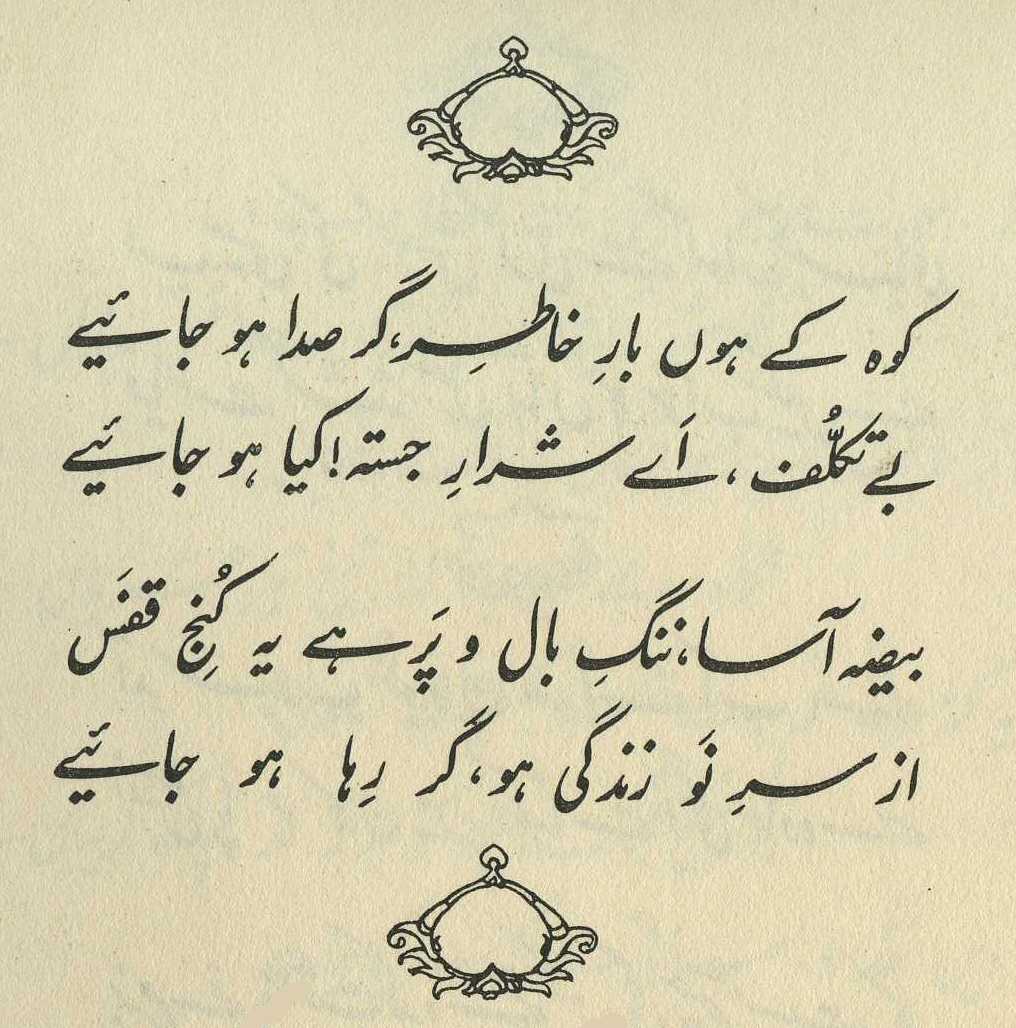
For coming out of the cage and the starting of a new life, the verse was in need of a proof. Calling him 'like an egg', the author proved it. That is, a bird's new life begins after emerging from the egg. In the same way, after being released from this corner of the cage-- that is, the egg of the sky-- a new life in the world of spirits will begin. (251)
== Nazm page 251

He says, 'The way a bird emerges from an egg and begins life, in the same way after being released from this corner of the cage-- that is, the sky-- a new life will begin'. The meaning is that after dying one will be compelled to start life anew in the world of spirits. (309)
The way that to remain in an egg is, for any bird whose feathers and wings have grown out, a disgrace to feather and wing, in the same way while there is strength to become free, to remain lying like a helpless one in this bodily cage, or in the power of sensory pleasures, or in the prison of some powerful king, is a disgrace to one's strength. Thus it is mankind's duty to enter a new life, and tear apart and throw away this prison. (453)
This verse is as sharp and powerful as the previous one, 220,1 , is muddy and elusive. 'Like an egg'-- what more potent and complex image is there? An egg is an utterly helpless, vulnerable, delicate thing-- and also radically potent, exciting, full of promise. To be compared to an egg might thus, depending on the context, mean almost anything. Then of course means both 'shame' and-- less often-- 'honor' (as discussed and documented in 3,5 ), so as we move on through the first line, our choices don't narrow at all.
Thus the interpretive range is 180 degrees broad. At one extreme, we have an insulting depiction of a bird who perversely chooses (or has been forced) to live in a corner of a cage, and thus becomes a disgrace to the feather and wing he ought to be using, so that in fact he's as humiliatingly helpless as an egg. At the other extreme we have a flattering evocation of a bird who, though now confined by a cage, has the kind of powerful potential that an egg does, and is destined one day, when he leaves the cage, to be a credit to, to be part of the 'honor' of, feather and wing.
We look hopefully to the second line for clarification-- and find only an enticing, wistful speculation: there would be a new, fresh life, if the addressee would become 'released'. The bird might be talking to himself, or the speaker might be another bird; a phrase like 'a disgrace to wing and feather', and the comparison to an egg, would come naturally to the lips (beak?) of a fellow-bird. The lover often speaks as a bird (for examples see 126,5 ), and this verse might well be another such instance.
On any reading, the wistfulness, the hope, the uncertainty remain. The petrified phrase literally means 'from a new head', which works beautifully with the image of an egg hatching open.
Compare 3,5 , with its equally complex use of ; instead of playing with the egg and the cage, it plays with the shroud and the garment.
graphics/cagedbird.jpg