Verse 4x1816aaho jaa))iye
G1
1
keep in memory the coquetries of the original kindness/courtesy
2
become the nest of the 'bird of color' of henna
'Regard, attention, countenance; respect, consideration, courtesy, civility, kindness'.
'Colour, colouring matter, pigment, paint, dye; colour, tint, hue, complexion; beauty, bloom; expression, countenance, appearance, aspect; fashion, style; ... sport, entertainment, amusement, merriment, pleasure, enjoyment'.
| References | |
|---|---|
| Arshi, Imtiyaz Ali | Ghazal# 171 |
| Raza, Kalidas Gupta | 241 |
| Nuskhah-e-Hamidiyah | 258-259 |
| Asi, Abdul Bari | 264-265 |
| Gyan Chand | 386-387,552 |
| Hamid Ali Khan | Open Image |
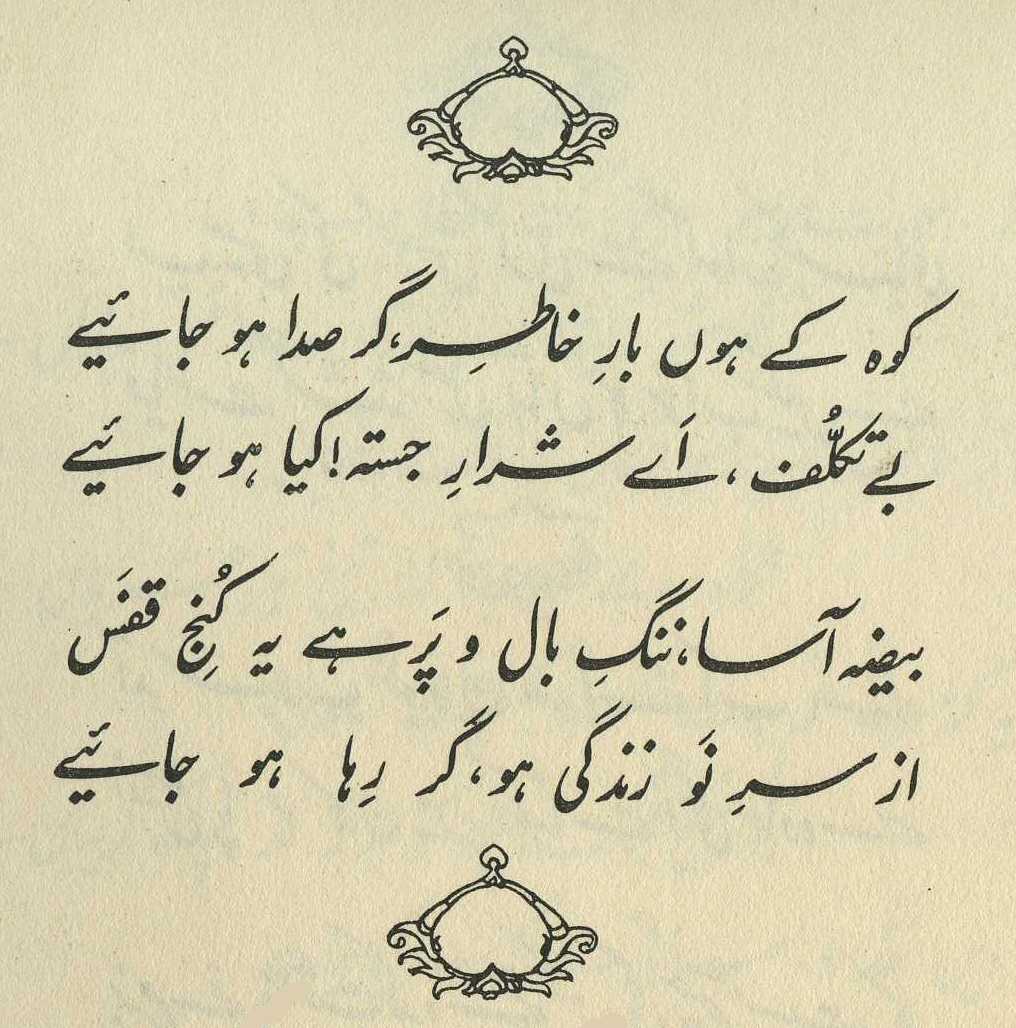
Go on remembering the coquetries of the beloved's former kindness/courtesy. That kindness of coquetry was, so to speak, a bird of color that has now flown away. But in the case where you keep the kindness of coquetry in mind, then it's as if you have to become the nest of the bird of henna. In the tangles of thought, convolutions have overtaken the end of the thread of meaning.
== Asi, p. 264
They call the color of henna a bird through the affinity that it flies away. The original kindness/courtesy was such that like henna, it received the honor of hand-kissing and foot-kissing. And now finally the unkindness is such that like the flying-off color of henna, it is not even inquired about.
If instead of the word 'nest' there were or some other word only for padding , then straightforwardly the meaning would emerge that when we became far from her, now we would become lost in her memory (like the color of henna). But the 'nest' has created 'Ghalibness' []-- that since the original kindness has become a bird and flown away, when the memory of it remains in the heart then the heart is established as its nest. But because of metrical constraints 'heart' was not able to come in, so that he himself became the nest of the bird of the original kindness. Although the verse is not meaningless, it is not devoid of convolutedness.
== Zamin, p. 385
The addressee of the verse is the lover, not the beloved. Ghalib gives for the flying-away of the color of henna, the simile of the flight of a bird. It is not that now the beloved has ceased to apply henna and the color of her henna has flown away. Rather, now we don't at all see that beloved with the hennaed hands. So to speak, as far as our relationship goes, the bird of the color of henna has already flown away. It is not within our power, but if the bird would be settled in a nest, then it will not be said that the bird has flown off and vanished.
Oh lovers: the kindness that the beloved coquettishly showed toward you in the very beginning (that is, she had shown the glory of her hennaed hand)-- keep on remembering it, and make your mind a nest of the bird of the color of henna. Although the color of henna might not remain protected before you in a physical way, at least in a mental way it would be possessed by you alone.
== Gyan Chand, p. 386
For background see S. R. Faruqi's choices . This verse is NOT one of his choices; I thought it was interesting and have added it myself. For more on Ghalib's unpublished verses, see the discussion in 4,8x .
On henna, see 18,4 . Henna is a dark greenish-brown when newly applied (as in the image below), then dries to a red color that eventually pales as it fades away. As the commentators point out, the fading color can be said to 'fly away' the way a bird flies away. Or, of course, the way the beloved's initially flirtatious kindness and favor gradually pale into much colder treatment.
The addressee is enjoined to use and curate his memories so as to become a 'nest' for this bird of the color of henna. As Zamin notes, the unexpected appearance of the 'nest' creates a certain 'Ghalibness' in the verse. For the 'nest' offers twofold possibilities. Young birds are said to 'leave the nest' when they have grown, and many kinds of disturbance can induce adult birds too to abandon their former nests even in the middle of the egg-laying season-- not to speak of from one year to the next. Especially in the case of the bird of 'the color of henna' (which is guaranteed to fade away), it's easy to see the nest of such a bird as an image of desolation and abandonment.
But a nest is also, of course, a bird's only real home. Birds carefully build nests as part of their mating rituals; they constantly leave their nests to find food, only to hasten back to nurture their young. So to be the home 'nest' of a bird-- even a bird as evanescent as the color of henna-- can also conjure up images of loyalty, faithfulness, love. As Gyan Chand observes, once the bird of the color of henna has flown, its radiant red color will be possessed by the lover alone-- the one who has made his mind and memory into a shrine or 'nest' for the long-ago beauty and color of that bird. Along these lines, see the similar thought in 88,5x .
Compare Mir 's use of the 'bird of the color of henna': M 52,2 .
graphics/hennabird.jpg
graphics/birdnest.jpg