Verse 11816aaho jaa))iye
G1
1
[we?] would be a bother/burden for the mountain, if [we?] would become an echo/voice
2
{without formality / 'to tell the truth'}, oh having-leaped spark, what would [we?] become?
tir>> : 'Load or trouble of mind; tiresomeness'.
'Echo; sound, noise; voice, tone, cry, call'.
| References | |
|---|---|
| Arshi, Imtiyaz Ali | Ghazal# 171 |
| Raza, Kalidas Gupta | 241 |
| Nuskhah-e-Hamidiyah | 258-259 |
| Asi, Abdul Bari | 264-265 |
| Gyan Chand | 386-387,552 |
| Hamid Ali Khan | Open Image |
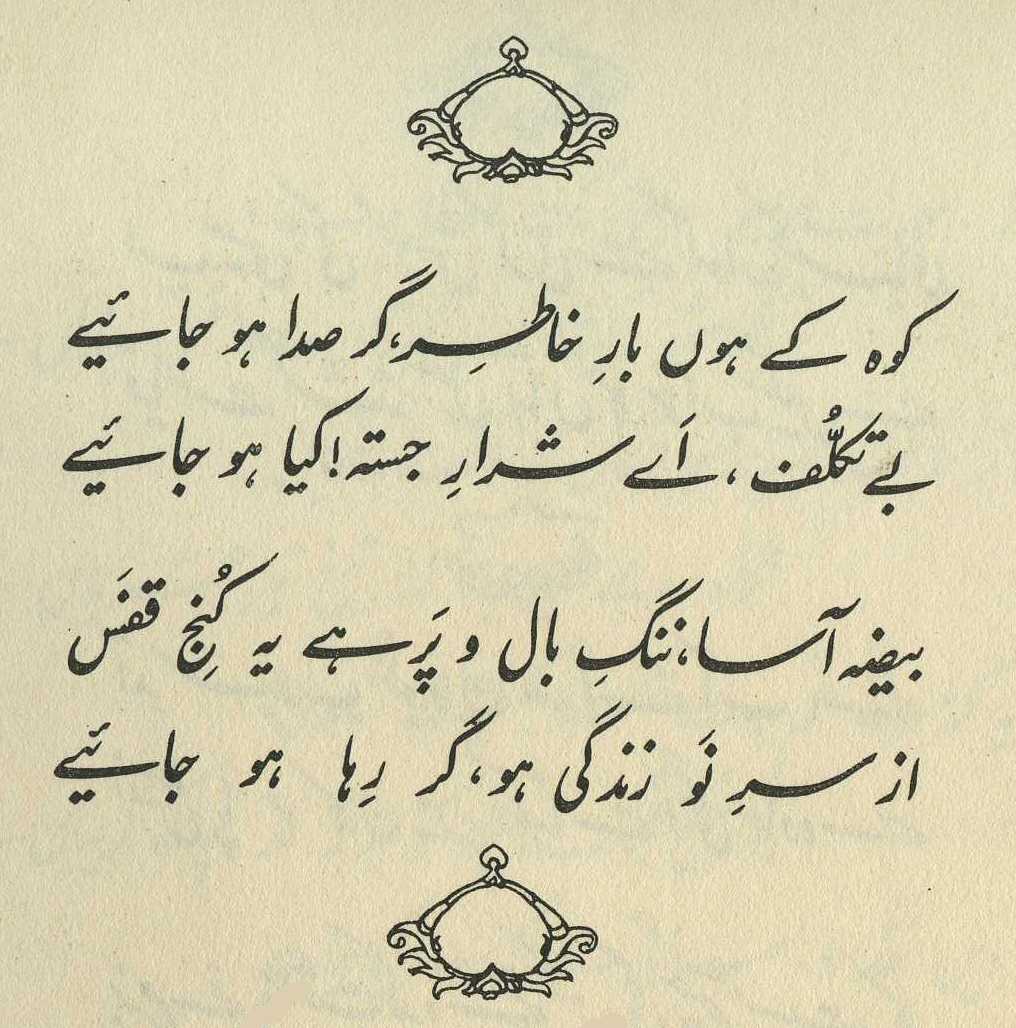
Having seen the spark's self-transcendence and informality, he says, what the hell-- as if we would become informal like you, and how would we let self-control slip from our grasp! Here is the explanation: that if we would become light and refined like a voice, and quiver, even then we would become a bother to the mountain-like stone-like and immovable body. The gist is that to the extent possible, one ought to control himself and tread lightly, otherwise he will become a bother for everybody. The cause of similitude in this verse is that the spark emerges from a stone, and a voice rebounds from the mountain and comes back. That is, it is a bother to him, and and for this reason he stops it. (250)
== Nazm page 250

That is, the mountain gives back the voice, from which it is shown that we were a bother to the mountain, he didn't accept it, and sent it back. Oh leaped-spark, if we were self-transcendent and informal, and quivered like you, then no telling what a commotion we'd be in. The meaning is, to the extent possible, one ought to control the state of restlessness. The spark emerges from a stone, and the voice rebounds from a mountain and comes back. (308-09)
If we would become even as light and delicate as a spark, then we would be heavy on the heart of the mountain (of which the massive heaviness is proverbial). Oh emerged spark, tell us clearly-- after all, what ought we to become? The style of the question reveals that the poet means to say that our heart too wishes that we would become like you-- would burn out and be extinguished in a breath/moment, and find escape from the disasters of the world. 452)
[Quoting Asi:] I'm so ill-fortuned that for the whole world I'm a bother/burden. To such an extent that if I would become a voice, which is an extremely delicate thing, then I am a bother for the mountain, and it too returns me.... And from the returning, a proof has been given for my being a bother. So finally, oh having-leaped spark of grief! what would/should I become. And the way you have leaped up and are becoming informal, how would/should I show this kind of informality? (489)
Compare 91,9 . (277)
The polite imperative is here used colloquially as a kind of subjunctive, so that is more like . But it's awkward, and very unusual, that there seems to be no real indication of subject at all, in the whole verse. The colloquially-permitted omission of the subject normally depends on the context making the subject clear. But in this verse, of course, there is no such context. The reader is left to guess that the subject should be understood as 'we', for the first line has the plural form to pluralize the 'bothers', and thus the subject. And any other plural subject would be even more awkward, since the least marked voice in the ghazal world is the first person; moreover, the spark in the second line appears to be singular, which also encourages a reading of a 'we' that refers chiefly to the speaker.
The commentators suggest that the speaker's becoming an echo would mean his bothering the mountain by (apparently) not creating but literally turning into voice-waves, which the mountain would find troublesome and would reject by bouncing them back, thus creating (or explaining the presence of) an echo. Or, alternatively, are his cries so passionate and fiery that even the sturdy stone of the mountain is in danger of melting? Or is his grief so heavy a 'burden' that even the tough stone mountain can't bear it? Or does the mountain simply suffer the extra 'bother' or 'trouble', without any reaction; and if so, how does it feel toward him? The possibilities seem pretty broad, and aren't effectively anchored in any physical imagery.
Then in the second line, instead of clarity we find further complexities. Why does the speaker address a spark, and why a 'having-leaped' one? Presumably because sparks come from stones, and in fact are thought of as coming from the 'veins' in rock the way drops of blood come from human veins (for more on sparks and stones verses, see 20,6 ). Is the spark only a nearby listener who happens to be handy; or is it a particularly sympathetic listener who deeply understands the situation; or is it an interested party who might be affected (for the better? for the worse?) by the slamming of the echo/voice into the stone?
Given all the other uncertainties, the question 'what would (we) become?' is in its own right a sufficiently vague one. And even more complex is the role of cleverly exploited itself. It can have two adverbial senses: it might describe how the speaker is asking the question ('tell me frankly'); or it might describe how the proposed action would be done ('if we simply go ahead and become'). There are also several more complex adjectival readings: 'Why would we become informal?' or 'As if we would become informal!' or 'What would we become if we were without formality?' For more on the subtletles of , see 25,1 .
In short, this verse is the open-ended kind that I call a 'generator'; but it's not that satisfying an example. What is really going on here? What is the 'hook' that should engage our imagination, or the 'punch' word or idea that should cause us to say , and would make us feel that we 'get' the verse? Because of this quality of murkiness too, and not just for its sparks and stone imagery, this verse reminds me of 20,6 .
Compare this verse to the next one, 220,2 , which offers us far more fascinating complexities. That verse does successfully what the present verse merely flails around trying to do.
graphics/spark.jpg