Verse 3x1816aaho jaa))iye
G1
1
the amplitude/ease of drinking is the gift/offering of the trouble/vexation of wildness/madness, Asad
2
let one become a 'whole-desertful' shadow/shade of the wing of the Huma
'Latitude; amplitude; spaciousness; capacity; space, extent; space covered, area; dimensions; bulk; —convenience, ease; opportunity, leisure'.
'Petition, supplication, prayer; —inclination, wish, eager desire, longing; need, necessity; indigence, poverty; —a gift, present; —an offering, a thing dedicated'.
'Desert, solitude, dreary place;—loneliness, solitariness, dreariness;—sadness, grief, care;—wildness, fierceness, ferocity, savageness; barbarity, barbarism;—timidity, fear, fright, dread, terror, horror;—distraction, madness'.
| References | |
|---|---|
| Arshi, Imtiyaz Ali | Ghazal# 171 |
| Raza, Kalidas Gupta | 241 |
| Nuskhah-e-Hamidiyah | 258-259 |
| Asi, Abdul Bari | 264-265 |
| Gyan Chand | 386-387,552 |
| Hamid Ali Khan | Open Image |
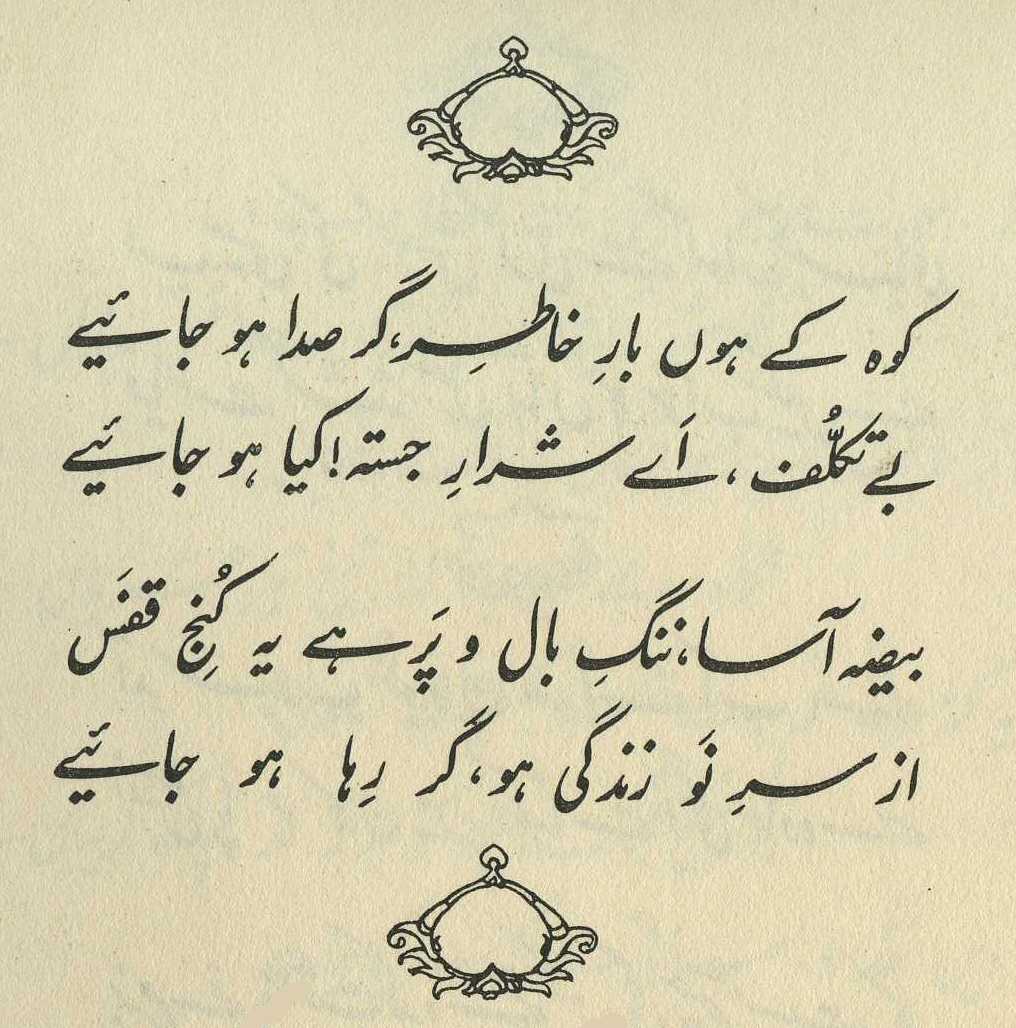
The meaning of the amplitude/ease of drinking is drinking freely, but here the writer's intention is a multiplicity of sects/religions/paths. He says that you should make the restrictions of customs and rules an offering to wildness/madness; and having adopted madness, you should become the king of the wilderness (like the shadow of the Huma's wing, you should spread over the wilderness). And why should you do this? Because the variety of sects/religions/paths does not allow you to go in any one direction.
== Zamin, p. 386
The amplitude/ease of drinking is only in supplication/indebtedness to the wildness of passion. In the madness of passion, run all around in the wilderness, and obtain the kingship. Who will be a more ample drinker than a lover? Thanks to the amplitude of vision and the sovereignty of the heart, the lover is not less than a king.
== Gyan Chand, p. 387
For background see S. R. Faruqi's choices . For more on Ghalib's unpublished verses, see the discussion in 4,8x .
The verse is not without its pleasures, and chief among them is the striking and imaginatively elegant imagery of the second line. There's a sort of abstract imperative, apparently directed to any listener, or any lover, or to the speaker himself. That person should himself become a 'shadow of the wing of the Huma '. If the shadow of the Huma's wing falls on you, then you're destined to become a king. But if you yourself become such a shadow, does that mean that you're the very embodiment of a royal destiny? Or might it mean that you have the power to confer such a destiny on others? Perhaps it means that you soar so high that you transcend such minor desires as kingship, and your mystical flight is so powerful that it provides shade and auspiciousness to everything over which it passes?
But above all, what one should become is a 'whole-desertful' of the shadow of the wing of the Huma. On the idiomatic subtleties of , see 11,1 . The contrast between the 'whole desert', a treeless and radically sunny place, and the 'shadow' or 'shade', is piquant in itself. (Surely 'a desertful of shade' is of the same imaginative order as 'a desertful of roses'.)
When we look for the connection with the first line, however, the structural problems of the verse loom larger. In this respect, if we analyze all the possibilities of all those constructions in the first line, and those three extremely multivalent nouns (see the definitions above), the verse becomes almost unresolvably complex-- and not all that rewarding. In principle, the verse can be seen as having all the problems of 220,1 -- and then some. It's really impossible to come to any satisfying resolution of the question of why and how the injunction in the second line is warranted.
No doubt something involving drinking and madness is at the heart of it, but what exactly? Anybody can generate a number of possibilities-- but none of them really glows in the dark or gives the verse that excellent 'got it!' quality. At the heart of the problem is the multivalence of (see the definition above). Is the verse talking about a 'gift' or 'offering'? And if so, is it a gift 'of' something in the sense of the nature of the gift ('a gift of chocolate'), or something given by someone ('the gift of the students to their teacher') or something equational ('the gift that is ')? Or is the verse referring to a 'prayer' or 'petition', which would generate a similar set of possibilities of its own? Or is the reference to a 'longing' or a 'necessity', which would have a third range of possibilities? Needless to say, when any of these possibilities is combined with the abstract multivalence of the rest of the line, the permutations spiral out of control.
So we might as well just enjoy the verse as one of imagery and mood . After all, it's not as though Ghalib even planned for us to read it.
graphics/huma.jpg