Verse 11816aaraatish
G2
1
if the straw of the polish-lines wouldn't take moisture from the lines of down/'greenery' [on the cheek]
2
the face of the beautiful one would, in the mirror-chamber, light a fire
is a variant form of the subjunctive , as is of .
'The diversified wavy marks, streaks, or grain of a well-tempered sword'.
taraavat>>: 'Freshness, juiciness, succulence; greenness, verdure; moisture, humidity, dampness'.
| References | |
|---|---|
| Arshi, Imtiyaz Ali | Ghazal# 73 |
| Raza, Kalidas Gupta | 189-90 |
| Nuskhah-e-Hamidiyah | 120-121 |
| Asi, Abdul Bari | 135-137 |
| Gyan Chand | 228-230 |
| Hamid Ali Khan | Open Image |
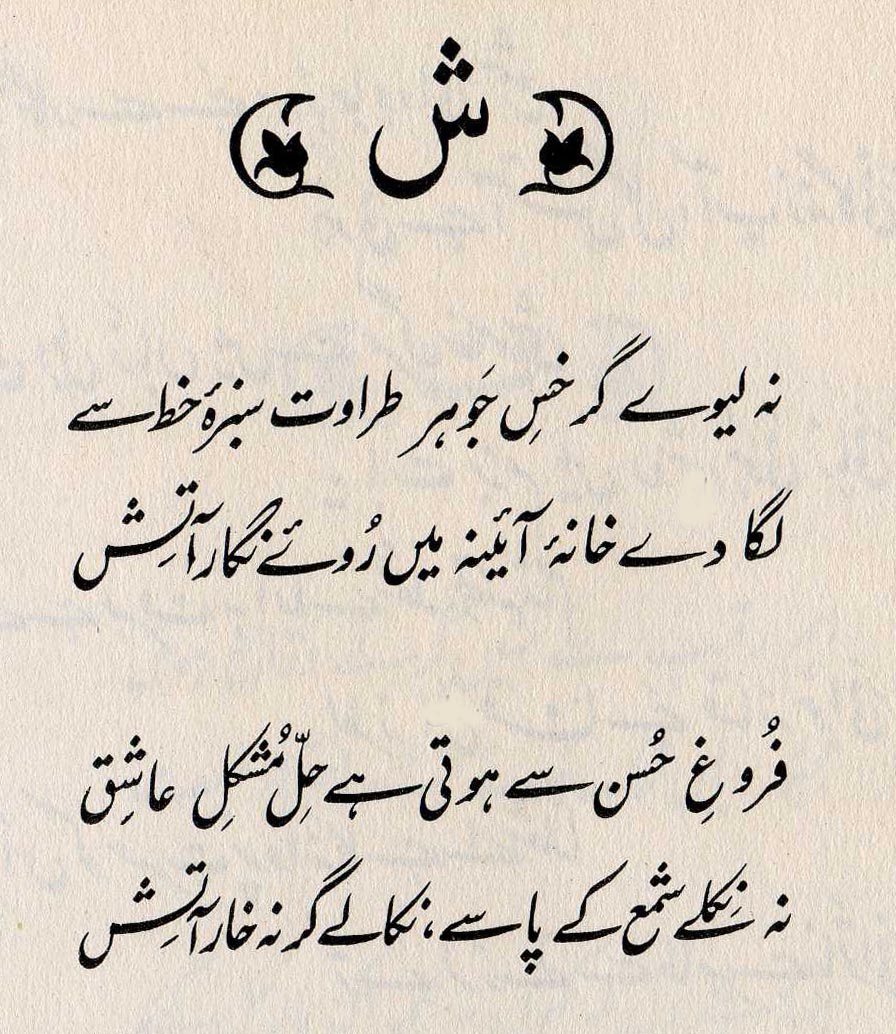
For a reflection to fall on a mirror, and for a fire to start-- in both of these, the cause of similitude is movement, and this simile is extremely eloquent [] because the cause of simitude is highly refined. The meaning is that the polish-lines of the mirror receive moisture from the down on the cheek of the beloved; otherwise, the reflection of the flame of the cheek would have started a fire in the mirror-chamber. (76)
== Nazm page 76

If the straw of the polish-lines did not receive moisture from the down on the beloved's cheek, then the moment the fire of the beloved's reflection fell on it, fire would start in the mirror. (This is a poetic explanation for fires not starting in mirrors.) (157)
For expressing the radiance of beauty he has used exaggeration , and in the ardor of his inventiveness [] he has created a new enchantment of words. is a word from old speech []; now they say only . (159)
The ghazal in its truncated divan form has no opening-verse . The original opening-verse was 73,3x .
This verse combines 'flame and straw' imagery with creative exploitation of the word (for more on this term, see 5,4 ). The verse of course also belongs to the 'mirror' set; for more on mirror-chambers in particular, see 10,5 .
It would be easy to call this verse far-fetched or obscure, yet Nazm apparently got it quite easily, and since then the commentators seem to have either got it with equal ease-- or else simply paraphrased Nazm's interpretation.
The beloved here is unambiguously a youth, a boy just reaching puberty who has begun to have light or 'green' down on his cheeks []. (For other examples of the adolescent boy as beloved, see 9,2 .) The literal meaning of is greenery or verdure, from the Persian word for green []
Thus the word works suggestively with all the meanings of the (much rarer) Arabic word . The scratched-in polish-lines on the metal mirror are like bits of dry straw; if they weren't moistened by the reflection of the verdant green lines of down on the beloved's cheek-- the in literally means 'lines'-- they would burst into flame when exposed to the sudden brilliant fire of his face.
And there you are: you put it together like a complex machine, and then-- voila, there it is, properly engineered but quite inert. Compared to, say, the first few verses of 71 , how cumbersome and one-dimensional it seems! In fact, for a much more satisfactory use of fire imagery, we need look no further than the next verse, 73,2 .
graphics/mirrorfire.jpg