Verse 5x1816aaraatish
G2
1
the desire/breeze/flight of wing-fluttering is the lightning of the harvests of the temperament
2
with a wing of restless flame, it is a Moth -garden-- fire
'Air, atmosphere, ether, the space between heaven and earth; —air, wind, gentle gale; —a gas; —flight;—an aerial being; spirit, fiend; ... —affection, favour, love, mind, desire, passionate fondness; lust, carnal desire, concupiscence; —an empty or worthless thing'.
tir>> : 'Mind, soul, heart; inclination, propensity; affection, regard, favour; pleasure, satisfaction; will, choice'.
'Collection, multitude, crowd; (as a suffix) place where anything grows in abundance, place, bed, garden'.
| References | |
|---|---|
| Arshi, Imtiyaz Ali | Ghazal# 73 |
| Raza, Kalidas Gupta | 189-90 |
| Nuskhah-e-Hamidiyah | 120-121 |
| Asi, Abdul Bari | 135-137 |
| Gyan Chand | 228-230 |
| Hamid Ali Khan | Open Image |
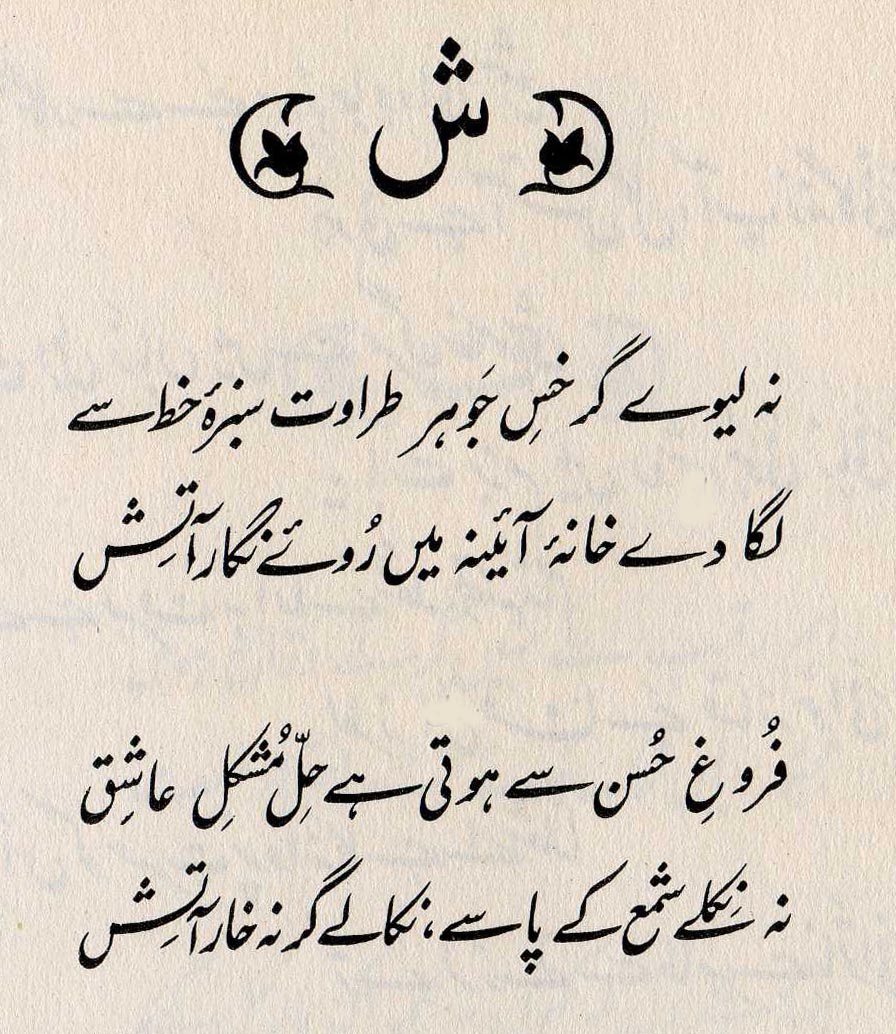
In the heart of fire is contained a desire of wing-fluttering, and this has become for it the lightning of the harvest-- it's as if it has wings, and because of those wings it has become a Moth-garden. That is, for it this very desire to fly is the lightning of the harvest, which is burning up its being. And it is obviously clear that only flame-scattering makes fire into fire, and burns it up.
== Asi, p. 136
For the writhing of flames, he has given the simile of the Moth's wing-fluttering.
That is, the ardor for wing-fluttering acts as lightning for the harvest of its life, such that on the one hand the Moth falls into the candle and burns to death, while on the other hand the agitation of the flame of the candle finishes off the candle-- if the flame would not flare up, neither would the candle burn itself out and be finished.
== Zamin, p. 201
= Desire. = Where many Moths would be gathered-- that is, burning and burning their wings, they are blowing out their lives. The Moths' desires act as lightning of the harvest upon their hearts.
Look at fire-- it wanted to fly on the wings of flame, and ended up being burnt and blown out like a Moth, and finally finished off. He has established the flame as a Moth. When something would be lit, then after the flame flares up the fire turns to glowing coals. As long as no flame emerges, the fire remains slowly smoldering. The idea is that the result of lofty desires is usually destruction.
== Gyan Chand, p. 229
For background see S. R. Faruqi's choices . This verse is NOT one of his choices; I thought it was interesting and have added it myself. For more on Ghalib's unpublished verses, see the discussion in 4,8x .
For discussion of the 'lightning of the harvest' imagery, see 10,6 . On the multivalence of , see 8,3 .
The first line is uninterpretable without further information, forcing us to wait (under mushairah performance conditions) until the second line is finally vouchsafed to us. And even then, the striking punch-word is, in classic 'mushairah-verse' style, withheld till the last possible moment.
Why is 'harvests' in the plural-- is it just metrically convenient padding ? Instead, perhaps it's because the verse brings together the experience of both the Moth and the fire. The 'desire' of the Moths-- who are here, unusually, treated as plural-- causes them to flutter their wings in agitation, creating a 'breeze' as they circle the candle or the fire in their 'flight' (see the definition of above), until they suddenly flare up as if struck by lightning. Thus they are destroyed, and the fire comes to be a 'Moth-garden' full of dazzling sparks.
Similarly, the 'desire' felt by the fire itself causes it to flutter its wings of flame, fanning itself with this 'breeze' into an ever-brighter blaze; thus it rapidly burns itself out, and comes to be a 'Moth-garden', since it has behaved as suicidally-- or rather, in the ghazal world, self-sacrificingly-- as a whole cluster of Moths.
graphics/mothflame.jpg