Verse 4x1816aaraatish
G2
1
the thought of smoke would have been the froth/'head-ebullience' of the madness of misconception
2
if it did not keep the vexation/affliction/'dust' of ash-sitting-- fire
'Smoke, vapour, mist, haze, exhalation, breath'.
'Dust; clouds of dust; a dust-storm; vapour, fog, mist, mistiness; impurity, foulness; (met.) vexation, soreness, ill-feeling, rancour, spite; affliction, grief; perplexity'.
| References | |
|---|---|
| Arshi, Imtiyaz Ali | Ghazal# 73 |
| Raza, Kalidas Gupta | 189-90 |
| Nuskhah-e-Hamidiyah | 120-121 |
| Asi, Abdul Bari | 135-137 |
| Gyan Chand | 228-230 |
| Hamid Ali Khan | Open Image |
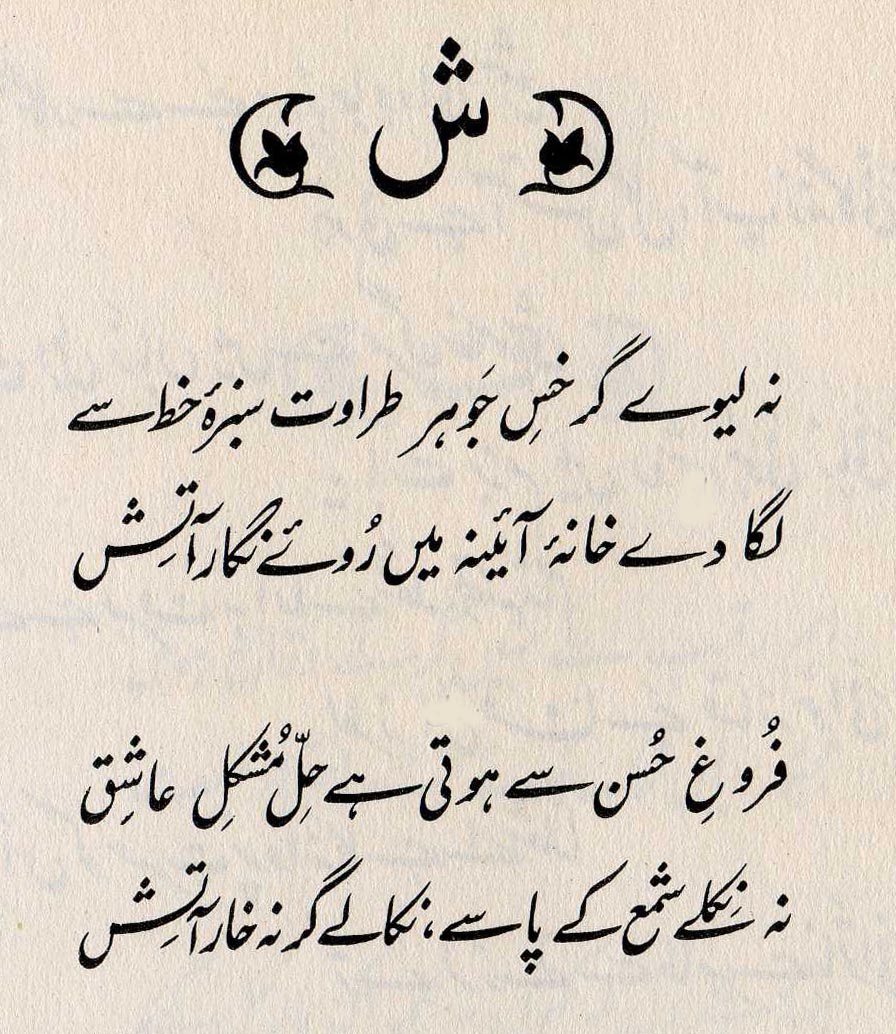
From the thought of smoke, the head of my madness of misconception would spin around, and in it a kind of ebullience would be created-- if somehow the thought of the dust of ash-sitting were not present. That is, in my misconception various kinds of thoughts would have been created by its smoke, but fortunately in fire, because of its ash-sitting, the substance of dust is also present, which is not present in lovers and people of that kind. Thus now there is no misunderstanding on its part.
== Asi, p. 136
That is, fire's thought of arrogance/'high-headedness' (the thought of becoming smoke and becoming high/lofty) was the madness of non-understanding, if ash-sittingness had not comprised, along with arrogance, weakness and humility.
== Zamin, p. 200
= If ebullience would be given to some delicate substance, then it is whatever boils up into a layer, or would overflow from the pot-- that is, clearly the best part.
Who has the misconception-- I, or fire? In both ways, meanings can emerge. (1) Haughtiness and pride are called 'smoke of the mind'; and ash-sitting is a sign of humility/lowness. If fire did not have around it the dust of ash-sitting, then when we saw smoke arising from it we could wrongly think that the fire was arrogant.
(2) We sigh, and that has a similitude with smoke. To 'keep dust in the heart' is to feel resentment/anger. Fire had a misconception about us. First there was the 'dust' of our ash-sitting; second, we had the smoke of sighs. Because of both the ash and smoke, it considers me its rival/enemy. Ashes are dust-- fire habitually sits in ashes, and faqirs too.
== Gyan Chand, p. 229
For background see S. R. Faruqi's choices . This verse is NOT one of his choices; I thought it was interesting and have added it myself. For more on Ghalib's unpublished verses, see the discussion in 4,8x .
What is 'the thought of smoke'? Thanks to the fruitful ambiguity of the , it can be a thought that is in the mind of smoke, or a thought about smoke (in someone else's mind), or a thought that itself 'is' (is made of?) smoke, or a thought that belongs to smoke, or is related to smoke in some other, unspecified way. On these ambiguities see 41,6 .
The verse is basically an interactive play of metaphors. Fire is condemned by its very nature to perpetual 'ash-sitting', a sign of sorrow, humility, or renunciation. This lowness saves it from the frothing-up ('head-ebullience') of the madness of misconception' represented by 'the thought of smoke'. Whatever the 'thought of smoke' might be, it's clear that it is something that rises high, something on the ascendant-- and thus an image of arrogance or 'high-headedness' ( , 'drawing up the head', is a traditional sign of arrogance).
Such arrogance would presumably be a form of the 'madness of misconception'-- and, as so often, it's left up to us to decide what that mad misconception or misunderstanding might be. No doubt it would involve smoke-- smoke that rises so high (might it not reach up to the heavens?), smoke that is so thick and dense (might it not come to pervade the atmosphere?), smoke that contains the 'heat' and turmoil and passion of the fire (might it not therefore have some mystical efficacy?).
All such delusions of grandeur are kept in check by the 'vexation' or 'affliction'-- literally, the 'dust' (see the definition above) of 'ash-sitting'. Dust resembles smoke; but here, dust keeps smoke in check. Dust and smoke balance each other out. Fire is crowned by 'the thought of smoke', but it's also grounded in 'ash-sitting'. For a more complex, more deeply Ghalibian use of , see 15,11 .
Note for grammar fans: In the first line, seems to be used in place of , the contrafactual that would accord with the grammar of the second line. For another, similar kind of colloquial usage (the perfect for the subjunctive), see 35,9 .
graphics/ashfire.jpg