Verse 11821aaliihai
G2
1
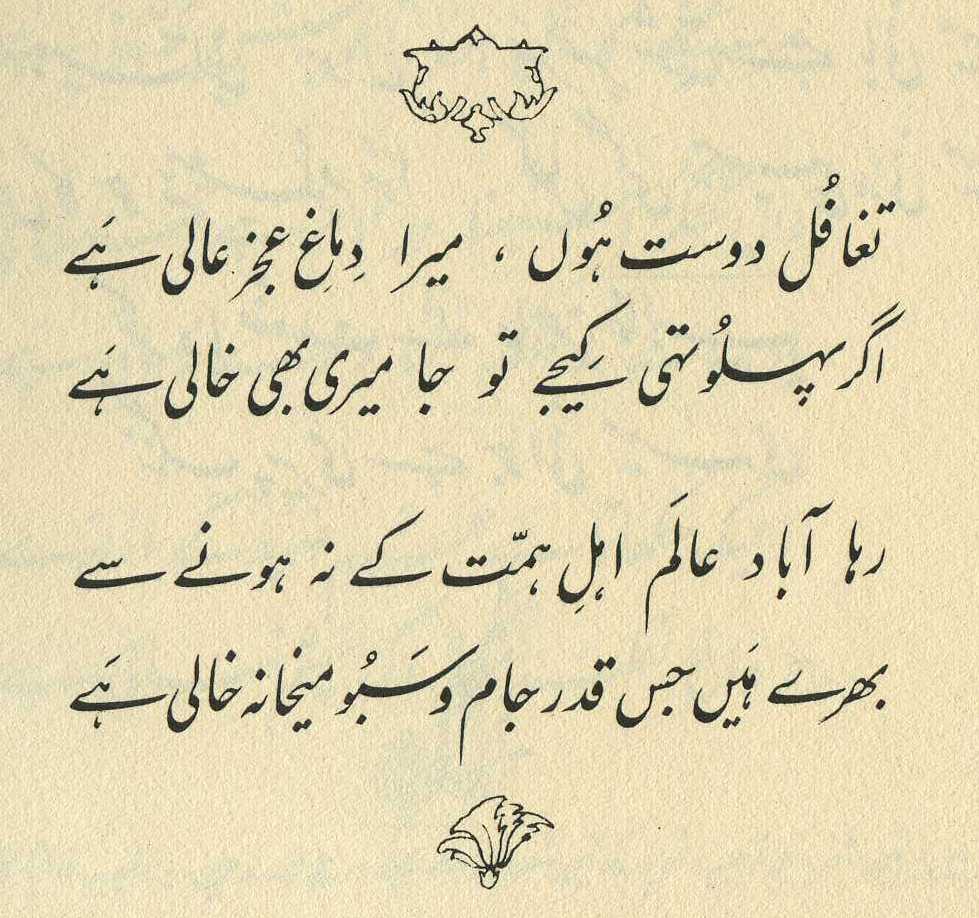
I am a negligence-friend, my arrogance/'mind' of weakness is lofty
2
if withdrawal/'a vacant side' would be made, then even/also my place is empty
'Unmindfulness, heedlessness, forgetfulness, neglect, negligence, inattention, inadvertence, indifference, listlessness'.
'The brain; head, mind, intellect; spirit; fancy, desire; airs, conceit; pride, haughtiness, arrogance'.
'Powerlessness, impotence, weakness, helplessness, submission, wretchedness'.
'Drawing aside, withdrawing (from); evasion, shirking, neglect'.
is an archaic form of ( GRAMMAR )
| References | |
|---|---|
| Arshi, Imtiyaz Ali | Ghazal# 150 |
| Raza, Kalidas Gupta | 346 |
| Nuskhah-e-Hamidiyah | 217-218 |
| Asi, Abdul Bari | 228 |
| Gyan Chand | 350-351 |
| Hamid Ali Khan | Open Image |
That is, weakness and humility have assumed such a dominance in my temperament that I am pleased only by inattentiveness and unkindness toward me. To 'make the side empty' is as if to make a place empty for me, for I consider aversion to be kindness. (204)
== Nazm page 204

= inattentiveness. There is so much humility in my temperament that the inattentiveness of the people of the world suits me. If you are inattentive to me, then my place too would depart. That is, it only pleases me when someone doesn't honor me; if in truth you want to show me honor, then don't direct your attention toward me. I will consider that you have shown me great respect. (361)
In the verse there are two pivotal expressions, 'mind' [] and 'an empty side' []. 'Mind' has a number of meanings. The one that's helpful to our purposes is 'pride, arrogance'. [Examples of modern Urdu idiomatic usage of this kind.] Thus the meaning of 'mind of weakness' becomes 'pride and arrogance about weakness'. And becomes 'I have extremely much pride in my weakness'. Here too Ghalib, as is his habit, has used metaphor upon metaphor. For the mind to be lofty is a metaphor. It means 'to be very intelligent, for the mind to be very powerful'. Then for 'mind' to mean 'pride, arrogance' is another metaphor. Ghalib has combined the two and made a third: 'for the mind of weakness to be lofty'.
The meaning of 'an empty side' [] people have taken to be 'inattention, ignoring, unkindness', etc. In fact, its meaning is 'shunning, avoiding'. It's true that this meaning suggests 'inattention', etc., but 'inattention' etc. is not the real meaning of this idiom....
Some people dislike negligence. But I, on the basis of my weakness, like negligence. This is my distinctive quality; thus I also pride myself on it. Thus if you would shun me, then you'll find my place empty as well. That is, on the basis of my 'negligence-friendship' and pride in weakness I won't have anything to do with you, and you won't find anyone else like me. Thus my place will surely remain empty.
Another interpretation is this. Negligence is pleasing to me, and it's also such that I'm very proud of my weakness. Thus if you would shun me, I too will make my place in the gathering empty. If I were only a 'negligence-friend', then perhaps your shunning would not seem bad to me. But since I'm also proud of my weakness, where you shun me, I too rise from my place and leave.
The point is that 'negligence' and 'to make the side empty' are two separate things. Negligence is that someone wouldn't pay attention to us; and 'to make the side empty' is that someone would shun us, upon seeing us would move away, would avert his eyes, would withdraw. Negligence is pleasing to us, but we don't care for shunning. Negligence is pleasing because in it deliberate inattentiveness and disregard are not proven. Because of my weakness and humility I am happy that you show me negligence, you don't straightforwardly disdain me. But shunning is deliberate; in it there's an element of disdain. Thus where you shun me, then I leave my place empty.
A third interpretation can be this: that I am arrogant about my weakness, and arrogant to such an extent that because of it even negligence pleases me. Because the claim of weakness is that you would absolutely overturn your individuality, and would cherish the thing (for example, negligence) that your individuality would reject. Thus if you shun me, then I'll be even happier, and I'll consider that you've emptied a place for me.
Since means empty [], between and the relationship of and always remains established.
== (1989: 307-08) 2006: 330-33
Well, here is a madly Ghalibian verse, and what a contrast to the facile little 181 ! The first line is so ostentatiously abstract and multivalent that it's quite impossible to figure it out on its own. What is a 'negligence-friend'? Someone who is involved with 'negligence', no doubt-- but how? By accepting it from others without demur, as the commentators generally maintain? Or by pointedly showing it toward others at every opportunity? Or by cherishing 'Negligence' as a friend in its own right? The first line gives us no grounds for choosing any one possibility over the others.
Nor, of course, can we decide what it means to claim that one's 'arrogance/mind of weakness is lofty'. It's the kind of thing Ghalib puts together when he wants to keep us guessing. We know it's going to be something paradoxical and perverse, but what beyond that can we possibly say? We're obliged to wait-- and under mushairah performance conditions, that wait will of course be as long as conveniently possible-- for the second line.
But as we've been secretly fearing, the second line offers simply a new pair of compared-and-contrasted complexities. The verb kiije is an archaic form of the passive, , 'would be made'; from it we can get no hint of who or what might be doing the 'withdrawing'-- or literally, with the usual elegant Ghalibian wordplay, the 'making vacant of the side'. If this 'withdrawing' is made, then 'even/also the speaker's place is empty'-- if there's withdrawing going on, then he's a part of it.
But who or what might be doing with withdrawing, and what is the sequence of events? The grammar is consistent with two possibilities: the withdrawal might come first, then the emptying of the speaker's place (X withdraws, then notices that the speaker's place too has suddenly become empty, since the speaker has instantly reacted with his own withdrawal); or else the emptying of the speaker's place might come first, then the withdrawal (X withdraws-- and in the process notices that the speaker's place is already empty, since he had previously withdrawn unnoticed, or perhaps had never been there at all). Either sequence of events is consistent with the quite inscrutable qualities of being a 'negligence-friend' whose 'arrogance/mind of weakness is lofty'.
And what might be the point of such 'withdrawing'? It might of course be a sign of arrogance, disdain, rejection (on the part of the beloved? by some patron?); but it might also be a sign of diffidence, modesty, humility-- in fact of exactly the kind of 'arrogance in weakness' that the speaker might be attributing to himself. And is the 'withdrawing' identical with being a 'negligence-friend', or some kind of consequence of it? And what is the tone of the verse-- proud, humble, ironic, matter-of-fact? There are so many such questions, and we're given so little material with which to answer them, that we really end up inventing the verse for ourselves.
Compare the rival exigencies of beloved's and lover's pride in 115,7 .
graphics/emptyseat.jpg