Verse 21821aaliihai
G2
1
the world remained populated, through the not being [there] of people of courage/spirit
2
to the extent that the glass and flagon are filled, the wine-house is empty
'Mind, thought; anxious thought, solicitude; attention, care; —inclination, desire, intention, resolution, purpose, design; —magnanimity; lofty aspiration; ambition; —liberality; —enterprise; spirit, courage, bravery; —power, strength, ability; —auspices, grace, favour'.
| References | |
|---|---|
| Arshi, Imtiyaz Ali | Ghazal# 150 |
| Raza, Kalidas Gupta | 346 |
| Nuskhah-e-Hamidiyah | 217-218 |
| Asi, Abdul Bari | 228 |
| Gyan Chand | 350-351 |
| Hamid Ali Khan | Open Image |
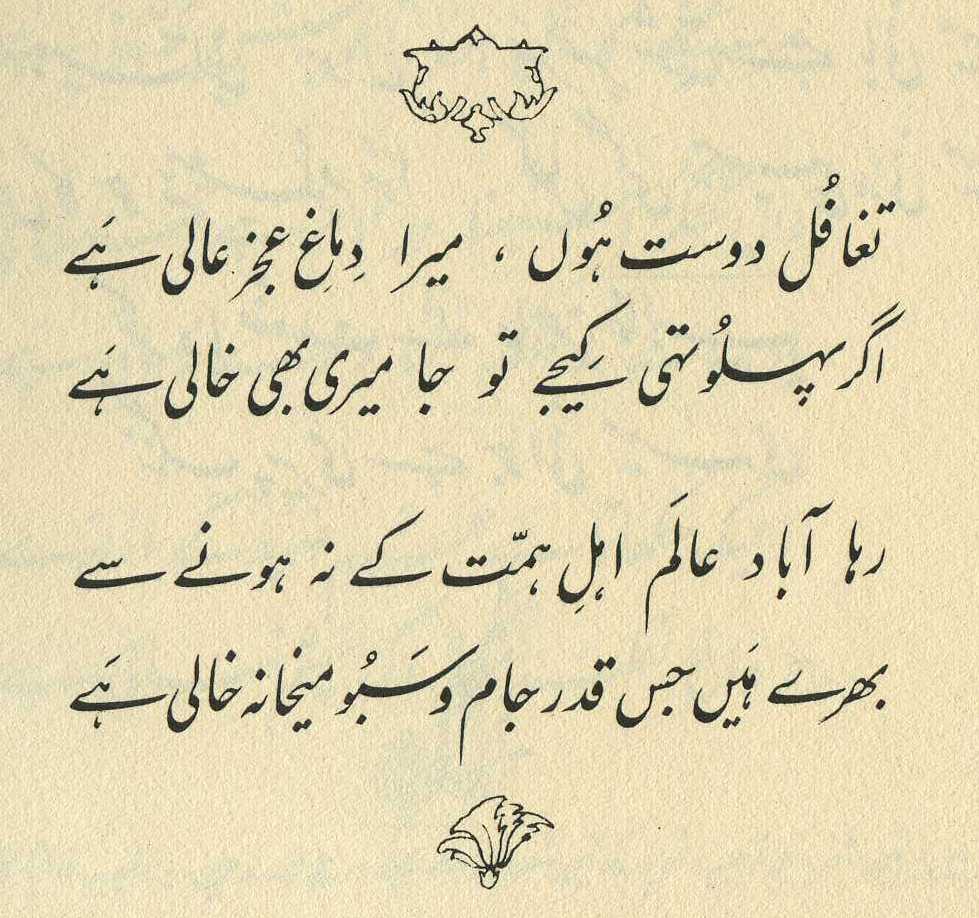
This thought might perhaps have arisen in someone else's heart as well, but the illustration [] has made it an entirely untouched theme , and has lifted the verse to an extremely high level. That is, if there were people of courage in the world, who would consider the world to be a mere nothing and would have no affection for it, then the world would become desolate. Thus one ought to know that the world appears populated because people of courage are not to be found. That is, just as in a winehouse the fact that glass and flagon remain filled with wine proves that there's no wine-drinker, in the same way the world's being settled and populated proves that there are no people of courage in it.
==Urdu text: Yadgar-e Ghalib , p. 126
The gist is that to the extent that glass and flagon are filled, to that same extent the wine-house is empty. That is, the glass and flagon's becoming brimful of wine are the cause of the wine-house's becoming empty. This is an illustration [] of how the world's remaining populated is a proof of the non-existence of people of courage, and their non-existence is is the cause of the inhabitedness of the world. If they existed, then because of their generous presence the world's remaining populated would be difficult-- the way because of the generous presence of glass and flagon, the wine-house's remaining full is difficult. (204)
== Nazm page 204

Compare 91,3 .... This too is worth reflecting on: that if in the beloved's gathering, along with other people there would also be someone who loves her truly, then it's certain that the beloved will address herself to others and neglect that one. It is illuminated to the 'people of the heart' that this negligence is better than [a show of] affection. (142)
If people of courage existed in the world, then because of their generosity the world would not remain populated-- whatever they found, they would give away; no regime would remain established. Just look-- to the extent that the glass and flagon are filled, to that same extent the wine-house has become empty. The inhabitedness of the world is a proof of the non-existence of people of courage; and their non-existence is a cause of the world's inhabitedness. He has said a new thing, and by giving an illustration [] has made his thought into a mirror. (361)
The commentators, following Hali, generally agree on reading the two lines as independent propositions, with the second one acting as a straightforward illustration of the first:
=Because the world remained populated, [it's proved that] people of courage don't exist.
=Because glass and flagon are full, [it's proved that] the wine-house is empty.
In other words, if people of courage existed, the world wouldn't or couldn't remain populated. How so? Hali feels that they would disdain the world and refuse to live in it; Bekhud Mohani feels that in their extravagant generosity they would give it all away. But I keep noticing the . Their readings have no use for its proportionality, but I have trouble framing a reading that can make use of it.
Still, it's a marvelously provocative verse, isn't it? Resonant and memorable-- one's mind always wants to savor that second line and gnaw on it a bit more. It feels like some profound thought that is only just out of reach. Surely it must be possible to work it out and 'get' it! (But don't hold your breath.)
Note for grammar fans: If you're interested in the grammar of , see the discussion in 115,2 . Although can also be transitive, here it seems clearly intransitive.
graphics/emptywinehouse.jpg