Verse 31816aamathai
G9
In this meter the next-to-last long syllable may be replaced by two shorts.
1
with the twisting and turning of desire/lust/ambition, don't break the thread of well-being!
2 a
a gaze of weakness/submission is the end/origin of the connection/'thread' of safety/health
2 b
the end/origin of the connection/'thread' of safety/health is a gaze of weakness/submission
'Twisting and twining; convolution, twisting knots, folds; contortions; restlessness, anxiety, agitation, perplexity, disquietude, distraction, distress; vexation, anger, indignation'.
'Desire, lust, concupiscence, inordinate appetite; --ambition; --curiosity'.
'Thread, string; order, series, train; course, tenor; road, way'.
'Health, soundness; safety, security; well-being, welfare, freedom from evil or discomfort &c.; success, prosperity'.
'Powerlessness, impotence, weakness, helplessness, submission, wretchedness'.
'Head, top, pinnacle, tip, end, point; front, face; origin, beginning; head, chief; intention, end, aim; inclination, aim, desire, will'.
'Thread, string, line; series; connexion, relationship, kin; relation by blood or marriage; alliance, affinity'.
'Safety, salvation; tranquillity, peace, rest, repose; immunity; liberty; soundness; recovery; health'.
| References | |
|---|---|
| Arshi, Imtiyaz Ali | Ghazal# 165 |
| Raza, Kalidas Gupta | 235 |
| Nuskhah-e-Hamidiyah | 250-251 |
| Asi, Abdul Bari | 260 |
| Gyan Chand | 378 |
| Hamid Ali Khan | Open Image |
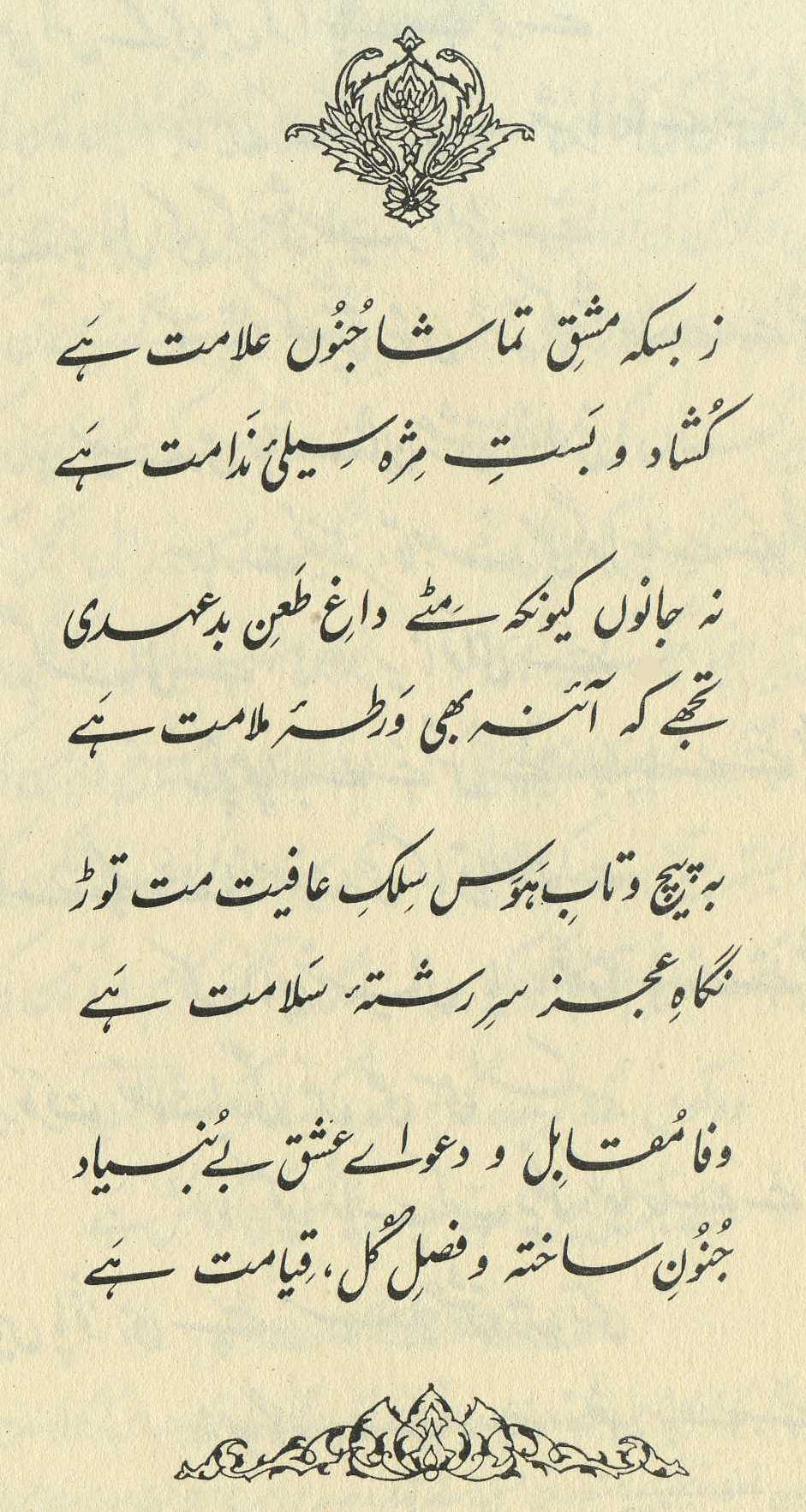
Well-being is a thread, for which desire/lust is a twist and a tangle from which there's the fear of the thread's breaking. That is, desire/lust comes to a man, and well-being goes. And a gaze of weakness/submission-- that is, reunuciation of desire/lust-- is the connection/'thread' of well-being. (233)
== Nazm page 233

The meaning is that through desire/lust, comfort and well-being in both worlds are destroyed. (291)
The means for the obtaining of well-being is humility []. The difference between the two lines has emerged as: if you want peace and repose, then adopt contentment [] and flee from desire/lust. And if you want well-being, then abandon pride and adopt humility. (413)
This is a maddeningly difficult verse to pin down, and obviously Ghalib made it that way on purpose. The first question is one that only Bekhud Mohani realizes the need to ask: what is the relationship between the two lines? Do they mean to give the same basic advice, in slightly paraphrased forms, so that they're like two parallel moral maxims? In favor of this possibility, we can notice that and are almost synonyms (see the definitions above), and that both of these qualities are available by means of a 'thread' to which we're urged to pay attention.
Or are the two lines not parallel-- is one situation a mere secondary illustration or 'proof' of the other, or do they stand in some other relationship? Since the first line is an imperative, it might be considered the urgent message of the verse, while the second would provide a reason for obeying the command. Or the abstract, general maxim offered in the second line might be taken as the main point, with the first line a mere behavioral extrapolation from it. As usual, we have to decide all such questions for ourselves.
And above all, what's the tone of the verse? Here's where all that carefully ambiguous vocabulary comes in. In the first line, can mean (see the definition above) anything from the physical ('convolution') through the helplessly suffering ('anxiety, distress') to the actively purposeful ('anger, indignation'). And can mean almost any kind of 'desire', from 'lust' through 'ambition' to 'curiosity': it's true that often has a negative valuation, as in 138,4 ; but sometimes it can be apparently morally neutral, as in 21,1 or 123,9 ; or even clearly positive, as in 112,6 .
Since the lover is never in the realm of worldly well-being or anyway, prudential admonitions ('Don't upset the applecart!', 'Don't rock the boat!') from the Advisor would hardly commend themselves to him. The first line might well be the kind of worldly, cynical injunction the Advisor might deliver-- the kind that the lover knows he is destined to go out and violate immediately. Perhaps, indeed, he's only saying these lines by way of mockery.
And similarly, what's the tone in the second line? The world has the same sense of all-purpose (worldly) wellbeing as does , and thus invites us-- as it surely does the lover too-- to rebellion. For if the way to achieve such is to constantly and prudently display a 'gaze of powerlessness / impotence / weakness / helplessness / submission / wretchedness', then what kind of can it really be? Either the gazer would really be wretched, and thus the lover wouldn't enjoy any kind of 'well-being' at all, or else he would be faking it, offering a great show of hypocritical humility in order to get certain worldly advantages-- just as the Advisor would instinctively do and the lover would instinctively not do.
In short, I defy anybody to genuinely pin down the tone of this verse. It's radically elusive. Is it a counsel of despair offered by the broken-down lover to himself? A cynical trick urged by the Advisor? A genuine moral maxim about Sufistic resignation and contentment and humility? A simple report, from some worldly person who's been-there-done-that and is telling us the best way to make it through life? Even the question of whether means 'beginning, origin', or 'end, aim', is left entirely up for grabs.
Whatever the tone may be, the wordplay is terrific. The beautifully-deployed thread imagery includes . And to see how the (long, narrow, straight) 'gaze' too ties into (sorry, sorry!) the complex of thread imagery, compare the magnificent 10,12 .
graphics/threads.jpg