Verse 41816aamathai
G9
In this meter the next-to-last long syllable may be replaced by two shorts.
1
faithfulness, opposite/confronting; and a claim of passion, without foundation
2
a contrived/artificial madness, and the season of the rose-- it's a disaster/Doomsday!
'Fronting, confronting; opposing, contending; opposite; --comparing; collating; --corresponding, matching; resembling, like; --in opposition (to, - ); in front (of), over against; face to face (with), in the presence (of); --in comparison (with)'.
'Made, formed; artificial, counterfeited, fictitious, false, feigned'.
| References | |
|---|---|
| Arshi, Imtiyaz Ali | Ghazal# 165 |
| Raza, Kalidas Gupta | 235 |
| Nuskhah-e-Hamidiyah | 250-251 |
| Asi, Abdul Bari | 260 |
| Gyan Chand | 378 |
| Hamid Ali Khan | Open Image |
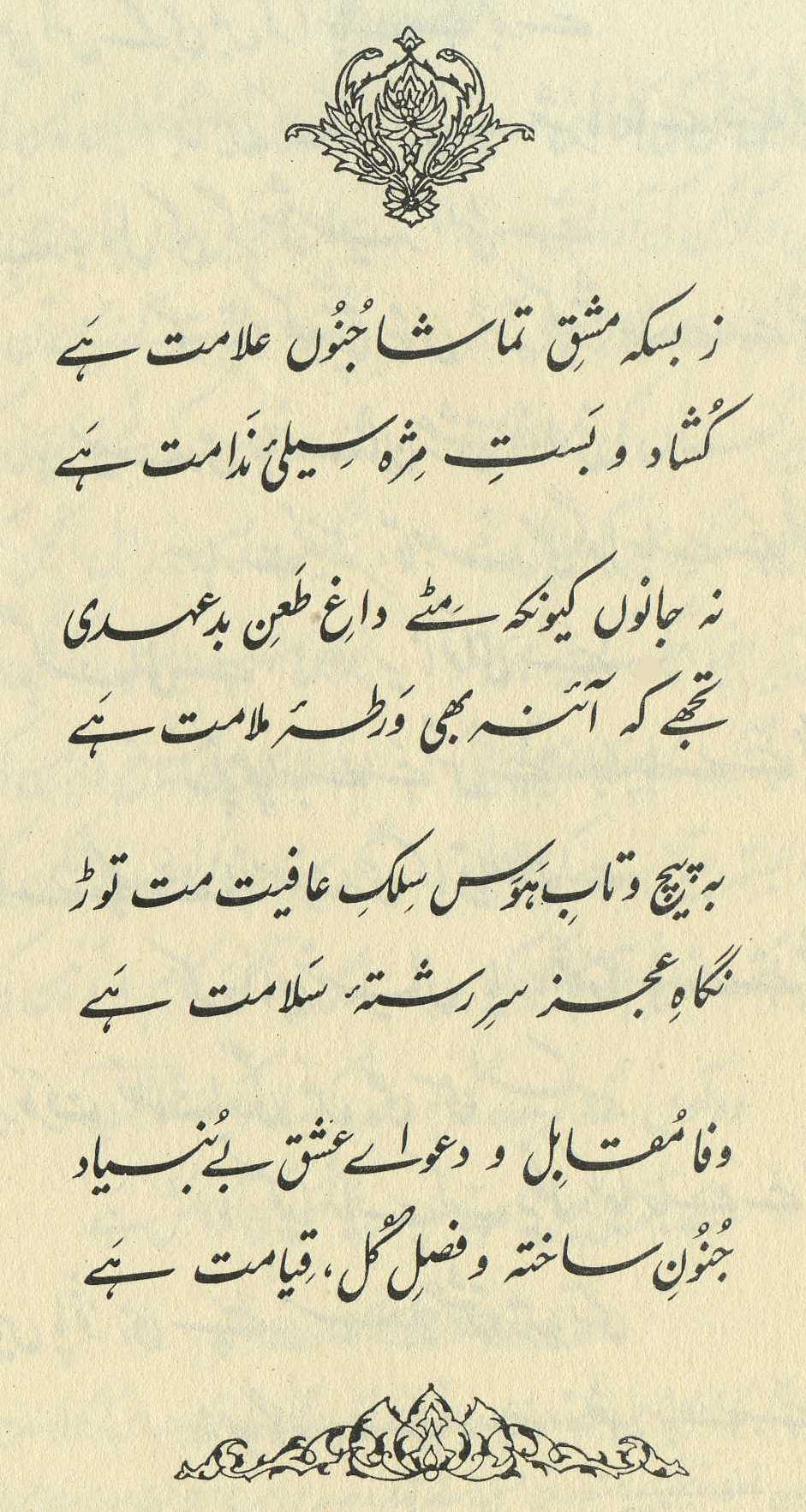
He says that for the beloved to become inclined toward faithfulness, and the claim of passion to be false-- this is a great cruelty/tyranny. In the second line is an illustration [] of this: that spring would in real fact have come, and there would be fakery in madness-- this is a Doomsday! The purpose of this is a taunt against the Rival . (233)
== Nazm page 233

In this verse is a taunt against the lustful Rival. He says, a faithful beloved would become inclined toward showing faithfulness, and a false claim of passion would be made! The illustration of this is as if the spring would truly have come, and there would be a fake madness-- what more shameful thing can there be! (291)
It might be his own situation, or that of the Rival. He says that a great difficulty has occurred, because the claim of passion is that there would be faithfulness. If there were to be a lover, then no matter how much difficulty and humiliation would confront him, he wouldn't cease to be faithful. But when there is an empty claim of passion, in name only, then the links of faithfulness would not be maintained. An illustration [] of this is that in the spring madness increases, and when this state exists, then to tear one's garment in madness and set out into the desert is no great thing. But when madness would be faked, then one must confront a great difficulty, because while in one's senses it's not easy to show the behavior of a madman. Shame at this behavior appears, and it becomes clear that the madness was feigned, not real. (413)
[For his comments on the word , see M 1706,6 .]
The verse is almost grammar-free: the structure of the first line is 'A and B'; that of the second line, 'C and D -- it's a disaster/Doomsday!'. We have to figure out for ourselves the connection between the two 'and'-linked members of each pair, and also the relationship between the first pair and the second pair. This is thus one of his 'list' verses; for others, see 4,4 .
In the first line, what are we to make of , which can mean either 'confronting' (in the sense of 'appearing directly before') or 'opposing' (with a suggestion of rivalry or hostility)? Perhaps, as Nazm maintains, 'faithfulness' is 'confronting' the false lover in the form of a faithful beloved (though this is a bit hard to believe, since we know the beloved better than that). Or perhaps 'faithfulness' is a quality of the true lover, who is juxtaposed and 'opposed' to the falsity of the Rival 's 'passion'.
Or perhaps the first line is a more general 'if-then' reflection: if faithfulness is available, then no claim of passion can have any foundation, since passion seems to presuppose a cruel, faithless, or at least essentially unavailable beloved. Without such a harsh environment, it can't prove itself; or perhaps it can't even exist at all, but declines instead into settled, un-obsessive affection.
Then in the second line, what is the relationship between 'a contrived madness' and the 'season of the rose'? Does the springtime make real madness so powerful and ubiquitous that nobody needs even to contrive it? Or is a contrived madness a supreme, intolerable insult to the power of the spring?
If the 'baseless claim of passion' and the 'contrived madness' are to be taken as parallel, then in what way does 'faithfulness' resemble the 'season of the rose'? After all, we know the rose's lifespan is all too brief, and spring will soon vanish-- is that true of 'faithfulness' too?
Does the final exclamation 'it's a disaster/Doomsday!' apply only to the second line, or to the first one as well?
In short, we really do have a box of puzzle pieces, and not enough clues to show us any one ideal way to put them together. But then, isn't it kind of irresistible to keep rooting around among the pieces, waiting for that magic click when suddenly they'll all lock perfectly into place?
This ghazal originally had a closing-verse , but Ghalib chose to omit it from the divan . It appears here as 206,5x .
graphics/madness.jpg