Verse 6x1816aar-ena;Gmah hai
G1
1
it is a 'sunbuli'-singer, with the relish/taste of/for the strands/'strings' of long curls/ringlets
2
the lament of the chains of Majnun is a relation/'string-possessor' of melody
'A plant of sweet odour, spikenard (to which the Persians compare the locks of a mistress); — the hyacinth; maiden-hair
'Thread, string, line; series; connexion, relationship, kin; relation by blood or marriage; alliance, affinity; ... — , Relation, kinsman; a dependent'.
| References | |
|---|---|
| Arshi, Imtiyaz Ali | Ghazal# 166 |
| Raza, Kalidas Gupta | 264-65 |
| Nuskhah-e-Hamidiyah | 253 |
| Asi, Abdul Bari | 260-261 |
| Gyan Chand | 378-380 |
| Hamid Ali Khan | Open Image |
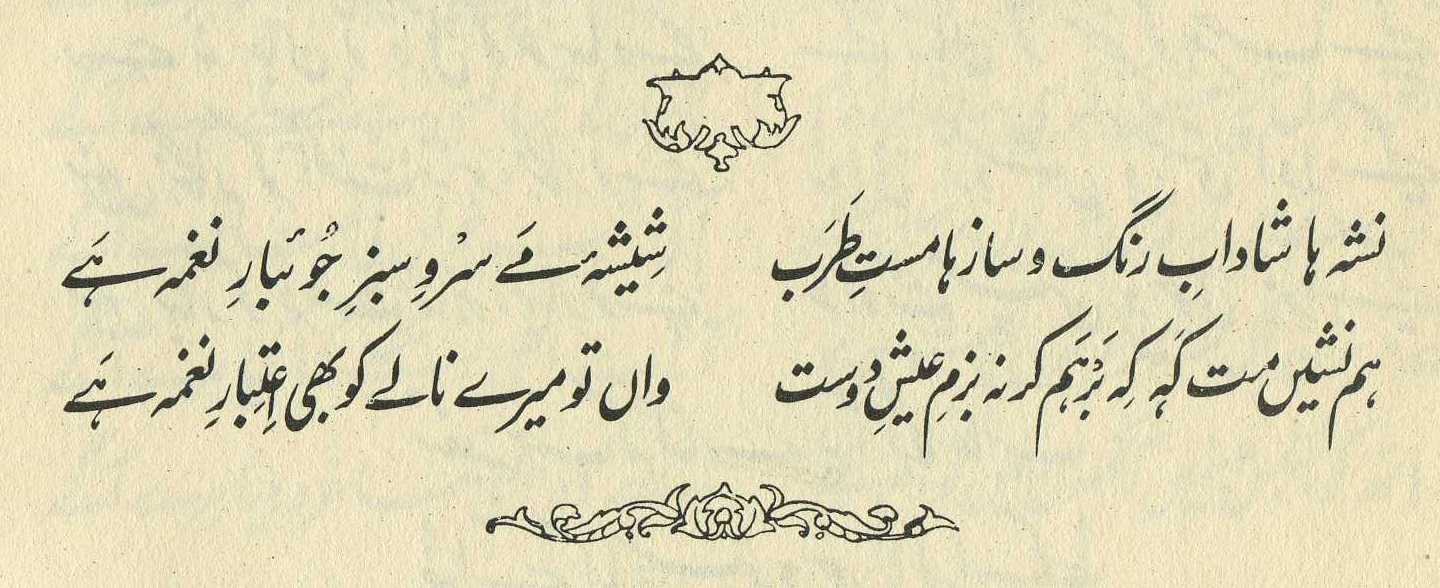
and are the names, in music, of two voices or two mouths. And is also used as a simile for . The idea of the verse is based on this verbal wordplay . He says that the sound of Majnun's chains is , so to speak, a relation of melody; that is, it mingles with melody and is close to it, because it too is a of the memory of the long tresses of the beloved. On the one hand have a relationship; on the other hand have one as well. All these are verbal wordplay-- and that's it []. (261)
is the name of a . That is, the lament of Majnun's chains, in memory of the strands/strings of Laila's curls, sings the raga of . It is, so to speak, a relation of the melody. are words with a . (376)
= a musical tune. = a singer of . Similarly there is another raga, ((amal gesuu , that according to 'Bahar-e ajam' is the Hindustani raga Dhanasri. Majnun has a taste for the strands of Laila's long hair. The sound that is created by his chains is singing the raga . Since Majnun had a taste for , and has a similitude to , the raga has been called . He has called the lament 'a relation of melody'.
Among there is wordplay ; and on the other hand have a relationship of wordplay.
== Gyan Chand, p. 379
For background see S. R. Faruqi's choices . This verse is NOT one of his choices; I thought it was interesting and have added it myself. For more on Ghalib's unpublished verses, see the discussion in 4,8x .
On the distinctiveness of this ghazal, see 211,1 .
It's clear enough that the verse offers an enjoyably interlocking system of wordplay, as the commentators carefully explain. Asi then wraps it up somewhat dismissively: . I love that ! I'm inclined to agree with him. Even the most elegant tangles of wordplay, if they have hardly any meaning behind them, are low-power work for a poet like Ghalib. (Another such example: 211,7x .)
Majnun doesn't even spend much time chained up as a madman, in most stories, so even the minimal theme itself seems a bit forced.
For more on 'string' imagery, see 10,12 .
graphics/spikenard.jpg