Verse 4x1816aar-ena;Gmah hai
G1
1
from whom/what, oh heedlessness, would you obtain the interpretation/quality of awareness?
2
the ears are quicksilvery/mercurial, and the heart is restless with/for melody
'Interpretation, explanation (particularly of dreams); — attribute, quality'.
'Quicksilver, mercury; malevolent, shameless'. (Steingass p.717)
| References | |
|---|---|
| Arshi, Imtiyaz Ali | Ghazal# 166 |
| Raza, Kalidas Gupta | 264-65 |
| Nuskhah-e-Hamidiyah | 253 |
| Asi, Abdul Bari | 260-261 |
| Gyan Chand | 378-380 |
| Hamid Ali Khan | Open Image |
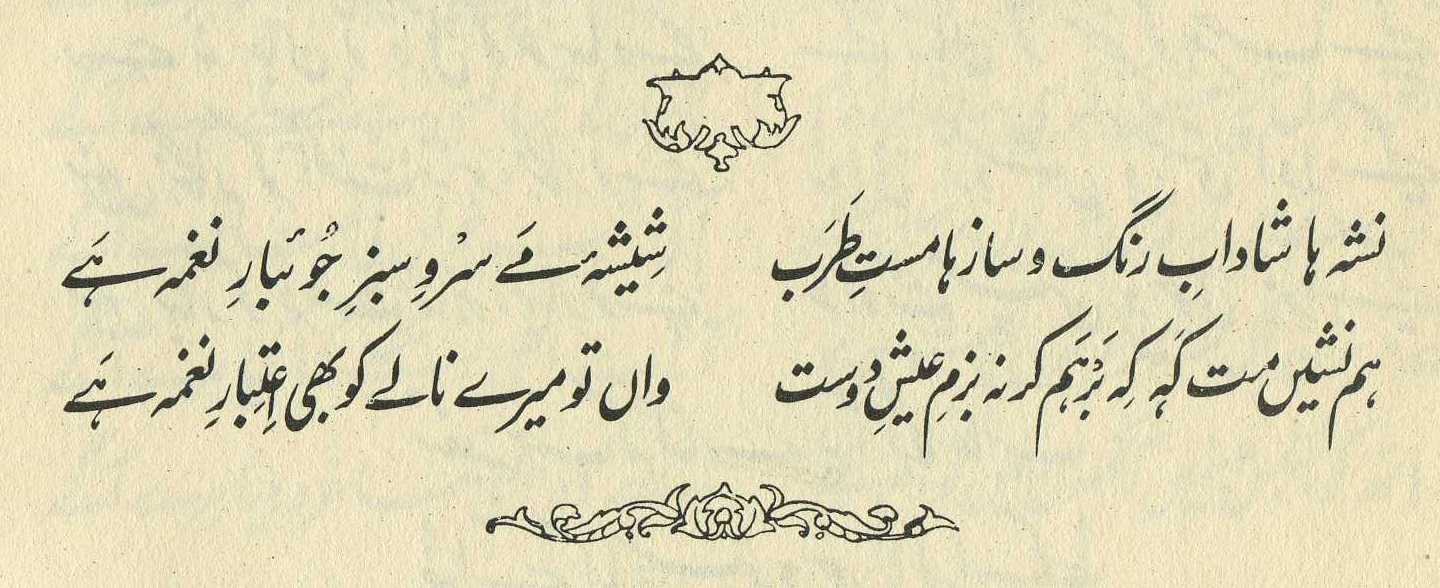
Addressing 'heedlessness', he says, 'Oh heedlessness, after all, from what kind of thing might/would you obtain the lesson of awareness? There are only two means for it. Either you would hear some such thing with the ears, or the heart itself would obtain good advice. Here, both of these are useless. As for the ears, they are full of quicksilver, so that they have become deaf. And as for the heart, the effect of melody, or the longing for melody, have made it restless and self-less.
== Asi, p. 261
That is, having heard a raga, both ear and heart are restless and beside themselves. Who would awaken 'heedlessness', and who would interpret its dream-- the kind of interpretation that would be a cause of awareness?
== Zamin, p. 375
means 'restless', but means 'deaf'. Oh heedlessness, who would convey awareness to you-- everybody's ears are deaf, and their hearts are restless for melody. Desirers of melody cannot give awareness; they themselves are seekers of intoxication. Deaf ears cannot hear my words at all. Thus there's no one to be entrusted with awareness and wisdom.
It is certain that by 'ears' is meant the ears of others. It's possible that by 'heart' an allusion to his own heart might be intended. My heart is restless to hear melodies, but here the situation is such that people's hearing itself is restless. They have no musical taste. Then how can they bestow wisdom on me? In this interpretation hearing will be accepted as a means for knowledge of the truth.
The first interpretation is better, because in the second one the interpretation of the first line is not well grasped-- that is, that the ears and hearts of others are referred to.
== Gyan Chand, pp. 378-79
For background see S. R. Faruqi's choices . This verse is NOT one of his choices; I thought it was interesting and have added it myself. For more on Ghalib's unpublished verses, see the discussion in 4,8x .
On the distinctiveness of this ghazal, see 211,1 .
Apparently Gyan Chand's confidence that 'ears' refers to 'the ears of others' is based on their conspicuous (Persianized) pluralization. (I can't see anything else that it could be based on.) Idiomatically, he's surely right-- think for example of the singular in 169,7 , and how much more natural the singular sounds.
Yet Asi and Zamin are unfazed, and surely that's a tribute to the power of parallelism. For the first line sets up a question (how would 'heedlessness' gain awareness?), to which the 'ears' and 'heart' seem to be presented and analyzedl as possible answers. This parallel presentation pushes us toward treating the two entities similarly, as two body parts.
My own preference is to go with Asi and Zamin. It's true that is clunky and unusual, but it's also very awkward to arbitrarily break the parallelism that's such a common tool of verse construction in the ghazal.
graphics/mercury.jpg