Verse 21816aar-ena;Gmah hai
G1
1
companion, don't say, 'Don't disrupt/overthrow the pleasure-party of the friend'
2 a
there even/also my lament has the esteem/credit of [being] a melody
2 b
there even/also my lament has respect/consideration for melody
'Confused, jumbled together, turned upside down or topsy-turvy, entangled, spoiled; offended, angry, vexed, enraged, sullen'.
'Confidence, trust, reliance, faith, belief; respect, esteem, repute; credit, authority, credibility; weight, importance; regard, respect, view, consideration, reference'.
| References | |
|---|---|
| Arshi, Imtiyaz Ali | Ghazal# 166 |
| Raza, Kalidas Gupta | 264-65 |
| Nuskhah-e-Hamidiyah | 253 |
| Asi, Abdul Bari | 260-261 |
| Gyan Chand | 378-380 |
| Hamid Ali Khan | Open Image |
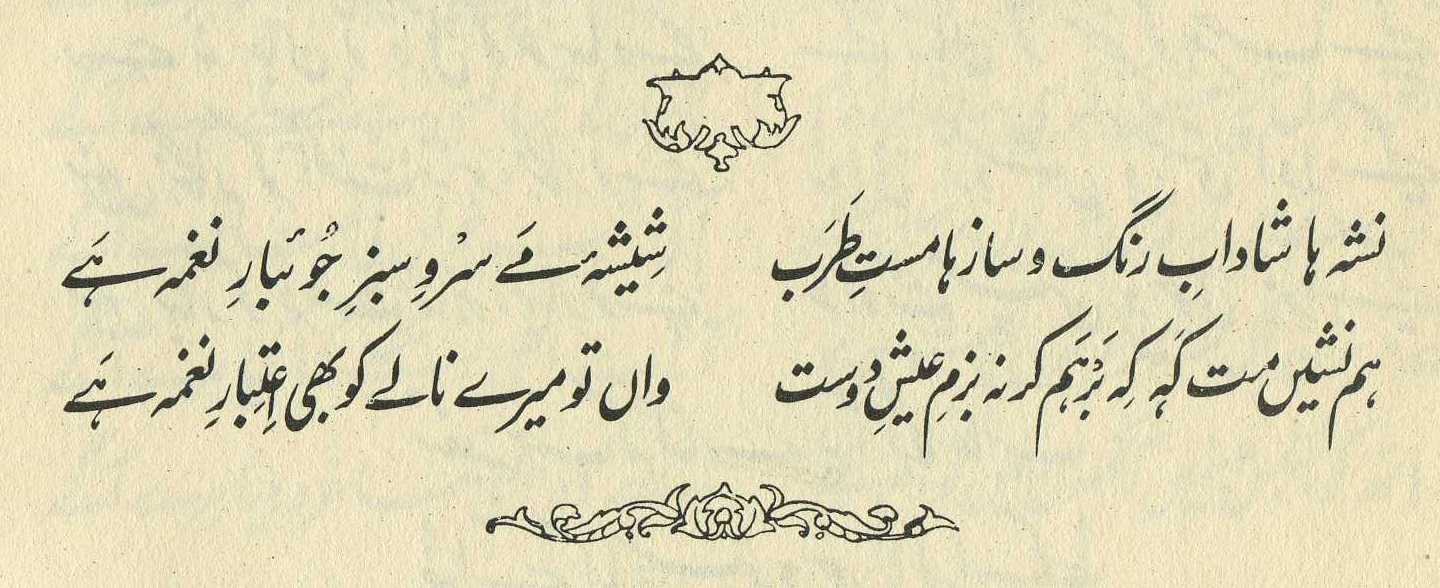
The person sitting with him is saying, 'You will disrupt the pleasure-party with your laments; stay sitting here quietly'. The answer to that is, 'In her gathering my laments have the esteem of a melody'. That is, having heard my laments, she becomes happier-- why would her enjoyment begin to be disrupted? (240)
== Nazm page 240

The meaning is that having heard my lament she is happier-- why will her enjoyment be disturbed by my complaint? (298)
Alas, you haven't seen the absorption of her gathering in melody. The members of it remain so absorbed in the pleasure of melody that if the sound of a lament falls on their ears, it mingles with the colorful singers of the gathering and begins to seem as if someone is offering hope. (430)
Compare 153,5 . (287, 275)
Arshi proposes in 153,5 the perfect verse for comparison; the same double possibilities open in the present verse. Perhaps the lover's lament will be transformed by the general melodic clamor and hustle and bustle of the gathering into just one more part of the good cheer, and really nobody will notice it much. Or perhaps the beloved will actively enjoy hearing his lament and contemplating his suffering-- it will be literally 'music to her ears'.
But there's a third possibility, thanks to the clever use of and the versatility of the construction. Perhaps not only the lover but even his lament has respect and regard for the beloved's enjoyment of melody. Perhaps the lament will voluntarily cease its clamor when a melody is being heard, or will transform itself into a melody. This reading too lends itself to a sarcastic tone-- perhaps everybody over there is so music-mad, even the lover's lament is led to join them. So much for his suffering, and so much for her ability to even hear it (much less care about it)!
graphics/melody.jpg