Verse 5x1816aar-ena;Gmah hai
G1
1
the making/instrument/harmony of the enjoyment of heart-lessness is house-desolation, to me
2
the flood, here, is the cry/shriek of the voice of the waterfall of melody
'Making, preparing, effecting; feigning; ... apparatus; instrument, implement; harness; furniture; ornament; concord, harmony; a musical instrument'.
'Heartlessness [i.e., being disheartened], dejection; dissatisfaction, discontent'.
'Crying; sobbing, wailing; cry, scream, shriek (of a human being, or of a peacock, or cuckoo, &c.); a warble, a trill'.
'Water-fall, cascade'.
| References | |
|---|---|
| Arshi, Imtiyaz Ali | Ghazal# 166 |
| Raza, Kalidas Gupta | 264-65 |
| Nuskhah-e-Hamidiyah | 253 |
| Asi, Abdul Bari | 260-261 |
| Gyan Chand | 378-380 |
| Hamid Ali Khan | Open Image |
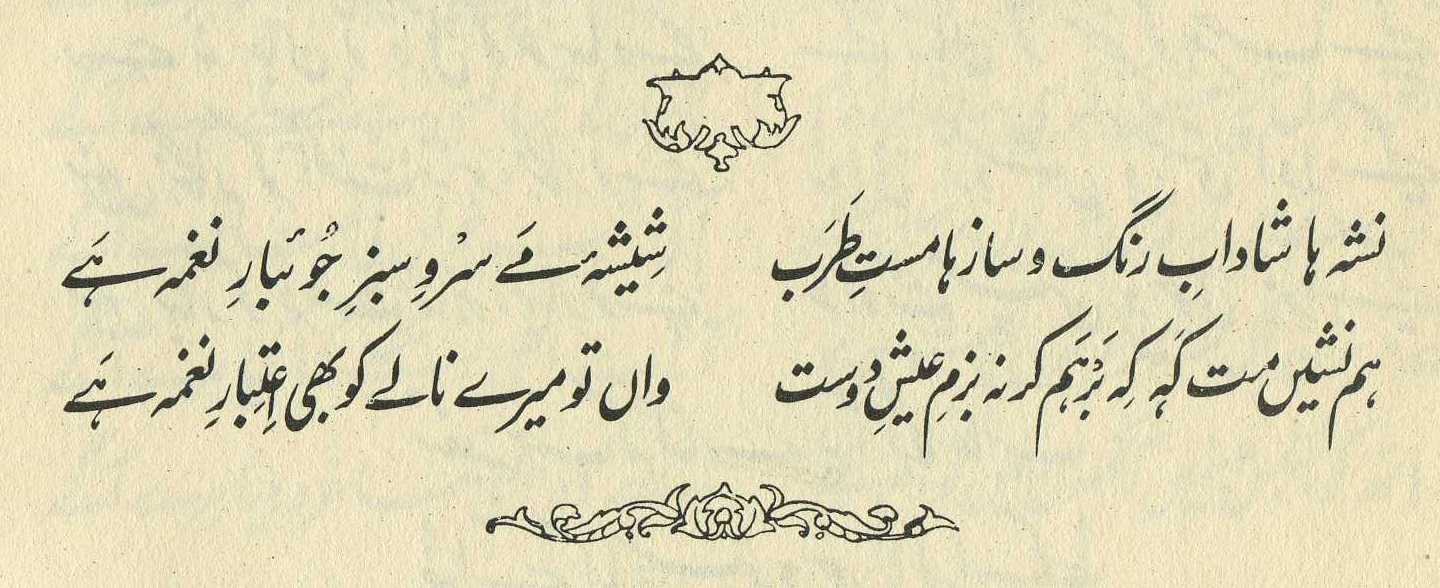
My heart-lessness is the foundation of leisure/freedom, and for me the musical instrument of that enjoyment of heart-lessness is my house-desolation. And that flood is the cry of the voice of the house-instrument of melody, which is a source of enjoyment.
== Asi, p. 261
= harmony, the sound of an instrument. This is the same theme as that of 15,10 . For a waterfall, the simile of a melody is extremely eloquent; the cause of similitude is movement and voice.
== Zamin, pp. 375-376
= the mingled voices of instruments or musicians. For me, even in the destruction of the house there is equipment for enjoyment. The enjoyment is that of heart-lessness and despair. The flood comes, which will destroy the house. To me it seems like the sound of the raga of a waterfall. The 'waterfall of melody' is a very good construction. The meaning of is 'apparatus, equipment'.
== Gyan Chand, p. 379
For background see S. R. Faruqi's choices . This verse is NOT one of his choices; I thought it was interesting and have added it myself. For more on Ghalib's unpublished verses, see the discussion in 4,8x .
On the distinctiveness of this ghazal, see 211,1 .
At the center of the verse is the striking word , which has not been used in any divan verse; it should surely be considered a ' fresh word '. Platts gives it a feeling of despair (see the definition above), while Zamin and Gyan Chand insist on a musical sense (presumably related to the idea of a bird's 'warble' or 'trill'). But even among bird calls, Platts's first example is that of a peacock, and anybody who has ever heard peacocks calling knows the eerie wildness of their cry. In the context of the verse such a sound works perfectly, taking our minds back and forth between a musical tone and a cry of desolation.
Also at the heart of the verse's wordplay is , an excellently multivalent word; its possibilities are exploited even more elaborately in 147,2 . Almost all of its possibilities (see the definition above) work well in the context of the verse.
The commentators are right-- a 'waterfall of melody' is a wonderful construction. It takes our imaginations in directions that partly converge, and partly diverge.
In 15,10 Zamin has chosen the perfect verse for comparison. Much of the discussion of that verse will apply to the present one as well.
On 'heart-lessness', see 8,2 .
graphics/flood.jpg