Verse 2after 1821aaliine mujhe
G5
In this meter the first long syllable may be replaced by a short; and the next-to-last long syllable may be replaced by two shorts.
1
the credit and cash of the two worlds-- its reality/substance, 'known' [to be nothing]!
2
my lofty courage/spirit bought/'took' me from myself
'Mind, thought; anxious thought, solicitude; attention, care; —inclination, desire, intention, resolution, purpose, design; —magnanimity; lofty aspiration; ambition; —liberality; —enterprise; spirit, courage, bravery; —power, strength, ability; —auspices, grace, favour'.
| References | |
|---|---|
| Arshi, Imtiyaz Ali | Ghazal# 185 |
| Raza, Kalidas Gupta | 362 |
| Gyan Chand | 490 |
| Hamid Ali Khan | Open Image |
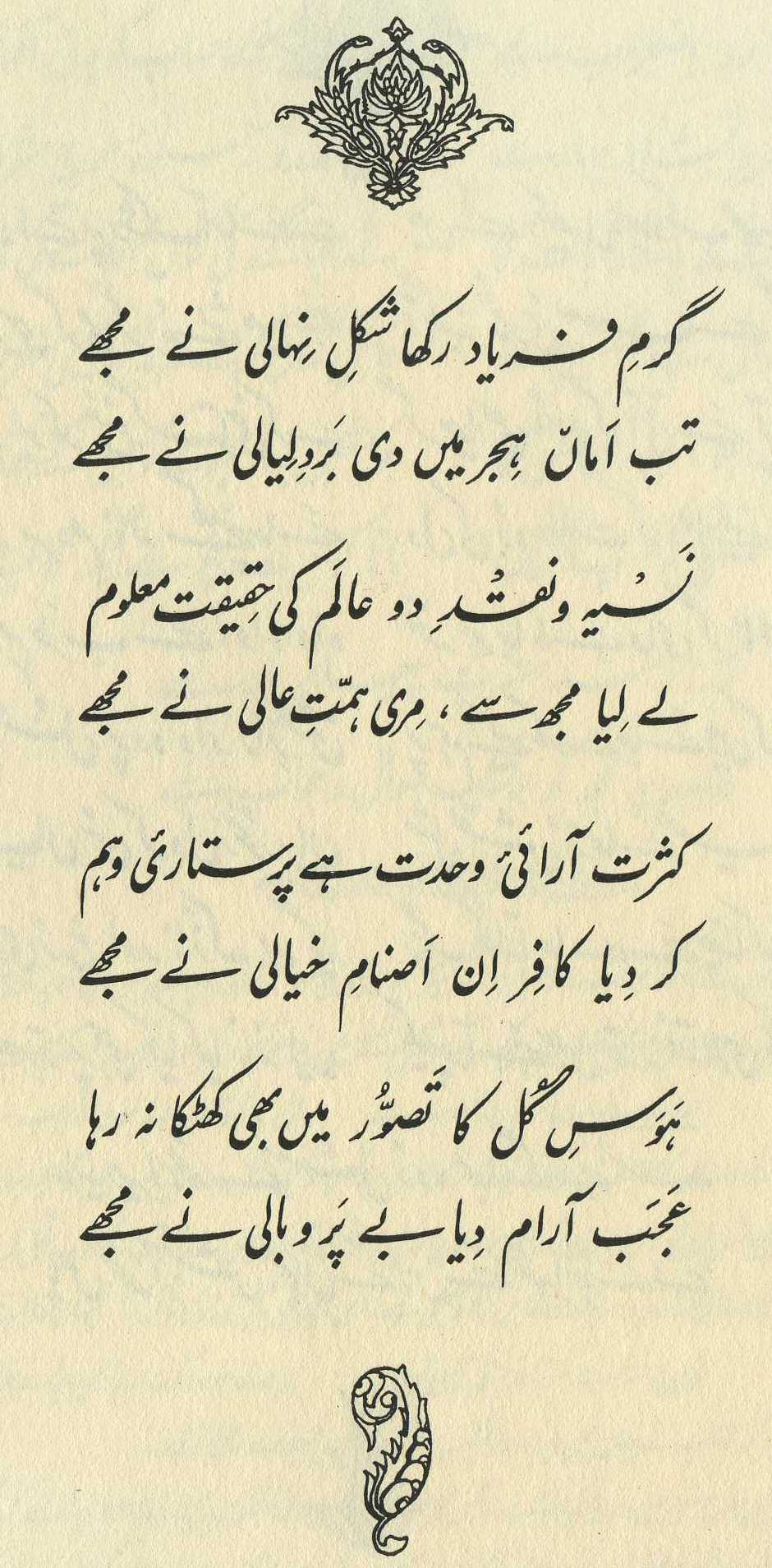
That is, my lofty courage considered both the world and its cash, and the next world and its credit, to be of little reality, and it separated me from them both. Neither worldly cash nor next-worldly credit is worth what I am worth. (166)
== Nazm page 166

That is, I am such an expensive item of merchandise that neither worldly cash nor next-worldly credit is sufficient to purchase me. (222)
Whether it be comfort in this world or or comfort in Paradise, in my eyes it has no substance. My lofty courage bought me from myself. That is, according to my courage, to long for the world and for Paradise was a shame. I abandoned them both. I am neither a seeker of the world, nor a seeker of Paradise; rather, I am a seeker of the Master. (298)
The first line pours colloquial scorn on the value of both this world and the next; for more examples of this very common idiomatic use of , see 4,3 . The tone makes the two worlds sound, at best, tawdry and cheap, mere commercial properties available for money-- and at worst, fraudulent, deceptive shell games with no 'reality' or 'substance' at all. The two worlds are made to seem so parallel, in fact, that the chief difference between them seems to be that one involves cash and the other credit. The first line strongly evokes the first line of 174,10 , in which a similar scorn is heaped on the 'reality' of Paradise. (For more on such 'two worlds' constructions, see 18,2 .)
In English we often use 'take' ('I'll take it!') to mean 'buy'; in Urdu the idiom is more prominent, so that part of the normal range of meaning for , 'to take', is 'to buy'. Thus the second line can have the sense that the speaker's lofty courage 'bought' him from himself-- nicely echoing the commercial imagery of the first line (and also creating a complex image of the speaker as both his own seller, and his own buyer). But the line can also mean that the speaker's lofty courage somehow 'took' him (away?) from himself-- seized him, or compelled him, or perhaps translated him into an entirely new sphere of self-lessness [] in which the wheeling and dealing of this world and the next were equally meaningless and unattractive. Or perhaps his radical independence of spirit-- on this see 9,1 -- made him refuse all external offers, so that his transactions were with himself alone.
This verse obviously belongs to the 'snide remarks about Paradise' set; for others, see 35,9 .
Compare Mir's M 69,7 , which has a similarly radical sense of autonomy and self-reliance.
graphics/cash.jpg