Verse 7xafter 1821aaliine mujhe
G5
In this meter the first long syllable may be replaced by a short; and the next-to-last long syllable may be replaced by two shorts.
1
from the glory/appearance of the sun, the dew is [habitually] obliterated/dead, Ghalib
2
the power/grandeur of the majestic Names destroyed/'lost' me
'Passed away, departed, deceased, defunct; non-existent, extinct'.
'Names: — , , The ninety-nine names or epithets of God'.
'To cause to be lost or destroyed; to lose; to fail of; to part with, get rid of; to do (or make) away with, to throw away, to waste, squander'.
tvat>> : 'Impetuosity; force, violence; power, authority, dominion; awfulness, awe, majesty'.
'Great, illustrious, majestic, glorious; awful, terrible; divine (attributes of the Divinity): — , s.m. 'The great name,' an epithet of the Deity; —texts from the Qur'an, used as a charm or spell'.
| References | |
|---|---|
| Arshi, Imtiyaz Ali | Ghazal# 185 |
| Raza, Kalidas Gupta | 362 |
| Gyan Chand | 490 |
| Hamid Ali Khan | Open Image |
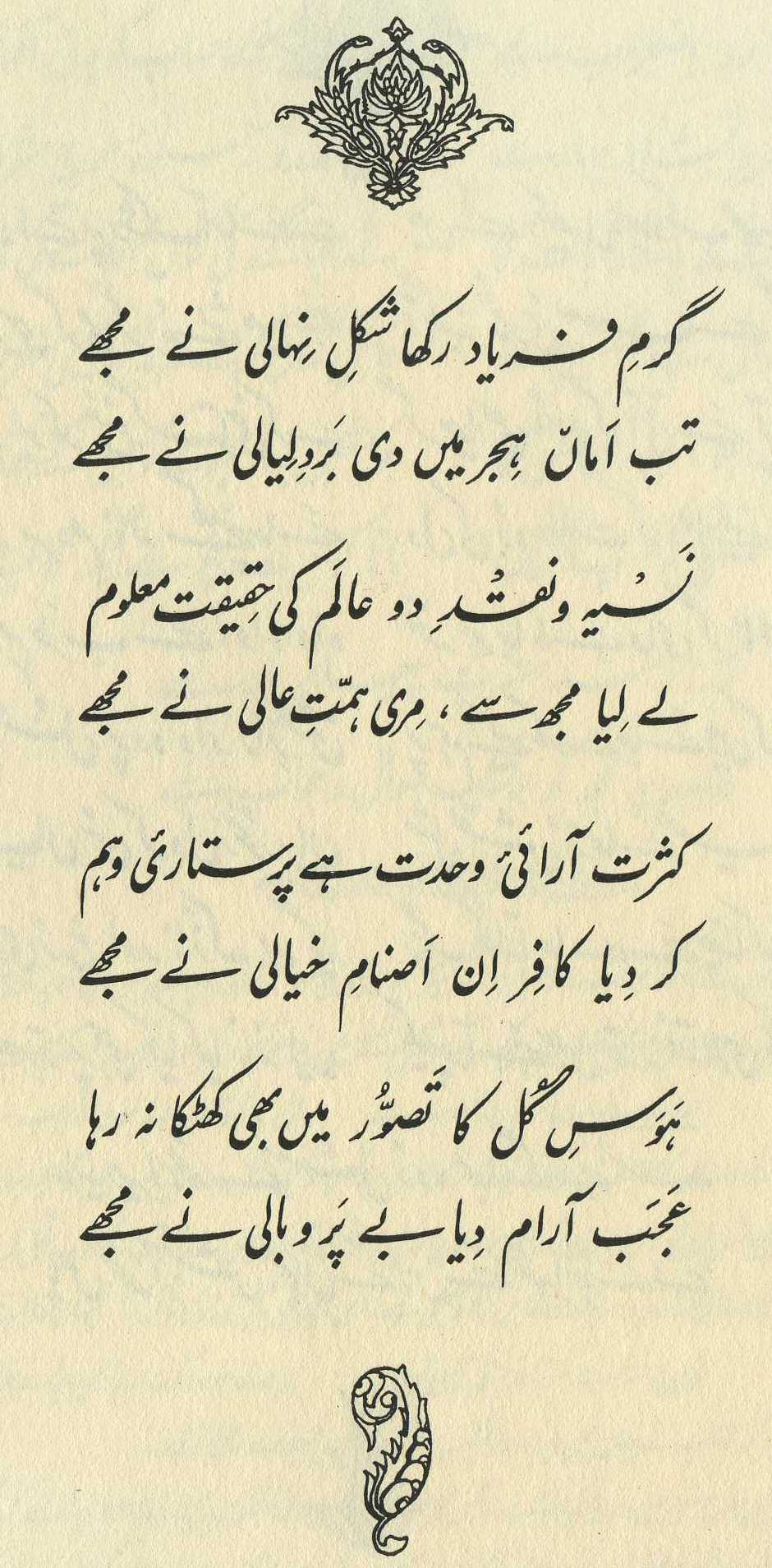
From the glory/appearance of the sun, the dew becomes obliterated. I didn't need even the glory/appearance of the Lord-- merely the imposingness of his names obliterated me.
== Gyan Chand, p. 491
For background see S. R. Faruqi's choices . For more on Ghalib's unpublished verses, see the discussion in 4,8x .
How is the speaker's situation in the second line to be juxtaposed to that of the dew in the first line? Is it to be considered similar (the way the dew is obliterated by the sun, he is obliterated by the divine glory)? Or is it, as Gyan Chand maintains, to be contrasted (the dew is obliterated by the sun itself, but he is obliterated not by God Himself but merely by his ' Beautiful Names ')?
I really can't see all that much going on in this verse.
graphics/greatnames.jpg