Verse 4after 1821aaliine mujhe
G5
In this meter the first long syllable may be replaced by a short; and the next-to-last long syllable may be replaced by two shorts.
1
even/also in the imagining/idea of desire for the rose, no pricking/anxiety remained
2
it gave an extraordinary rest/ease, wing-and-feather-lessness, to me
'Imaging or picturing (a thing) to the mind; imagination, fancy; reflection, contemplation, meditation; forming an idea; idea, conception'.
'A pricking or rankling (in the mind);... perturbation, anxiety, care, concern; apprehension, fear, dread'.
| References | |
|---|---|
| Arshi, Imtiyaz Ali | Ghazal# 185 |
| Raza, Kalidas Gupta | 362 |
| Gyan Chand | 490 |
| Hamid Ali Khan | Open Image |
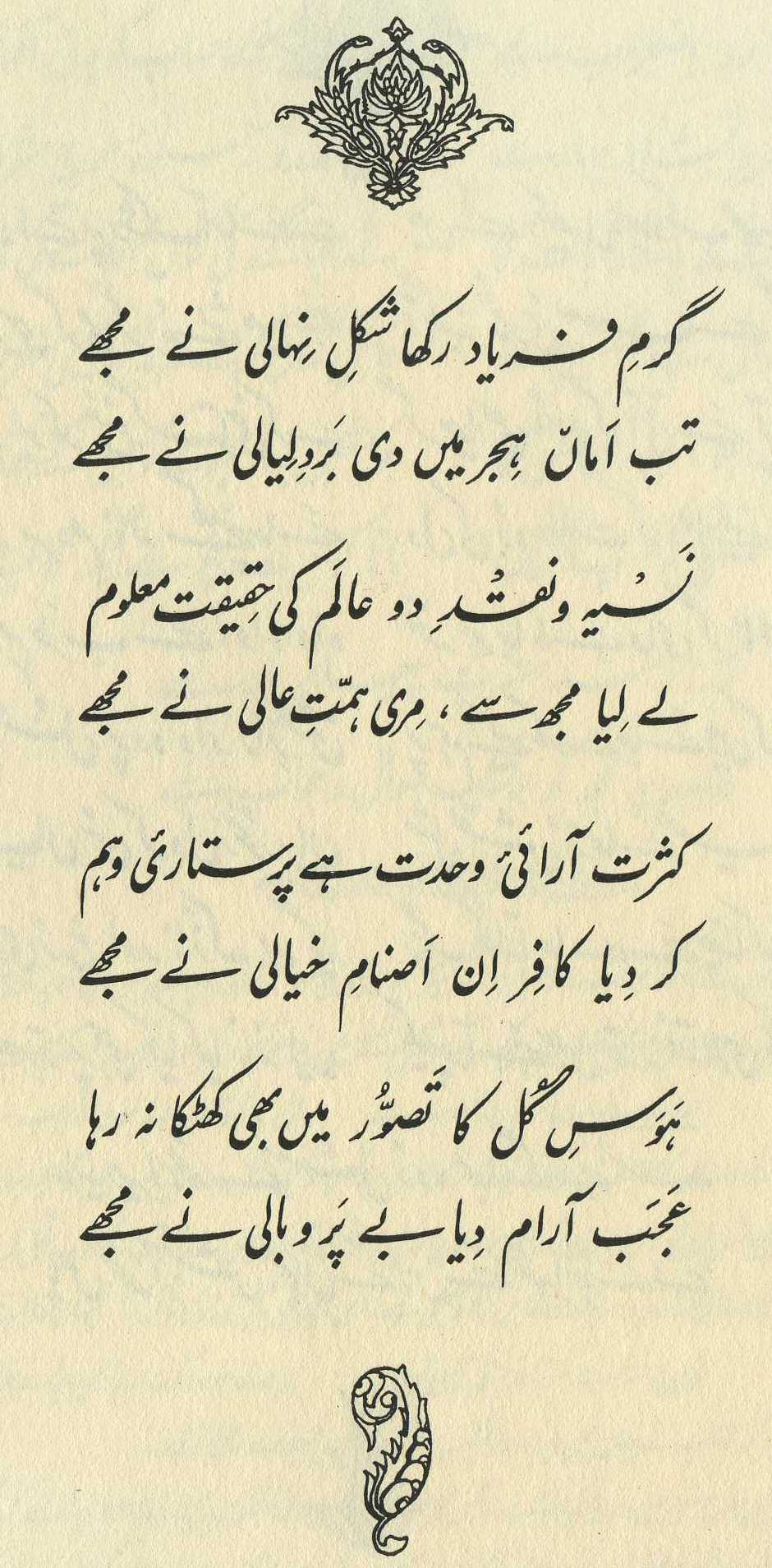
From becoming wing- and feather-less, there was such rest/ease that now not even the imagining/idea of the spectacle of the rose comes. (166)
== Nazm page 166

He says, now not even the imagining/idea of the spectacle of the rose manages to come. I've been saved from its pricking/anxiety too. The meaning is that as long as there remained in wing and feather the strength for flight, I used to fly off and arrive in the garden. Now, thanks to strengthlessness, I've become free from the bondage of passion for the rose. (222)
My wing- and feather-lessness gave me much rest/ease. Now, the thought of the springtime and the garden doesn't come to me even by chance.
On this theme , Mir and Sauda too have exercised their pens:
Sauda:
[the tongue falls short in [expressing] gratitude for broken-wingedness
which erased from the heart the ache for release]
Mir [M 435,4 ]:
[that it may remain in that very proximity, in that street,
are the pleas of broken-wingedness] (298-99)
Compare 120,10 . (251, 288)
This verse is one in which the lover speaks as a bird; for others, see 126,5 . And how utterly distant is the bird from the rose! The bird no longer has (if it ever did have) the rose itself; the bird no longer has anxiety about the rose; the bird no longer has desire for the rose; the bird no longer has anxiety about desire for the rose. All the bird may still perhaps have is an imagining/idea of desire for the rose-- and about that, it no longer has any anxiety.
Some of this extraordinary distancing effect is achieved through the magic of : is the bird's present peace so great that 'even' anxiety over the rose (the limit case) can't break through it, or is it so great that everything in the world, including 'also' anxiety over the rose (just one more item among many) can't break through it?
The versatility of the construction then enables us to emphasize different parts of the operative phrase, through a process that I call 'stress-shifting'. Where did no anxiety remain? 'Even in the imagining of desire for the rose' (as opposed to actually experiencing the desire)? 'Even in the imagining of desire for the rose' (as opposed to imagining some other feeling about the rose)? 'Even in in the imagining of desire for the rose' (as opposed to imagining some other kind of desire)? The fact that we have no way of deciding among these alternatives reinforces the abstraction and remoteness of the actual rose itself.
Since the rose has a thorn, it's a fine bit of wordplay to evoke the pricking [] that it might give to anyone who touched it. Oh, but wait-- it's not the rose that has the thorn, but the abstract 'imagining' of 'desire' for the rose that has the thorn. And even the imagining of the desire has the thorn no longer. So once more we're several metaphorical layers away from any real physical objects.
The verse that Arshi suggests, 120,10 , is indeed a good one for comparison. In both cases, the question of tone remains unresolvable. When the bird expresses gratitude for his winglessness, or the victim blesses the highway-robber, it could certainly be sarcastic. But in both cases the words are deadpan, and reasons are given for the gratitude-- reasons that could be imagined to be sincere rather than ironic. As usual, Ghalib leaves us woven into a web of possibilities.
graphics/rose.jpg