Verse 21816aarhanuuz
G5
In this meter the first long syllable may be replaced by a short; and the next-to-last long syllable may be replaced by two shorts.
1
entirely/'one-pen' burnt/'fire-stricken' paper is the surface/page of the desert
2
in the footprint is the fever of the heat of movement still/now
'Consistent (writer); --all, total; --together; entirely; at one stroke, at once'.
'Face, surface; page, leaf (of a book)'.
'A fever'. (Steingass p.278)
Devout austerity, religious penance, &c. (= , q.v.); the hot season, the height of summer'.
| References | |
|---|---|
| Arshi, Imtiyaz Ali | Ghazal# 70 |
| Raza, Kalidas Gupta | 185-86 |
| Nuskhah-e-Hamidiyah | 115-116 |
| Asi, Abdul Bari | 126 |
| Gyan Chand | 215-216 |
| Hamid Ali Khan | Open Image |
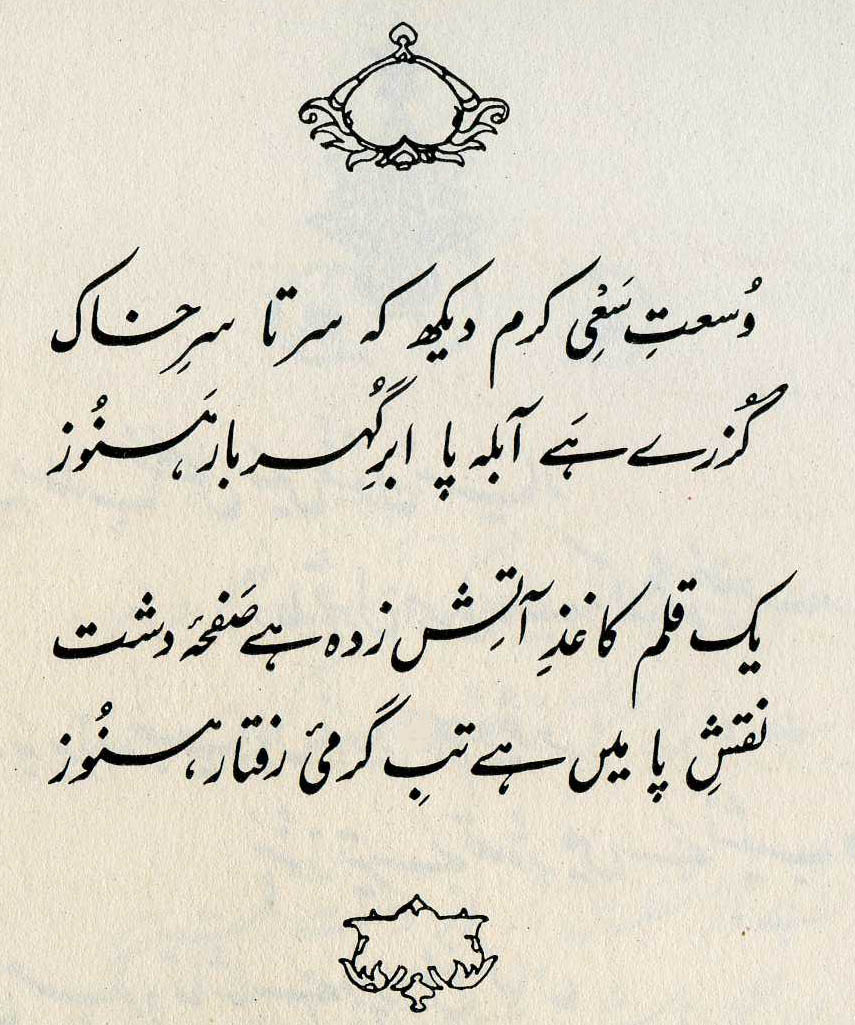
In this verse the author has used the term for the wordplay with 'paper'. In the poetry of that time, they consider wordplay too to be a verbal device , and they call it 'wordplay' when they use one word such that it would have some relationship and affinity , merely verbal, with another.... In short, there's no doubt that in such cases sometimes this wordplay, sometimes , seems good, but they carried it to such lengths that in their search for they have no thought for elegance of meaning [] or for simplicity of words.... Undoubtedly this is to be rejected; it is a verbal device invented [] by the common people []; literary people [] have nowhere mentioned it. When the loafers [] of the city assemble, they compose .... These very people have, in mushairah s and gatherings [], incited the poets to such wordplay, and drawn them in this direction. (68-69)
== Nazm page 68 ; Nazm page 69 ; Nazm page 70


He says, the effect of the heat of my movement is still left in my footprint, to such an extent that the page of the desert has become burnt. (117)
, paper, page-- all have an affinity .... When in the fervor of passion and mystical knowledge I showed the contemptibleness of the charms of the world, to this day the effect of it remains in the world. (152)
First of all consider the affinity . The words are so meaningful that at first glance the attention is not even drawn to them: 'pen' [], 'paper' [], 'page' [], 'shape, print' []. Now look at the meaning. Usually it is said to be a picture of the lover's heat/speed of movement. But this theme can also be for the beloved's heat/speed of movement.... Usually it's been said that so much heat of movement remains in the footprint that the whole desert lies there burning. But if this is so, then there's no way to understand the necessity of 'a burnt paper'. In reality the meaning is, the whole desert is not burning, rather only those places are burning where the footprints have fallen; thus the desert presents the aspect of a burning paper. When paper burns, it doesn't burn all at once, rather here and there glowing spots appear on it. The young Ghalib, in a ghazal from this same period, expressed this sight with even more beauty: 64,2 .
== (1989: 81) 2006:100-01
On the idiomatic construction, see 11,1 . As the commentators note, this is a verse based on wordplay. In fact wordplay is all it's based on; there's literally nothing else in it except a fancy description of a 'hot' footprint in the desert.
One of the pleasures of working with commentators is their unpredictable outbursts. (I certainly have mine!) Nazm has an enjoyable outburst about this verse. He seems especially provoked by the phrase and the verse's ostentatious wordplay . He goes on at length, giving hard-to-translate examples that I have omitted, and declaiming about how vulgar and low-class it is to engage in fancy punning and competitive word-games. This, he says, is what the loafers and common people do, and not what the 'proper' ghazal should do. Nazm was a Lakhnavi; for a more detailed account of what he describes as Lucknow street culture, see Harcourt and Hussain ; if you know Urdu well, you can go straight to the source, Sharar .
As usual, (on this see 3,4 ) has the two senses of 'still', emphasizing long duration, and 'now', emphasizing newness or immediacy. And what is it that the 'still' and 'now' help us to observe? The traces of the lover's passage through the desert; or, as Faruqi points out, the beloved's passage (though it's hard to imagine her as walking around in the desert). The 'heat of movement' might come from the lover's feverish passion, or the beloved's devastatingly 'hot' way of walking, or perhaps from a sheer power of movement that generates its own form of heat, like an engine running at high speed.
In any case, merely the act of lover's or beloved's walking through the desert was too much for the desert to bear; the desert now has charred, glowing embers in footprint patterns all over it. The inflammable sandy desert, when exposed to the movement of human passions, caved in immediately and entirely, and resembled something as frail and destroyed as a burnt, or literally (and more graphically) 'fire-stricken', paper. Compare the even more extreme (and effective!) 5,4 , in which even a 'passing thought' of wildness/madness inadvertently burnt up the whole desert.
graphics/desertfootprints.jpg