Verse 11816aa((
G1
1
the path of the road, to the sun, at evening-time, is the thread of a ray
2
the sky/wheel makes open, by means of the new moon, an embrace of leave-taking
'A wheel (as of a water-mill, or of a well, &c.); a potter's wheel; a lathe; the celestial globe or orb, the sphere of the heavens, the heavens, the sky; --circular motion; turn; --fortune, chance'.
| References | |
|---|---|
| Arshi, Imtiyaz Ali | Ghazal# 74 |
| Raza, Kalidas Gupta | 191 |
| Nuskhah-e-Hamidiyah | 122 |
| Asi, Abdul Bari | 138-139 |
| Gyan Chand | 231-232 |
| Hamid Ali Khan | Open Image |
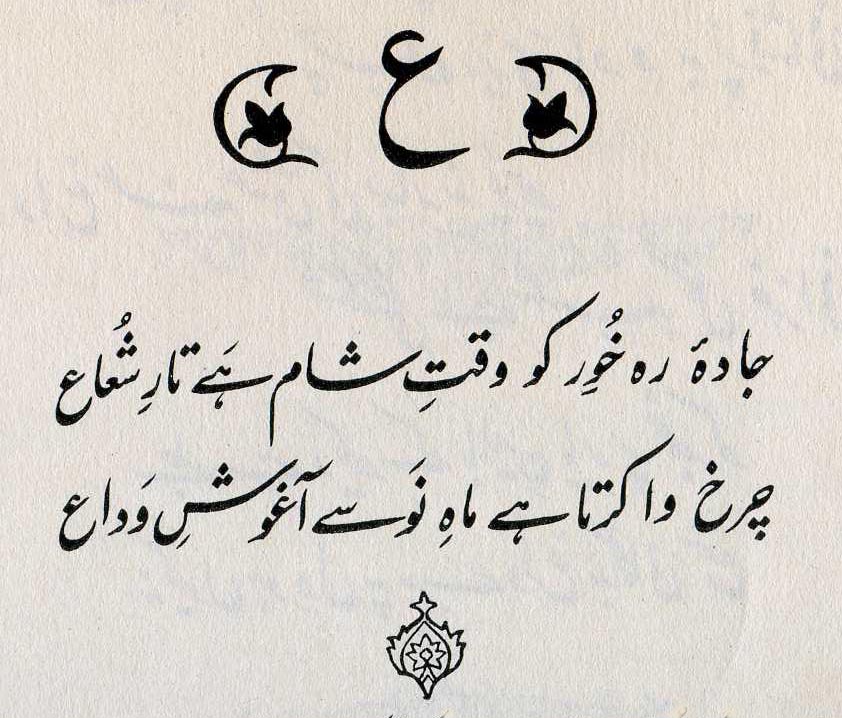
That is, the sun travels out of the sky, and the sky has opened up the embrace of the crescent moon. That is, after its setting, the line that shows itself just above the horizon is its track.... But in this theme there's no 'ghazalness' []; if it would be the opening-verse of an ode , then it would be acceptable. (76)
== Nazm page 76

After sunset, a white line appears on the sky, and in that situation a new moon is emerging; seeing this mood , the poetic imagination says that by the road of this shining line the sun is setting out; and this is not a new moon, but rather the sky, in order to take leave of it, has opened an embrace.
In reality if this would be the opening-verse of an ode , then that would be fine. If it's the opening-verse of a ghazal, then we ought to consider that the poet has given an imaginative form to the scene of the face of Nature. (158)
How can this meaning-creation , and this beauty of expression [], and this ' elegance in assigning a cause ', be sufficiently praised! (159)
Josh is right to see in this verse an instance of ' elegance in assigning a cause ,' since it accounts both for the line of light on the horizon after sunset (the path of the sun's departure that is the 'thread of a ray'), and also for its being accompanied by the crescent moon (which opens an 'embrace of leave-taking'). Now we know what's really going on-- not just random astronomical phenomena, but a traveler setting out on a journey, being seen off with a farewell embrace. The visual image is direct, approachable, and charming. On the rich possibilities of the 'embrace of leave-taking', see 57,6 .
Nazm has trouble accepting this verse into the ghazal universe. He made a similar complaint about 14,2 , which is, like this one, a verse of observation about the time of day and the natural world. I think that in both cases what he's objecting to is the way the verse seems to set the stage, as though preparing us for further action in due course-- the kind of further action that would then be presented in an ode , but not (as a rule) in a ghazal.
But surely the range of the ghazal can't be made so narrow that it would refuse to admit verses like this! On the contrary in fact: if Ghalib considers verses like this to be ghazal verses, why should we be more royalist than the king? Nazm had his own critical axes to grind, of course, as is evident in the course of his comments on many other verses as well. I'd like to write about him at more length sometime.
graphics/newmoon.jpg