Verse 3x1816aa((
G1
1
in the four-directions of the world, the market of/for heedlessness is 'hot'
2
from the loss/harm of intellect arises the thought of profit/benefit
'A quadrangle; a square; a court-yard; an open place in a town where the market is held (and where also the chief of the police-office is stationed); a daily market; the main street or central thoroughfare of a city'.
'Unmindfulness, forgetfulness, neglectfulness, negligence, neglect, inattention, heedlessness, inadvertence, remissness, carelessness'.
'Intelligence, wisdom, sense, understanding, intellect, mind, reason, knowledge'.
'Defect; deficiency; loss; waste; detriment, injury, harm, damage; blemish; prejudice; mischief'.
'Being benefited, deriving advantage; profit, advantage'.
| References | |
|---|---|
| Arshi, Imtiyaz Ali | Ghazal# 74 |
| Raza, Kalidas Gupta | 191 |
| Nuskhah-e-Hamidiyah | 122 |
| Asi, Abdul Bari | 138-139 |
| Gyan Chand | 231-232 |
| Hamid Ali Khan | Open Image |
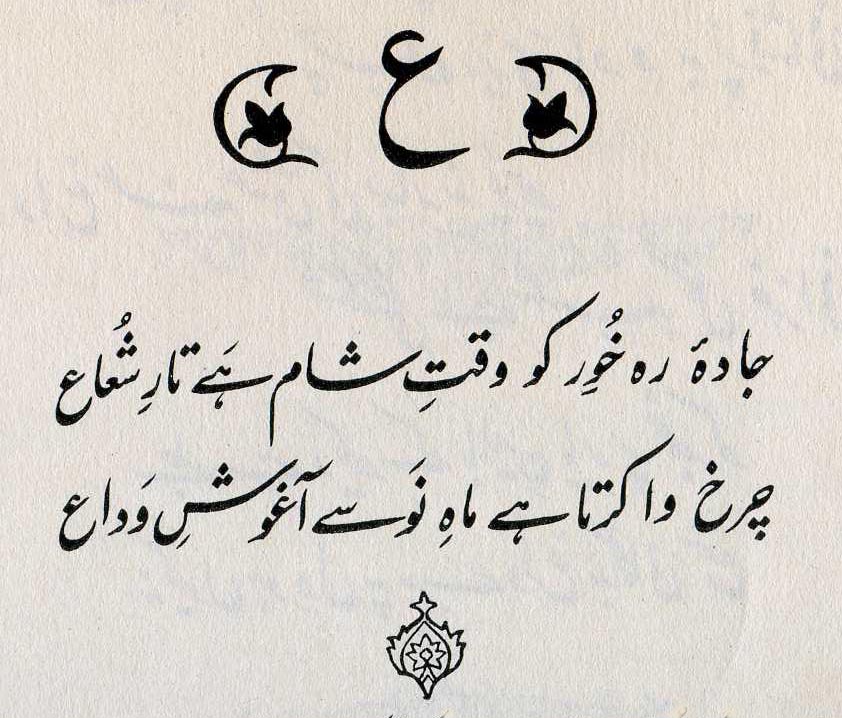
That is, in every corner of the world the bazaar of heedlessness is 'hot', and the people of the world/age are heedless. These wretches don't understand that the reality of the thought of profit is only this much: that in this age, because of the harm of intellect, it arises. Beyond this, it has no existence.
== Asi, p. 139
= . = a lack/shortage of intellect
That is, in the bazaar of the world there is a 'hot market' in heedlessness because where there is a deficiency of intellect, there the thought of profit has kept departing.
== Zamin, p. 203
In the world, in every direction heedlessness has free rein. People are not making use of intellect. In the 'loss of intellect'-- that is, in unintelligent/unwise ideas-- they consider there to be profit. From what ground does the 'thought of profit' grow? From unintelligence/unwisdom, and this is short-sightedness.
== Gyan Chand, p. 232
For background see S. R. Faruqi's choices . This verse is NOT one of his choices; I thought it was interesting and have added it myself. For more on Ghalib's unpublished verses, see the discussion in 4,8x .
I was wondering why there were only 'four directions' here, when Ghalib usually likes to have six (by including up and down), as for example in 41,4 . But then Zamin helpfully identified the (Persian) 'four directions' as (see the definition above). Many North Indian cities have a market called Chauk, based on the idea of four corners and/or a crossroads, which can also suggest a kind of 'main street' market.
The verse makes a truly enjoyable use of constructions (and the ). First of all, what happens in a , a market 'of' heedlessness? Is 'heedlessness' a form of merchandise? Is it a characteristic of the merchants? Or is it like a dark cloud that envelops the whole area and everything that happens there?
And then, there are several ways-- all of them bleak-- to read the second line:
=Because people have suffered a loss of intellect, they heedlessly think they are acting profitably when they are not.
=Only because of a loss of intellect do people think there even exists such a thing as 'profit'; this is their heedlessness.
=Because of the harm done by intellect/knowledge (as in the bitter 201,8 ), people decide they would be better off with heedlessness.
graphics/bazaar.jpg