Verse 7x1816aakaruu;N
G3
1
I am such a plea/entreaty of the relish/savor of cruelty/injustice that I
2
would make the scimitar of tyranny, the bent/curved back of supplication
'Prayer, petition, supplication, entreaty, request'.
'Pleasure, delight, enjoyment; sweetness, deliciousness; taste, flavour, relish, savour; —an aphrodisiac; an amorous philter'.
'Fleeing to (one) for relief or protection, taking refuge (with); refuge, protection; entreaty, petition, urgent request or prayer, solicitation, supplication'.
| References | |
|---|---|
| Arshi, Imtiyaz Ali | Ghazal# 84 |
| Raza, Kalidas Gupta | 202 |
| Nuskhah-e-Hamidiyah | 140-142 |
| Asi, Abdul Bari | 161-162 |
| Gyan Chand | 258-260 |
| Hamid Ali Khan | Open Image |
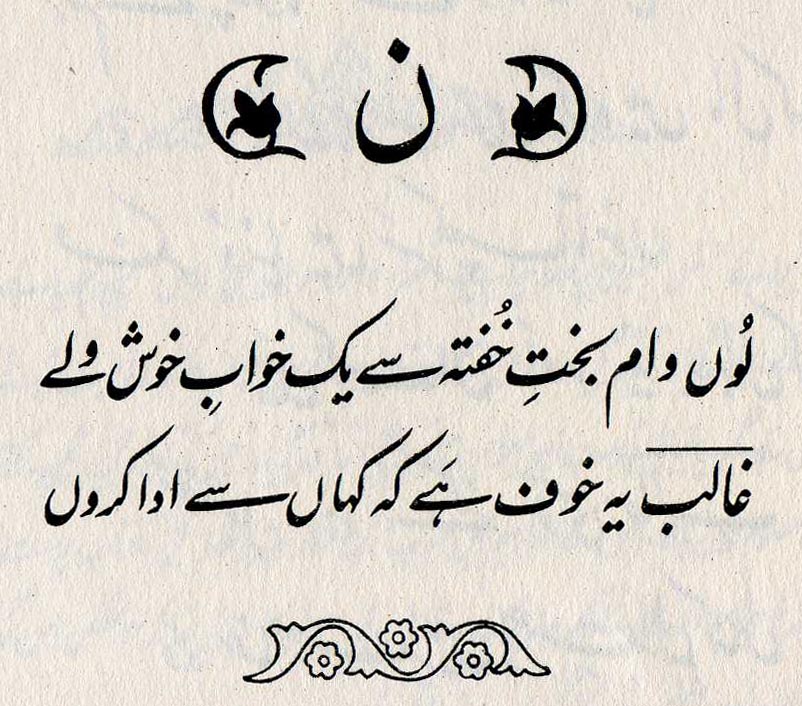
I am a single plea for the relish of cruelty, and I am a plea such that my attraction to cruelty has reached a level where I can make the sword of tyranny into a bent back that is bent for the sake of a plea and petition. That is, the sword of tyranny itself, when facing me, would come having turned into the bent back of pleading.
== Asi, p. 162
The meaning is that I am such a seeker of the relish of cruelty that I would want the [bent] back of pleading from the heat of the sword. That is, even if I would plead, then it would be for the stroke of a sword!
== Zamin, p. 229
When the beloved shows cruelty toward me, then I obtain relish; thus I always petition her, 'Do more tyranny!'. To me, the tyranny-performing sword is as if I am bending over in supplication to be killed, and the sword is an interpreter of my plea. That is, I am insistently pleading for a stroke of the sword.
== Gyan Chand, p. 259
For background see S. R. Faruqi's choices . For more on Ghalib's unpublished verses, see the discussion in 4,8x .
This verse has the same basic structure as do 84,6x and 84,8x .
Well, the conceit is ingenious enough: the curved shape of a scimitar is made to resemble the bent-over shape of a person bowing deeply in humble supplication. The 'I am' equates the speaker himself with his plea, just as the plea itself is equated with the scimitar that can provide such a desirable 'relish of cruelty/injustice'.
Still, the doesn't quite seem to work. How would the speaker 'make' the curved scimitar into a bent back? Just by the sheer power of his longing? Perhaps the speaker is claiming that with his persistent pleas to be slaughtered he could importune and pester the sword until it had a 'bent back' in supplication as it begged him to stop. (After all, we do know the beloved often refuses to use her sword on the lover, as in 19,4 .)
In the obvious verse for thematic comparison, 1,3 , there's no assertion that the lover actually has any such (physical?) power over the sword; there, intriguingly, the bloody-mindedness is (said to be) that of the sword itself.
graphics/scimitar.jpg