Verse 6x1816aakaruu;N
G3
1
I am so disaffected with an entreaty/favor/obligation of good-fortune that I
2
would feel wildness/horror about the wound/blemish of the shadow of the Huma 's wing
'Ill-tempered, irritable, impatient, easily provoked'.
'Kindness or service done (to); favour, obligation; —grace, courtesy; —entreaty, humble and earnest supplication; —grateful thanks, praise'.
'Prosperity, good fortune, auspices, felicity; prestige'.
'Loneliness, solitariness, dreariness; —sadness, grief, care; —wildness, fierceness, ferocity, savageness; barbarity, barbarism; —timidity, fear, fright, dread, terror, horror; —distraction, madness'.
'A mark burnt in, a brand, cautery; mark, spot, speck; stain; stigma; blemish; iron-mould; freckle; pock; scar, cicatrix; wound, sore; grief, sorrow; misfortune, calamity; loss, injury, damage'.
| References | |
|---|---|
| Arshi, Imtiyaz Ali | Ghazal# 84 |
| Raza, Kalidas Gupta | 202 |
| Nuskhah-e-Hamidiyah | 140-142 |
| Asi, Abdul Bari | 161-162 |
| Gyan Chand | 258-260 |
| Hamid Ali Khan | Open Image |
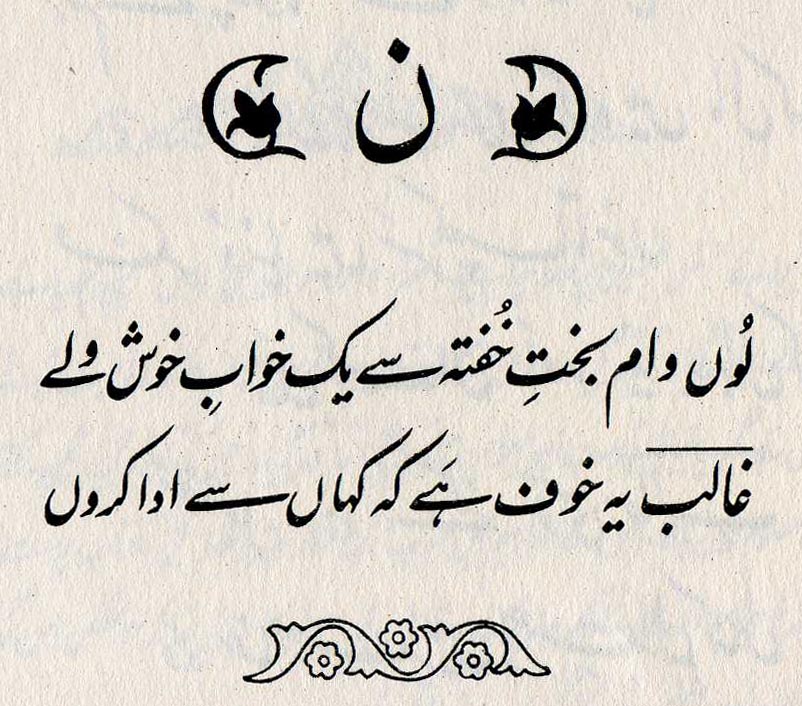
I am disaffected to such an extent with the generosity and entreaty-acceptance of good fortune that if I would even see the wound/blemish of the shadow of the wing of the Huma, then I would feel wildness/horror. The gist is that I cannot take on my head anyone's kindness.
== Asi, p. 162
That is, I am so fearful of the entreaty-acceptance of good fortune that if my gaze would somehow fall even on the shadow of the wing of the Huma, I feel wildness/horror even about that-- 'This is an omen of good fortune-- flee from it!'.
== Zamin, p. 229
I am greatly disaffected. I cannot agree to be under obligation to worldly good fortune. If the Huma's wing would want to extend its shadow over me (which is the auspicious announcement of kingship), then this shadow will seem to me to be a scar/stain/blemish, and I will want to show wildness/horror toward it and flee from it. Grandeur and good fortune, and even kingship, absolutely don't please me.
== Gyan Chand, p. 259
For background see S. R. Faruqi's choices . For more on Ghalib's unpublished verses, see the discussion in 4,8x .
The structure of this verse is notably parallel to that of the next two verses, 84,7x and 84,8x . They are all framed as 'I am so X that I would do Y'. There's not a strong enough unity to make them into a verse-set . Still, they seem to share not just a structure, but also a common mood or feeling, a sort of (boastful?) extravagance or grandiosity.
This verse is a classic example of what I call Ghalib's 'independence' verses; for more on these, see 9,1 . The speaker is so radically unwilling to abase or humiliate himself before others, or to borrow or beg for anything from others, that he wouldn't even want the kingship-bestowing shadow of the Huma's wing to pass over him-- for then he'd be indebted to the kindness or favor of the Huma, which would be unendurable.
Although the main thrust of the verse is clear enough, and truly enjoyable in its hyperbole, the verse also offers a piquant note of complexity through the beautifully chosen . For although it's clear that the speaker would react badly to the shadow of the Huma's wing, how exactly would he react? The exceptional range of (see the definition above) leaves the question still very wide open.
Moreover, what exactly would he be reacting against? The very idea of the Huma's patronizing presumptuousness? Or something about the itself? Is he so sensitive that the effect of the shadow would be to create a visible 'scar' or even 'wound' on his body? Or would he react to the moral 'stigma' or 'blemish' of the humiliation of dependence? Or would the 'wound' be just a more general blow to his pride, and thus a source of sorrow to his heart? As so often, such nuances are left for us to decide for ourselves.
graphics/wingshadow.jpg