Verse 11816aakaruu;N
G3
1
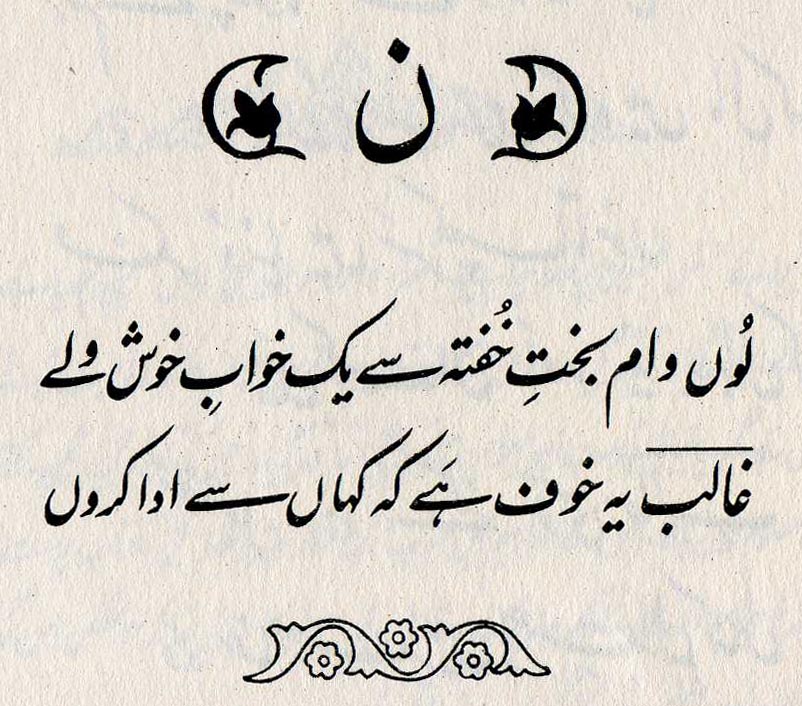
I would borrow from [my] sleeping fortune a single happy dream/sleep, but
2 a
Ghalib, there is this fear, that-- how/'from where' would I return/pay [it]?
2 b
this fear is dominant, that-- how/'from where' would I return/pay [it]?
'Debt; loan; —credit; —lending; —borrowing'.
'Overcoming, overpowering, victorious, triumphant, prevailing, predominant, prevalent; superior, surpassing, excelling; —most probable, most likely; —s.m. The most, the most or greater part, the generality'.
'To perform; accomplish; fulfil; discharge; liquidate, pay; to effect or accomplish satisfactorily, properly, &c.'.
| References | |
|---|---|
| Arshi, Imtiyaz Ali | Ghazal# 84 |
| Raza, Kalidas Gupta | 202 |
| Nuskhah-e-Hamidiyah | 140-142 |
| Asi, Abdul Bari | 161-162 |
| Gyan Chand | 258-260 |
| Hamid Ali Khan | Open Image |
Fate is sleeping, and I am sleepless/dreamless. If it's in my power to borrow a happy dream, then I can have one. But from where will I repay this debt? I am deprived of the 'wealth of a dream'. (83)
== Nazm page 83

In the grief of lack and poverty, it never befalls one to sleep in peace. One wants to borrow a little happy-heartedness from one's 'sleeping' fate. But the fear is, how will I be able to return this debt, and when will the wealth be available to me to pay this debt? Mirza always remained indebted; it's as if this verse is about his own situation. (169)
In the second line, is by way of a pen-name , but it also has its dictionary meaning too....
[In saying] instead of , instead of , and instead of , Ghalib has demonstrated his Persianization. But in place of , also has more of an affinity because it gestures toward ; this idiom is used to express compulsion. [An example is given.]
My fortune is asleep, but I am sleepless. I would borrow from the sleeping fortune one (= (1) deep sleep; (2) sweet dream), but then from where would I return the debt? There are a number of difficulties in paying a debt. (1) The poor man's fortune remains asleep. My fortune is sleeping, and I am so poor that I can't even repay the debt of a sleep. (2) A debt of sleep can only be repaid with sleep [which is exactly what I don't have, and won't want to lose if I should get it]. (3) The meaning of giving sleep back to fortune is to put the fortune to sleep. But my fortune is already asleep-- now who would be able to put a sleeper to sleep?
Let's consider some further points. My fortune is to be wakeful day and night, and my fortune's fortune is to sleep day and night. My wakefulness and my fortune's sleeping are two names for the same thing. A second point is that when I borrow a sleep from my sleeping fortune, then as long as that sleep lasts the fortune will awaken-- but then the fortune awakens, then I will go to sleep. If I go to sleep, then I won't be able to take advantage of the awakened fortune. A third point is that the awakening of the sleeping fortune is meaningless for this reason too: that afterwards I will be compelled to repay that debt-- that is, I will be compelled to myself put my awakened fortune to sleep. [Further discussion of such paradox ical possibilities.]
The final point is that a metaphor for life is 'to be awake' and a metaphor for death is 'sleep'. [Thus the paradox of my seeking to borrow 'death' in order to enhance my 'life'.] Because waking is life, and sleep is death. I can borrow either life or death; I can't take both at one time.
== (1989: 103-04) 2006: 126-28
[See also his comments on Mir's M 1504,1 .]
The commentators assume that we know that a 'sleeping fortune' is a common idiomatic expression for a negligent, inattentive, badly behaved fortune that is not treating one well. (Thus boys are sometimes named Bedar Bakht, or 'Awake Fortune'.) When people speak of their luck improving, they say their sleeping fortune has awakened. For a 'sleeping heart', see 129,3x ; and for a 'sleeping gaze', see 145,5x .
Here, of course, Ghalib is taking the worst-case situation and using it to make one of his plays with paradox. If his fortune is deeply and hopelessly asleep, one result might very probably be perpetual wakefulness for me-- because sleep is a good, and ill-fortune would naturally include loss of many such goods; and because ill-fortune would include many other losses and anxieties, such as poverty and debt, that would keep him awake with worry.
Because sleeplessness in itself is such a miserable state, and also because dreaming (in a wonderful example of word- and meaning-play) offers an escape from a world full of ill-fortune, he would like to borrow a that, as Faruqi points out, can mean either a good sleep or a happy dream (since means both 'sleep' and 'dream').
And from whom could he borrow it, except his own fortune, the giver or withholder of all aspects of his destiny? And yet-- when he thinks of borrowing it, all the problems, confusions, impossibilities, and paradoxes so well spelled out by Faruqi are bound to arise.
Vasmi Abidi points out the striking repetition of the letter -- especially in all four parts of the two phrases in the first line. Is it too fanciful to think that this might create a slightly soporific mood, or evoke the sound of a snore?
graphics/dream.jpg