Verse 11816arhu))aa
G1
1
the drop of wine became, out of amazement, to such an extent breath-holding
2
the line on the wine-glass became, end-to-end, a string of pearls
t:t>> : 'A line, a streak, or stripe, a mark; lineament; —writing, character, handwriting, chirography; a letter, epistle'.
| References | |
|---|---|
| Arshi, Imtiyaz Ali | Ghazal# 25 |
| Raza, Kalidas Gupta | 154-155 |
| Nuskhah-e-Hamidiyah | 72-73 |
| Asi, Abdul Bari | 69 |
| Gyan Chand | 107-109 |
| Hamid Ali Khan | Open Image |
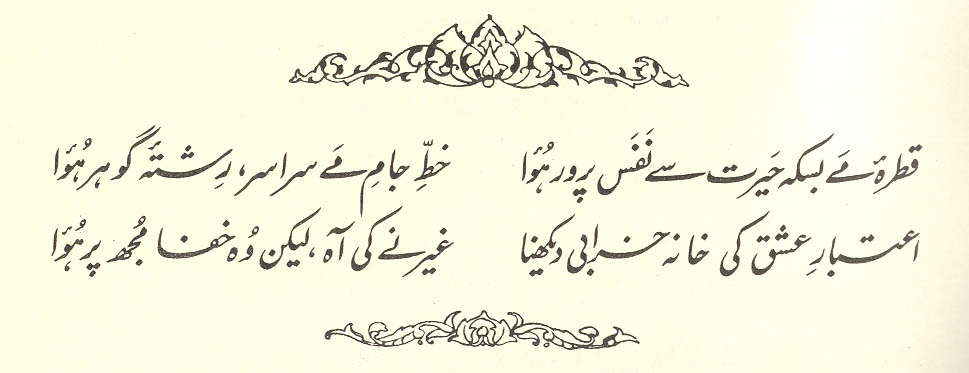
[1864, to Junun Barelvi:] In this closing verse the thought is subtle [], but-- [in Persian] 'to dig up a mountain, and bring forth a straw' []-- that is, the pleasure is not so great. The drop is helpless when it falls. Its duration is the span of the blink of an eye. Amazement prevents movement. The drop of wine, through an excess of amazement, has forgotten to drip. When rows of drops are lined up together without moving-- then the line in the wineglass has taken on the aspect of a string of pearls. (Arshi p.175)
==Urdu text: Khaliq Anjum vol. 4, p. 1513
Captivatedness, devotion, distress, and self-control are among the necessities of amazement/stupefaction. And when these qualities were created by amazement in every single drop, then the lines in the flagon and glass became strings of pearls. This is intended only to express the rare power of amazement, but that this amazement was created by seeing the Cupbearer 's beauty-- this theme remained confined to the author's mind. (29)
== Nazm page 29

Urdu text: Vajid 1902 {28}
When the glass of wine touched the beloved's lip, then the drops of wine were petrified by amazement and became pearls, and the line in the wineglass became like a string of pearls. (29)
I don't agree with any of these meanings, and the reason for my disagreement is that the author has ascribed to the drop of wine the act of holding its breath.... Here the meaning of is 'in an amazement-producing manner'. And then, if the drop of wine has become a pearl, and the line in the wineglass a string of pearls, what's the connection with holding its breath? After all, why did the author use the word 'amazement' in this verse? The task of the drop of wine is to make one unconscious, to create a special mood []. That its task would be to make one amazed-- this is beyond the understanding of the wretched Bekhud. (73)
[According to Asi:] The task of a drop of wine is to make one amazed, and that amazement is breath-holding and life-preserving. His/its life-protectingness made the line in the wineglass into a string of pearls. The intention is only the praise of wine. (100)
This verse remains at the level of carelessness/negligence. The reason is that the theme has no result/outcome. (93)
[See his comments on M 867,1 .]
../apparatus/txt_sets.html ABOUT WINE CONTAINERS IN GENERAL: Here are the words Ghalib uses in the divan for vessels that contain wine:
= : 'Mirror, looking-glass; drinking-glass; bottle; —wine; diamond'. (Platts p.2)= : 'Cup, drinking-vessel'. (Platts p.111)= : 'A drinking vessel, a cup, glass; a tea-cup'. (Platts p.295)= : 'A measure (for dry or wet goods) ...; a cup, bowl, goblet'. (Platts p.301) (For wordplay on this see for example 239x,5 .)
= : 'Goblet, bowl, cup, glass, drinking-vessel; a mirror'. (Platts p.372)
= : 'A large vessel or jar; an alembic, a still'. (Platts p.493); a possible example (with thanks to Zahra Sabri)
= : 'Cup, bowl, goblet'. (Platts p.625)
= : 'Ewer, jar, pitcher, pot, cup, glass'. (Platts p.633)
= : 'Glass; glass-ware; a glass bottle; a looking-glass, mirror'. (Platts p.740)
= : 'A goblet, cup, glass, bowl'. (Platts p.788)
= : 'A cup, goblet, bowl; a plate; a trencher'. (Platts p.801)
= : 'An earthen water-bottle with a long narrow neck, a gugglet; a pitcher; a jug; a jar'. (Platts p.862)
= : 'Heaven, paradise; the sky, the azure vault;—a blue colour; ... —a goblet, glass; decanter'. (Platts p.1107)
Apart from and , they're pretty broad terms, and in stylized two-line verses they're basically impossible to differentiate in any consistent way. In most cases, I haven't found it possible to get a clear sense of exactly what size, shape, or kind of wine-vessel is meant. Usually it's not even possible to pin down whether the reference is to an individual drinking-glass, or to a serving-vessel like a flagon or decanter. Of course, most of the time it's not necessary to make such distinctions; it's not even clear that the poet himself did (since for ghazal purposes, their varying scansions must often have been the crucial factor). In a few cases, two of the above terms are juxtaposed in the same verse-- which may give some clues to what's going on in that particular verse, but doesn't always help much in general. Here are some examples of juxtapositions: 81,6x ; 178,8 ; 182,2 ; 192,4 ; 208,13 .
S. R. Faruqi says that among portable (non-cask) wine-containers, 'the biggest one is called , then , then , then , then ' (M 617,1 ).
Nazm's criticism of the present verse echoes his famous complaint about the meaningless of 1,1 . Here, he faults Ghalib for having in mind an underlying theme -- namely, that the cause of the wine-drops' amazement was the Cupbearer's beauty-- but failing to make it explicit. In Ghalib's own interpretation of the verse, however, no such theme is mentioned. Ghalib claims to consider the verse a minor, overwrought one, and he mentions only the theme of the wine-drops' freezing in amazement. (On the special nature of , see 51,9x .)
Other commentators too are unusually dissatisfied with this verse, and have trouble finding a meaning that suits them. Apparently most of them have not seen Ghalib's own explanation in his letter. I don't have anything to add to what Ghalib has said. It does seem to be a minor verse: it rests on some physical similarities (wine-drops are like pearls) and behavioral analogies (amazement causes people to freeze in place; amazement causes wine-drops not to pour). But as Josh rightly points out, the verse doesn't seem to go anywhere, doesn't do anything with its material.
It's also particularly hard to envision the wine-glass situation that Ghalib might have in mind. The idea of a row of drops that fail to drip sounds as if the drops would be spilling out in a line, from a tilted glass. But the 'line on the wine-glass' sounds as if the drops of (white?) wine remain within the glass, but form a line like a string of pearls. For discussion of the imagery of lines in wine-containers, see 81,6x .
In an essay , Faruqi uses this verse as a classic example of the difference between ' delicacy of thought ', which the verse displays in a high degree, and ' meaning-creation ', which it entirely lacks.
Note for meter fans: has here been treated as , with a , in order to make the scansion work. Compare 33,2 , 81,6x , and 199,1 , which appear with no doubling of the final consonant. The official Arabic spelling is in fact ; Platts considers to be a 'vulgar' form (p.490), but obviously Ghalib didn't agree.
graphics/winedrop.jpg
