Verse 5x1816arhu))aa
G1
1
oh you who have not made a habit/custom of control/restraint of your condition: the ebullience of madness
2
is the intoxication of wine-- if it would become a 'whole-veil' more refined/sensitive
t>> : 'Keeping, taking care of, guarding, defending, watching over, ruling, governing; regulation, government, direction, discipline; restraint, control, check'.
'Nature, disposition, temper; habit, custom; way, manner'.
'Boiling, ebullition; effervescence; heat, excitement, passion, emotion; lust; fervour, ardour, zeal; vehemence; enthusiasm; frenzy'.
'A curtain, screen, cover, veil, anything which acts as a screen, a wall, hangings, tapestry; ... secrecy, privacy, modesty; seclusion, concealment; secret, mystery, reticence, reserve; screen, shelter, pretext, pretence;'.
'Thin, slender, slim, delicate, tender, fragile; fine; light; brittle; nice; neat; elegant; genteel; subtle; —facetious; gracious; keen; sensitive, touchy, testy'.
| References | |
|---|---|
| Arshi, Imtiyaz Ali | Ghazal# 25 |
| Raza, Kalidas Gupta | 154-155 |
| Nuskhah-e-Hamidiyah | 72-73 |
| Asi, Abdul Bari | 69 |
| Gyan Chand | 107-109 |
| Hamid Ali Khan | Open Image |
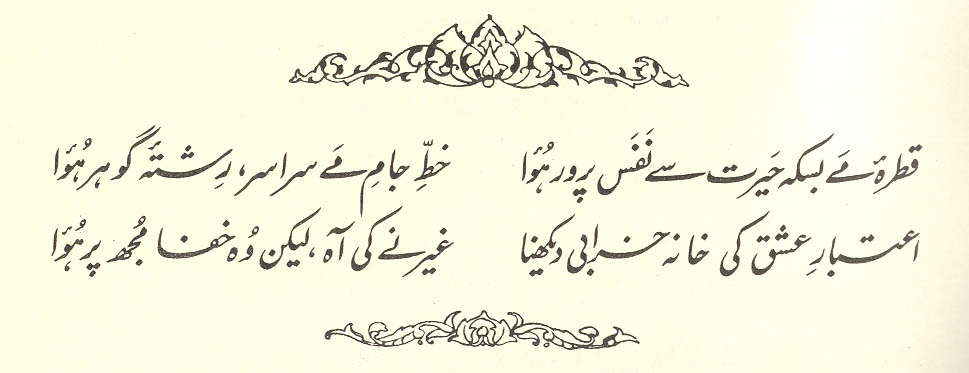
Oh, you who are controlling the condition of us downcast ones! [Asi's text has .] That is, who are writing it down, or looking at it. Do you even have any knowledge of what it is? -- that if it would be light-ish, and a delicate curtain would have fallen over it, then it is the intoxication of wine? That is, it is very delicate and excellent thing, and in it too those special things are present that are always there in the intoxication of wine.
== Asi, p. 69
Oh, you who are not displeased with the control of the condition! [Zamin's text has .] That is, 'Oh people in whose hearts there has occurred no obstruction to control and suppression of the secret of passion'.
He says that the ebullience of madness is nothing to cause fear. If a bit of equanimity would remain established in the temperament, then the very same thing is both the ebullience of madness and the intoxication of wine. From them both a kind of joy and 'mood' is obtained.
== Zamin, pp. 73-74
= those people who have not formed the habit of control/restraint of the condition-- that is, in whose temperament fortitude/endurance and control/restraint are very scant. Addressing those people, the poet says that 'If the ebullience of madness would to some extent remain refined and subtle, then it has the quality of intoxication'. By 'ebullience of madness' is meant 'ebullience of the madness of passion'. To those who do not control/restrain it he has given the advice that in place of manifest/evident madness, in controlled/restrained madness there is a joy.
== Gyan Chand, p. 108
For background see S. R. Faruqi's choices . This verse is NOT one of his choices; I thought it was interesting and have added it myself. For more on Ghalib's unpublished verses, see the discussion in 4,8x .
On expressions compounded with , see 11,1 .
The verse must of course be read with enjambment (that is, with continuing grammar) between the two lines; while the majority of ghazal verses have end-stopped lines, enjambment is not so uncommon. And in Urdu, if you say that 'A is B', you equally and inevitably say that 'B is A'; this basic grammatical fact is here enjoyably exploited. If the verse equates the ebullience of madness with the intoxication of wine, the equation goes both ways-- if it says that madness is drunkenness, it also, and equally, says that drunkenness is madness.
Which opens a clever ambiguity in the latter part of the second line. For what is the 'it'-- unstated of course in the Urdu-- that could be made ? Is it the ebullience of passion, which perhaps could be made somewhat more 'subtle, delicate, genteel, gracious'? Or is it the intoxication of wine, which perhaps could be made somewhat more 'facetious, keen, sensitive, touchy'? The word can accommodate all those possibilities, in any arrangement we choose, and more besides (see the definition above).
Whichever state is envisioned as perhaps being modified, the degree and nature of its modification is also made as piquant as possible. Expressions compounded with , discussed in 11,1 , are idiomatic in Persian. Usually the word used as a measuring-rod is something substantial (a city, a desert). In this case, with , it is something perhaps thin and subtle, like a curtain or veil, or perhaps disguised or concealed, like a secret or mystery (see the definition above). So at once the Sufistic world is fully present to our imagination.
This complexity makes us go back and pay more attention to the elaborate vocative 'oh you [plural] who have not made a habit/custom of control/restraint of your condition'. Is the verse addressed to excessively crazy mad lovers, or to serious drunkards, or to some group of wild mystics (like Mansur )? In any case, the verse is not doing what we might originally have expected: urging the addressees to exercise a bit more control/restraint. Rather, it is simply giving the addressees information about the relationship between two different kinds of uncontrolled situation; it does not urge them to do, or not do, anything at all. Perhaps it's only meant to give them esoteric ( ?) food for thought.
Note for meter fans: In the second line has the same variant scansion as does in 25,11x .
graphics/winecask.jpg