Verse 21816aarke
G3
1
the embrace of the rose is opened, by way of leave-taking
2
oh Nightingale , move on, for the days of spring have moved on
'Adieu, farewell; parting; bidding farewell'.
| References | |
|---|---|
| Arshi, Imtiyaz Ali | Ghazal# 153 |
| Raza, Kalidas Gupta | 284 |
| Nuskhah-e-Hamidiyah | 222-223 |
| Asi, Abdul Bari | 230-231 |
| Gyan Chand | 354-355 |
| Hamid Ali Khan | Open Image |
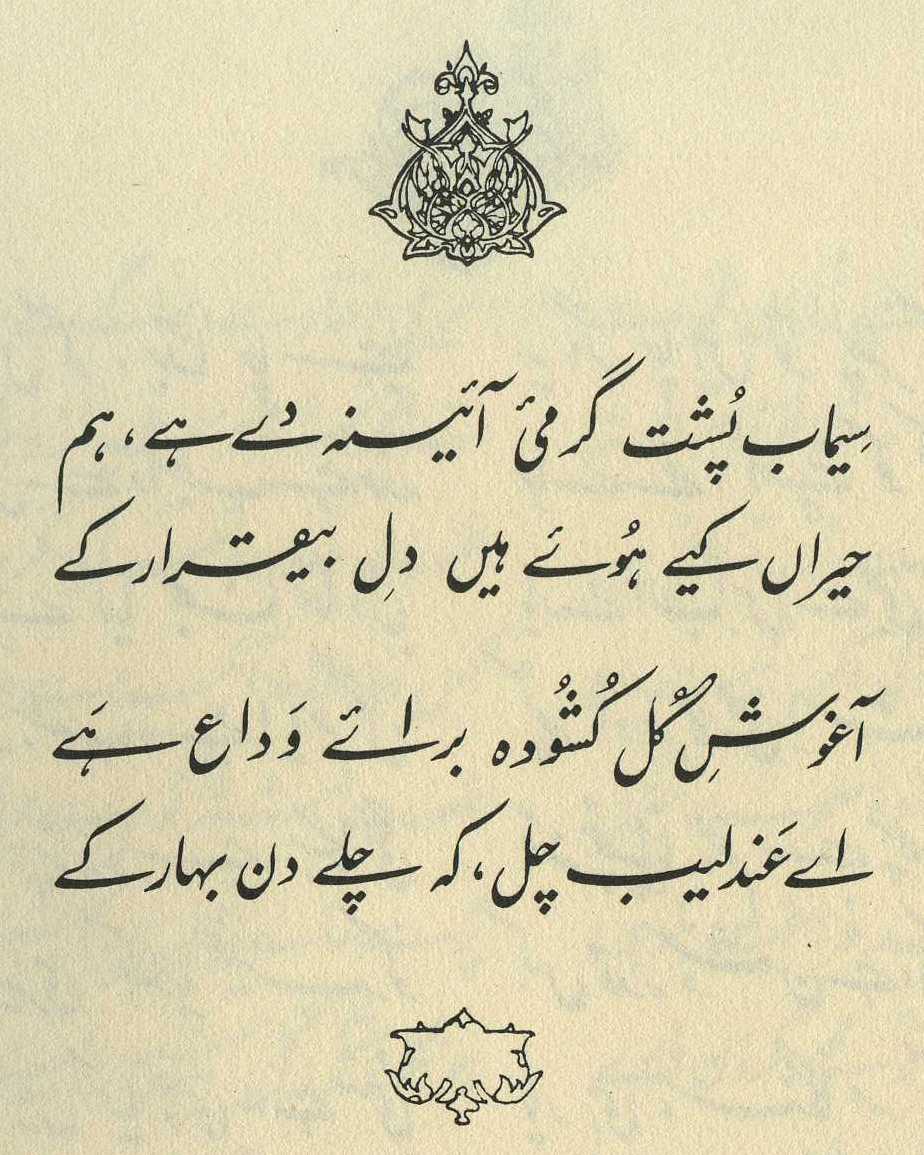
The flowers have opened an embrace so that they would fall on each other's necks and take their leave. (209)
== Nazm page 209

He says, the blooming of the flowers is the spreading of arms for an embrace. Oh Nightingale, come quickly and embrace them, the days of spring are about to leave, in the time from morning to night. The meaning is that the time of enjoyment and comfort in the world is extremely brief, the way spring no sooner comes than it takes its leave. (269)
In the blooming of flowers is a gesture that [says], 'oh Nightingale, come and embrace us, for spring is departing'. (367)
Compare 228,5 . (267, 280)
When the rose opens out from a tight little bud into a full, wide bloom, it's most often said to 'smile' or 'laugh' (see for example 80,1 ). But it can also be said to be opening its petal-arms for an embrace. Since Ghalib is Ghalib, he often makes this the paradoxical 'embrace of leave-taking'-- the embracing ones come closer and closer together, as a sign of preparation for going farther and farther apart. And of course, as the embrace ends the arms must once again be opened, to release the embraced one. On the rich possibilities of the 'embrace of leave-taking', see 57,6 .
Are the roses embracing each other, or the spring days, or the spring itself, or the garden, or (as Bekhud Mohani maintains) are they preparing to embrace the Nightingale? The beauty of it is that we don't know-- or care; there's a kind of mysterious depth in our not knowing, in the embrace being just there, opened, melancholy, elegiac. This is a verse of mood , rather than one of analytical subtlety. The rose's very opening-out, its acceptance, its reaching toward life, is also a sign of its imminent withering and death. And surely the rose itself realizes its fate, since the 'embrace of leave-taking' is above all for its own doom.
Is there a real connection between the two lines? Real enough, because it's emotional: since there's nothing at all that can be done to save the rose, or save the garden from the coming winter, the only thing to be done is to 'move on'-- just the way the days of spring have moved on.
In its melancholy moodiness the verse reminds me of 27,3 . But of course, as Arshi suggests, the perfect verse for comparison-- one almost a twin in many ways-- is 228,5 .
On the translation of as 'have moved on', see 38,1 .
graphics/rosefarewell.jpg