Verse 3after 1816uukii
G13
1
why do you fear the lovers' lack of spirit/guts/'stomach' ?
2
here-- well, no one {hears / listens to} anybody's complaint!
'Stomach....; desire, ambition; resolution; spirit, courage'.
'Exclamation; lamentation; cry for help, or redress; complaint; charge; suit'.
is an archaic form of ( GRAMMAR )
| References | |
|---|---|
| Arshi, Imtiyaz Ali | Ghazal# 193 |
| Raza, Kalidas Gupta | 303 |
| Nuskhah-e-Hamidiyah | 265-266 |
| Gyan Chand | 489-490 |
| Hamid Ali Khan | Open Image |
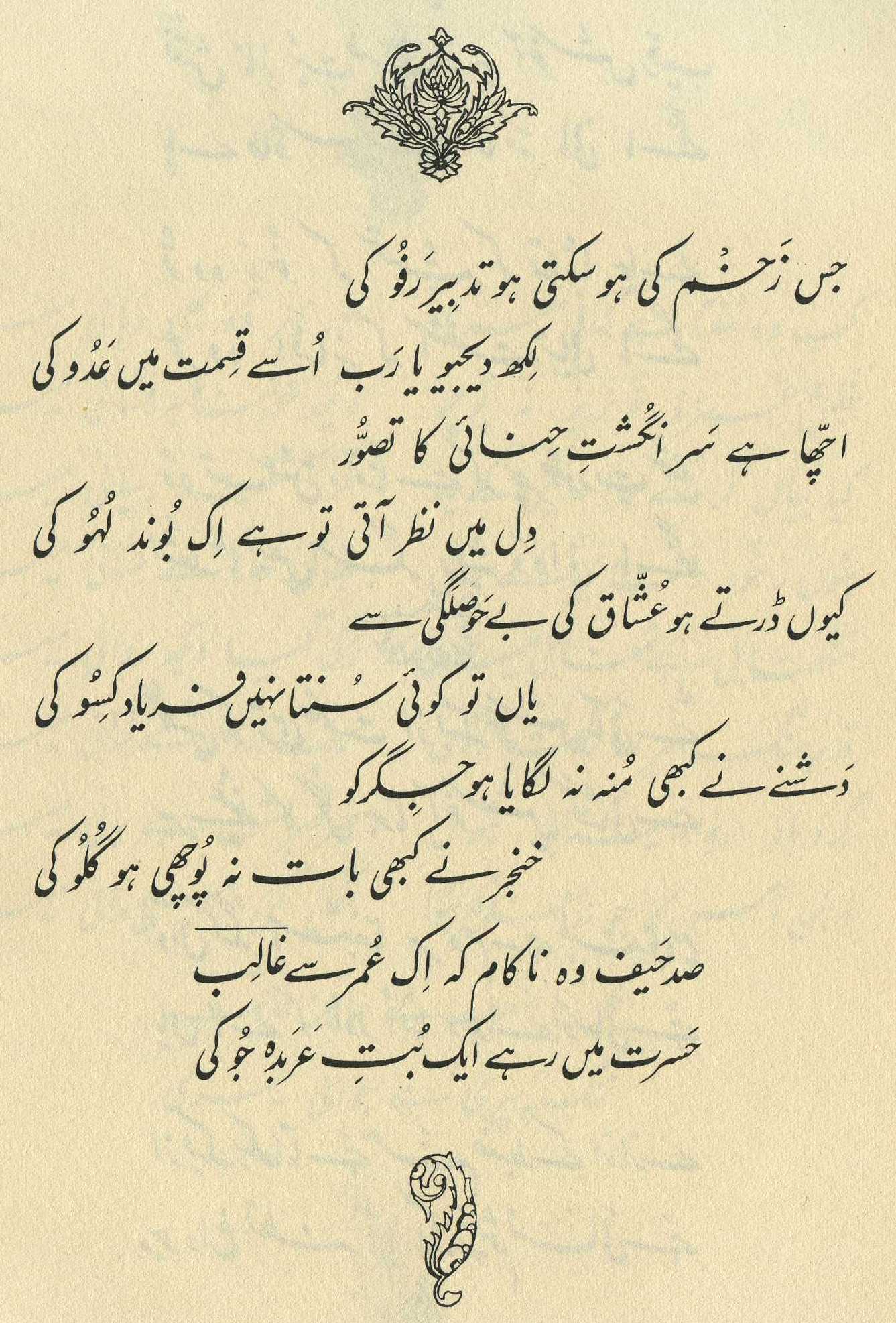
Here, the meaning of is 'shallowness' []. He says to the beloved, 'Why do you fear that we lovers will get fed up with your oppression and tyranny and complain against you to the Ruler or to the Lord? Because even if we do so, no one listens to anybody's complaint.'
==Urdu text: Yadgar-e Ghalib , p. 161
That is, even if through lack of spirit and lack of endurance they do complain against you, then who listens?.... [As for the archaic , examples are given to show that] even out of the necessity of rhyme , the use of these words is not correct. (208-09)
== Nazm page 208 ; Nazm page 209


I am astonished-- if the lovers, out of lack of courage, are not ready to endure your tyranny, then why do you halt your tyranny? Here, the state of things is such that nobody listens to anybody's lament-- so what is there to fear? (366)
Why would the beloved 'fear' her lovers' complaints in the first place? Perhaps she might fear God and the coming Judgment Day, when their complaints would be heard in the Divine Court (think of 111,7 ). Perhaps she might fear being accused of murder (think of 21,9 ), after she had tormented them to the point of death. Perhaps she might simply fear that if they collapsed and died on her, she'd have no more fun enjoying their convulsions (think of 8,3 ). Or perhaps if she tormented them to death she'd simply miss their crowding around her, their humility, their devotion (think of many of the verses of 57 ).
Whatever the reason, the speaker finds her fears absurd, or at least inappropriate. For 'here'-- in the beloved's domain, or in this world in general-- it's a flat rule: no complaints are heeded. The rule is so flat that it cuts two ways: she herself shouldn't heed, or 'fear', the lovers' moaning and groaning; and also she needn't 'fear' that anybody else will heed it either.
Or alternatively, 'here' in the lover's (or lovers') wretched neighborhood-- and this is the usual sense of 'here' when contrasted with 'there'-- nobody can even hear what anybody else is moaning and groaning about. Because they are all so weak that their complaints don't even make it past their lips (think of 177,7 )? Or because they're all so jealous that they begrudge each other any information at all about the beloved (think of 159,2 )? Or because they're all so self-absorbed that they pay no heed whatsoever to each other? In Urdu, has to do the work done by both 'to hear' and 'to listen to' in English, so the interpretive range is usually a bit wider.
Behind all these possibilities is surely the lover's indirect but insistent complaint to the beloved: she never listens to his words, she never pays any heed to him! The charm of the verse is that this rather humdrum, routine complaint has been cleverly turned into a flat 'rule'. Why is the rule stated so flatly? Surely for its very much greater (and more amusing) rhetorical effect. We all know that often a particular statement works better-- more ironically, more suggestively, more multi-dimensionally-- if it's phrased in the abstract ('It's not as if anybody does any work around here'; 'Nobody's asking anybody for any favors'; 'There's a law that all retired New Yorkers have to move to Florida'). Here such an operation has been performed by the amused or aggrieved lover-- and indeed, tone is everything in a verse like this. Is the lover speaking accusingly, or ruefully, or matter-of-factly? As so often, we're left to decide for ourselves.
graphics/complaints.jpg