Verse 5after 1816uukii
G13
1
the poniard would/might never have applied its face/mouth to the liver
2
the dagger would/might never have inquired about the idea/utterance of the throat
'A dagger, poniard'.
'A large knife, a dagger (generally curved and double-edged), a poniard'.
| References | |
|---|---|
| Arshi, Imtiyaz Ali | Ghazal# 193 |
| Raza, Kalidas Gupta | 303 |
| Nuskhah-e-Hamidiyah | 265-266 |
| Gyan Chand | 489-490 |
| Hamid Ali Khan | Open Image |
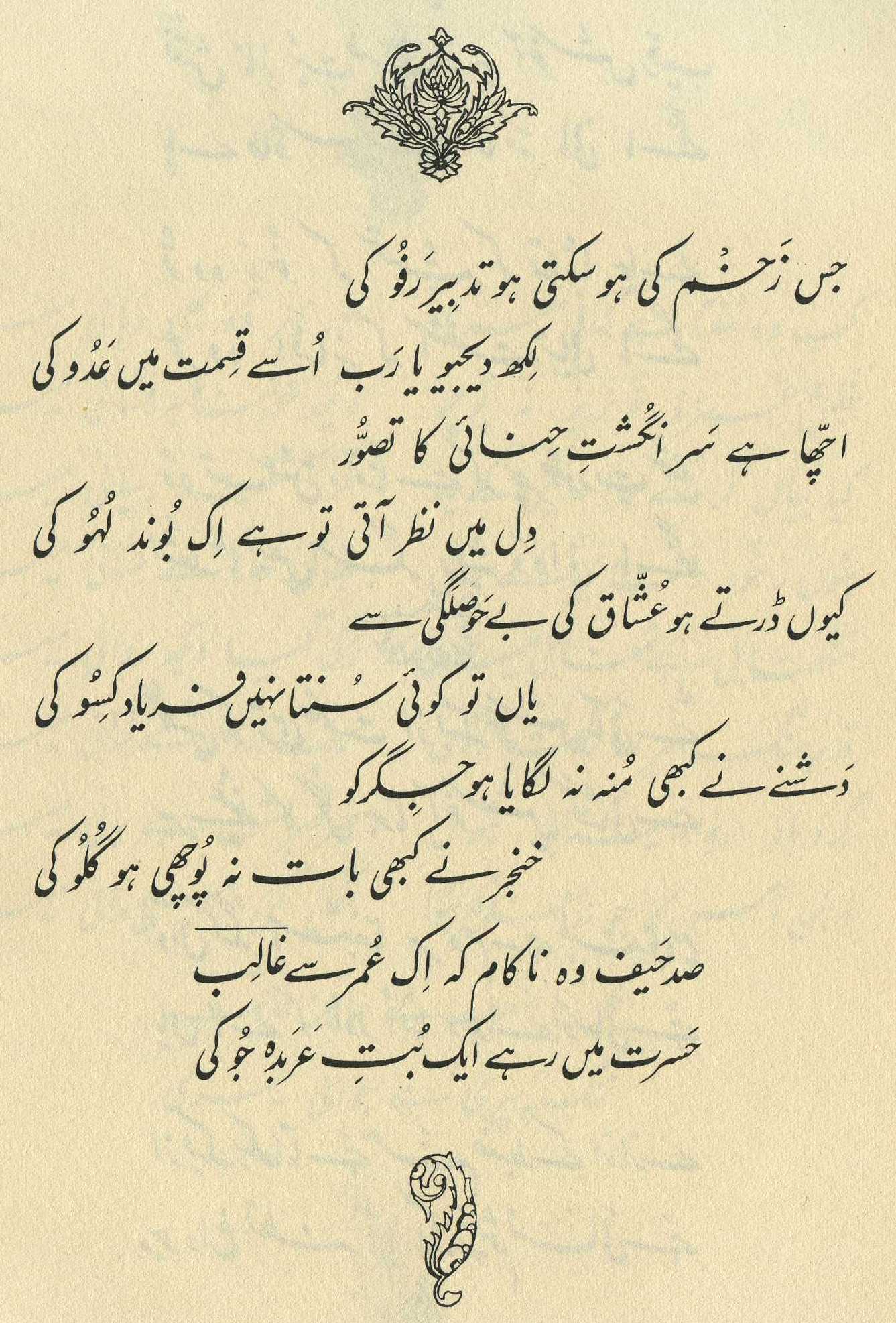
By dagger and poni ard are meant the airs and graces and conflict-seeking and cruelty of the beloved. (209)
== Nazm page 209

He says, 'The knife would never have come into contact with the liver-- that is, would not have shown affection to it. And the dagger too would never have inquired about the state of the throat-- that is, would not have given it attention. By poniard and dagger is meant the airs and graces and tyranny and injustice of the beloved. (268)
That unsuccessful lover to whose liver the cruel beloved's poniard would never show even its face, and about whose throat the dagger would never even inquire-- his [vain] longing is worth seeing! Asi and [Nazm] Tabataba'i have written this verse before the closing-verse; from this arrangement the interpretation of the verse becomes absolutely clear. (458)
This is the second and final verse of a two-verse verse-set ; moreover, some commentators reverse the order of this verse and the preceding one; see 186,4 for discussion of all such matters.
For more about and , and verses that refer to them, see 59,6 .
The commentators read this verse as a further description of the sad situation of the lover in 186,4 who would remain all his life vainly longing for a quarrelsome, dispute-seeking beloved. This is certainly very tempting, for otherwise it's hard to see how to read those parallel constructions. The future subjunctive is so ambiguous-- 'might not', 'would not'-- and the context impossible to provide, leaving us no tone of voice. This is what might be called an 'extreme verse-set verse'-- one that almost can't be read except as part of a verse-set. Very few verses in verse-sets are so radically dependent on context for their very intelligibility.
There's of course the nice wordplay of body parts ( ) and of conversation ( ). But this hardly suffices as a frame for the whole verse. Indeed, this wordplay too works much more cleverly if we interpret the verse in the light of {186,4), because then a wistful and vain longing for 'conversation' even with weapons (poniard, dagger) is explained by the lover's adoration of an aggressive, conflict-seeking beloved.
graphics/dagger.jpg
