Verse 4after 1816uukii
G13
1 a
a hundred pities!-- that unsuccessful/useless one who, for one [whole] lifetime, Ghalib
1 b
a hundred pities!-- [we are] so unsuccessful/useless that, for one [whole] lifetime, Ghalib
2 a
would remain in longing/grief for a single/particular/unique/excellent conflict-seeking idol
2 b
we remained in longing/grief for a single/particular/unique/excellent conflict-seeking idol
'Disappointed; unsuccessful; discontented;—useless; hopeless; remediless'.
'Grief, regret, intense grief or sorrow; —longing, desire'.
'Ill-nature, evil disposition; antipathy; dispute, conflict'.
| References | |
|---|---|
| Arshi, Imtiyaz Ali | Ghazal# 193 |
| Raza, Kalidas Gupta | 303 |
| Nuskhah-e-Hamidiyah | 265-266 |
| Gyan Chand | 489-490 |
| Hamid Ali Khan | Open Image |
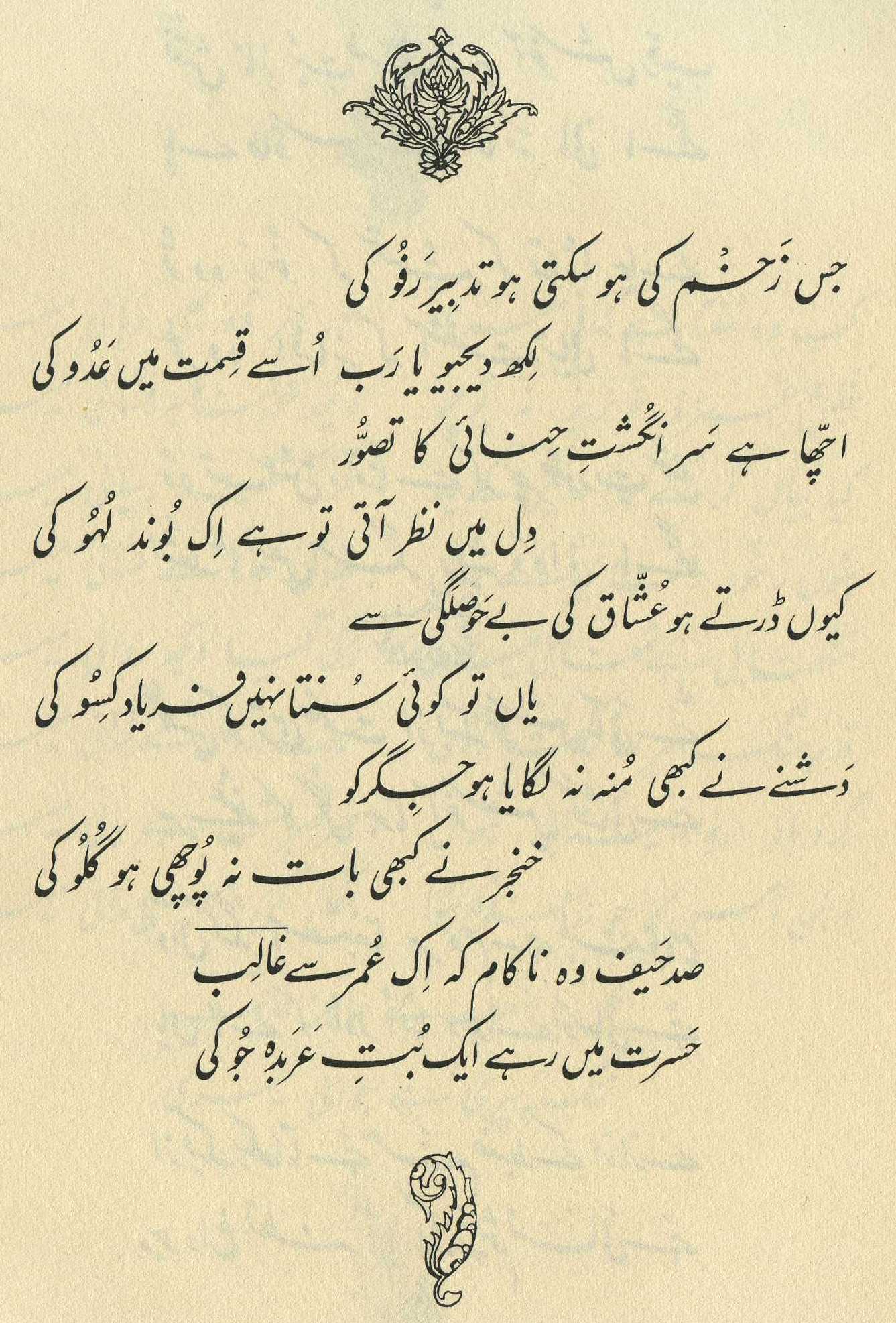
[No comment on this verse.]
== Nazm page 209

He says, 'Oh Ghalib, the state of that one whose longing is unsuccessful is worthy of pity-- he who for years would be passing his life in longing for a conflict-seeking idol'. (268)
The state of that unsuccessful one is worthy of pity, who would have yearned his whole life long for some cruel, angry-tempered, conflict-seeking beloved, and would never have been successful in obtaining the airs and graces of the beloved. (366)
He says, 'Oh Ghalib, I feel pity for that one unsuccessful in love, who for his whole life remained longing for a quarrelsome beloved, but his longing would have remained in his heart alone'.... Her conflict-seeking paid no attention to this one of unsuccessful longing. (311)
These last two verses of the ghazal constitute a verse-set ; Arshi correctly marks it as such in his first edition, but omits the mark (surely by accident) in his second edition. I am grateful to S. R. Faruqi for pointing out to me (March 2006) this omission.
Some commentators and editions of the divan (including Hamid) reverse the verse order, showing this verse as {186,5} and turning Arshi's {186,5} into {186,4}. One reason for this choice is no doubt that they feel awkward at seeing a closing-verse appear in penultimate position, as the next to last verse rather than the final one. However, such a positioning is rare but by no means unknown, and is not problematical. (There are other Ghalibian examples, and many more in Mir.) In any case, as always, I follow Arshi.
The commentators all agree on the reading (1a) + (2a), which indeed is very defensible and is, idiomatically speaking, the first one that springs to mind. But when we take even a second look (much less a third or fourth, as of course we ought to), it's easy to see another cleverly contrived interpretive possibility. For the verb in the second line, , is not only the third person singular subjunctive but also the plural perfect form for all three persons. There would then be a colloquially omitted subject for it, and the one that makes sense here would be 'we' (because of the self-address to 'Ghalib'), so that the reading would be (1b) + (2b).
In order to make it all work, the grammar of the first line would then be implicitly . After all, there are very similar usages elsewhere in the divan: in 23,1 ; and even more persuasively (since the verb is omitted), in 123,8 . So once we assume a colloquially-omitted , which is quite permissible, we're in business; and now we have two perfectly good readings instead of one.
Unusually, there's an in the first line and an in the second; the spelling difference of course is just to suit the meter. In the first line the feels ordinary-- it's the number 'one', and it measures the amount of time ('one lifetime') that the lover would spend, or has spent, in some kind of actifity. As so often, we have to wait for the second line to find out what this activity might have been.
Then in the second line we learn that the activity was the pursuit of quarrelsome idol, and all the possibilities open out-- a single one, a particular one, a unique one, an excellent one, etc. Are we meant to think that a 'single' such lifetime is obviously insufficient to win the loyalty of that particularly 'unique' beloved? Are the two appearances meant to invite a feeling of resemblance and similitude, or one of divergence and differentiation? Here once again the 'compare and contrast' imperative of sheer juxtaposition comes enjoyably into play.
graphics/weapons.jpg