Verse 41821iinah sahii
G5
In this meter the first long syllable may be replaced by a short; and the next-to-last long syllable may be replaced by two shorts.
1
the breath of Qais , that is the {light of the eye / 'eye-and-lamp'} of the desert/wilderness--
2 a
if it is not the candle of the 'black-chamber' of Laila , then so be it
2 b
if there is no candle in the 'black-chamber' of Laila , then so be it
'Dearly beloved; --a beloved object; light of the eye'.
'Of or relating to night, nocturnal; --one who does anything by night'.
| References | |
|---|---|
| Arshi, Imtiyaz Ali | Ghazal# 149 |
| Raza, Kalidas Gupta | 349 |
| Nuskhah-e-Hamidiyah | 216-217 |
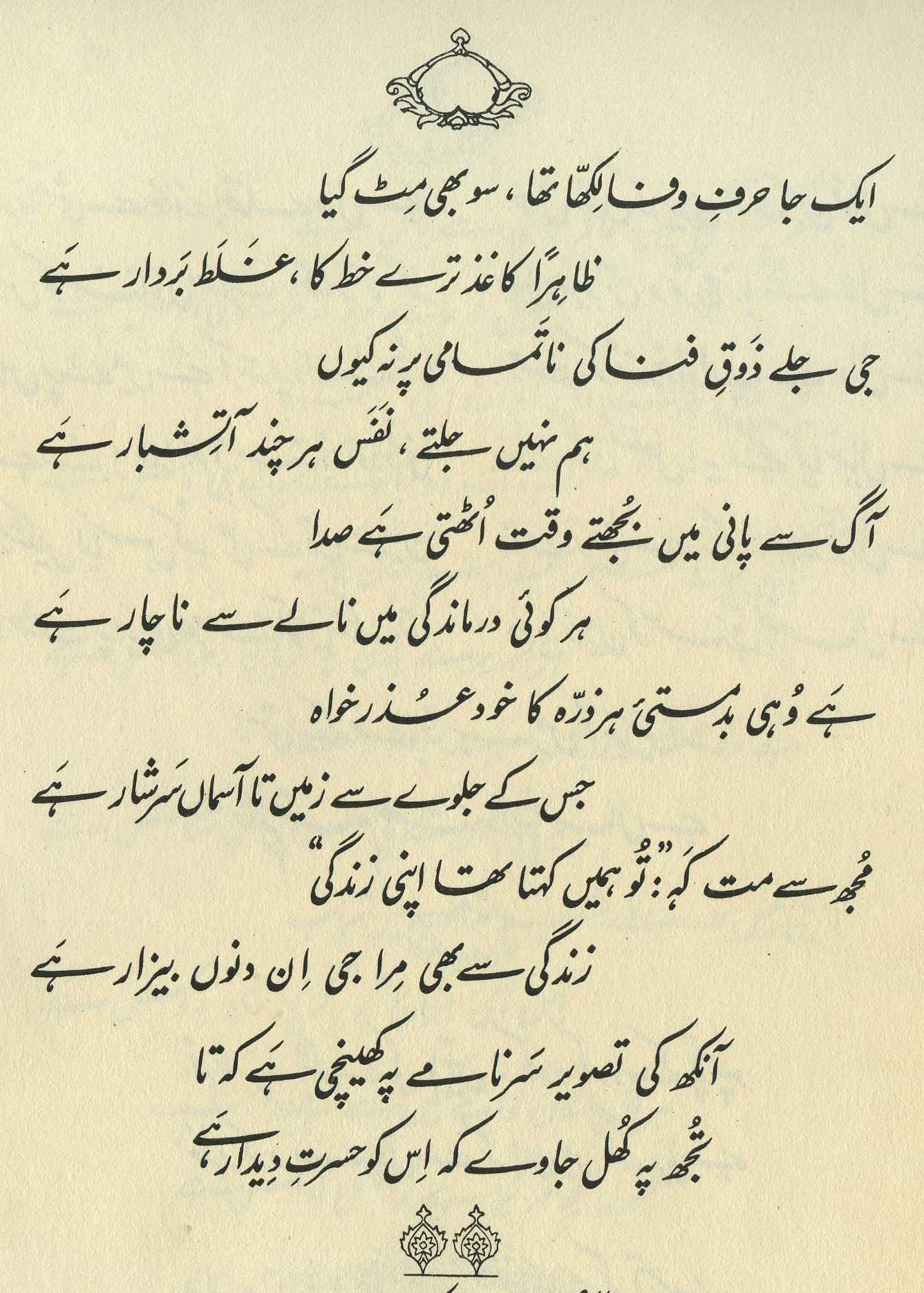
| Hamid Ali Khan | Open Image |
He has called Laila's house a 'black-chamber' by way of contempt-- that is, when Qais would not be shedding [light] in it, then how is it a house? In addition to this, her name too is Laila, and we also hear that she used to live in a black tent. (196)
== Nazm page 196

He says, for the desert/wilderness, the breath of Qais was the 'light of the eye'. If Qais was not successful in obtaining entry into the 'black chamber' of Laila, and was thrown out of there, then so be it. Laila's house has been called a 'black chamber' for three reasons. One is that Majnun did not obtain entry there; he has called it a black chamber out of contempt. The second point is that Laila's color/complexion is said to be black; with regard to this, her house too ought to be a black chamber. The third wordplay is that Laila always lived in a black tent. (254)
The of Qais is the sigh of Qais.... The gist is that to be a perfected lover is itself a grace/benefit. If the beloved doesn't value the lover, this does not weaken him. The weakness and ill-fortune are those of the beloved alone, in that she did not value such a lover. (345)
For discussion of , see 175,1 .
This verse continues the idiomatic wordplay of the ghazal: literally means 'eye and lamp'-- a perfect bit of interplay between colloquial and literal that luckily we can almost capture in English with 'light of the eye'. The commentators point out the literal meaning of (see the definition above), and some of the 'dark' imagery associated with her, so that the elaborate light/dark wordplay (and meaning-play) is a real pleasure in itself.
But there are much more complex things going on here as well. As so often, we have to decide for ourselves how the two lines are related. Both lines are enticingly (and undecideably) full of nouns that invite comparisons. But whose point of view is the verse adopting, and what sort of triangular relationships (Qais, desert/wilderness, Laila) is it creating? Is the 'light of the eye' being likened to the 'candle', or contrasted with it? Here are some (though not all) of the possibilities:
=The (fiery) breath of Qais is the 'light of the eye' of the desert/wilderness, but it is not the candle of Laila's black-chamber (2a), and that indeed has to be accepted. (And then, why is this so? Because she doesn't love him enough? Because she's held prisoner by her in-laws and thus can't constantly lose herself in visions of him? Because he'll never be allowed to visit her?)
=The (fiery) breath of Qais literally lights up the whole desert/wilderness-- that's why Laila doesn't mind if there's no candle in her black-chamber (2b).
=The (fiery) breath of Qais literally lights up the whole desert/wilderness-- that's why he doesn't mind if there's no candle in Laila's black-chamber, since he already has all the light he needs to imagine her, or to catch a glimpse of her, or even to approach her black-chamber.
=The (fiery) breath of Qais is the 'light of the eye' of the desert/wilderness, so he shouldn't mind if it's not the 'light of the eye'-- or 'candle'-- in Laila's black-chamber. (The desert/wilderness loves him more passionately than Laila does, so he should console himself with that. On the desert's jealous love, see 3,1 .)
Above all, the many possible multivalent readings are created by the fact that we don't know whose perspective is being adopted, and what feeling-tone should be used for the verse. The idiomatic is the ambiguous icing on the layer cake. Somebody is shrugging his/her shoulders resignedly-- or defiantly? or cheerfully? or indifferently?-- about something, but who is doing this, and about what? As so often, we're left to decide for ourselves.
graphics/candle.jpg