Verse 71821iinah sahii
G5
In this meter the first long syllable may be replaced by a short; and the next-to-last long syllable may be replaced by two shorts.
1
consider only/emphatically the joy/sociability of the companionship of beautiful ones to be a 'piece of luck'
2
if, Ghalib, no natural lifespan occurred, then so be it
'Social or familiar intercourse, pleasant and familiar conversation, society; pleasure, enjoyment, mirth'.
'Companionship, society, company; an assembly, meeting, association; a fair; discourse, conversation, intercourse; carnal intercourse, coition, cohabitation'.
'Plunder, spoil, booty; a prize; a boon, blessing, a God-send; a piece of good luck, good fortune; abundance; convenience; accommodation'.
tabii((ii>> : 'Of or relating to the natural or innate disposition or temper, &c.; natural, of nature, innate; physical; intrinsic'.
| References | |
|---|---|
| Arshi, Imtiyaz Ali | Ghazal# 149 |
| Raza, Kalidas Gupta | 349 |
| Nuskhah-e-Hamidiyah | 216-217 |
| Hamid Ali Khan | Open Image |
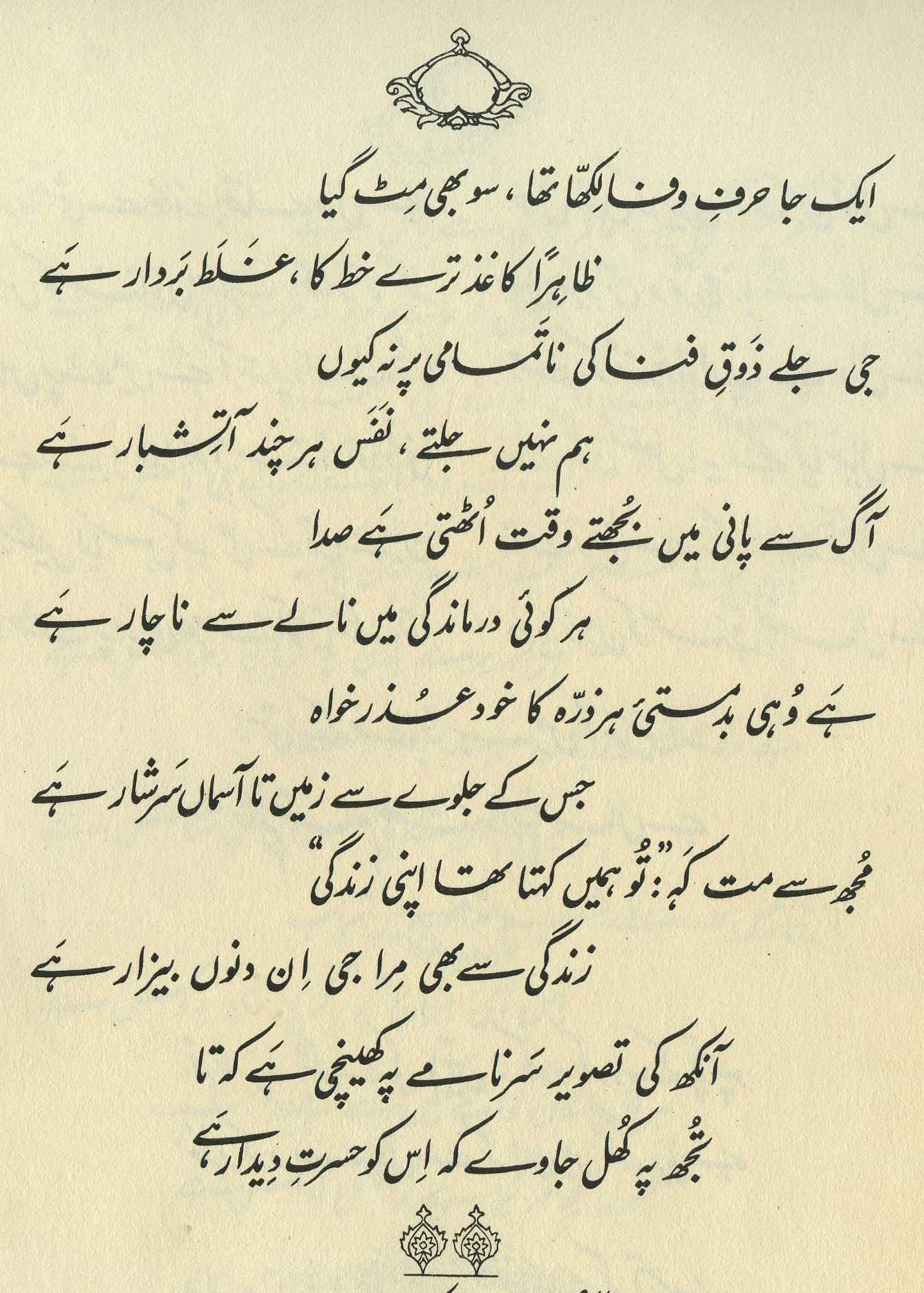
Although and mean the same thing, the Persian divan has used with the meaning of 'happiness' or 'joy'; for that reason, this will become correct. (197)
== Nazm page 197

He says, 'The happiness that is obtained in the companionship of beautiful ones, that is not stable for even a moment/breath-- oh Ghalib, consider it a 'stroke of luck'. If it has no enduringness, then so be it.' (255)
Oh Ghalib, granted that a natural lifespan is much desired. But when it can't be obtained, then the enjoyment of the companionship of beautiful ones is itself a 'stroke of luck'. That is, their companionship will be in exchange for a natural lifespan. (345-46)
For discussion of , see 175,1 .
If we take the cleverly placed little to be restrictive ('consider only...'), then the implication is that we should value only the joy/sociability of the companionship of beautiful ones, and should regard a natural lifespan as worthless by comparison, so that we don't care a bit of we don't have it. And if we take the to be an intensifier ('consider especially...'), then we are urged to console ourselves with the joy/sociability for the loss of a natural lifespan, even if its loss causes us real sorrow.
Either sense of works beautifully with the multifarious possibilities of (see the definition above). Literally, it is 'something taken from an enemy' [], and its classic reference was plunder acquired on the battlefield. That meaning itself works well: since fate is against us, let's seize and value whatever we can get. The meanings like 'blessing' and 'God-send' and 'good fortune' are equally appropriate: we should gratefully appreciate the joy/sociability vouchsafed to us. For more on , see 90,4 .
Then, of course, a basic question remains: how do we connect the two lines? Is A the cause and B the effect (the companionship of beautiful ones cuts short one's life)? Is B the cause and A the effect (if one is doomed anyway, one should value the brief pleasures of beauty and sociability)? Or are both A and B parallel parts of the same larger reflection on the nature of life?
Nazm is being rather nit-picking about . In Urdu generally, it seems to mean joy first, and sociability as a distant second. Compare the usage in 17,5 , where the primary meaning is definitely 'joy'.
graphics/romance.jpg