Verse 31821iinah sahii
G5
In this meter the first long syllable may be replaced by a short; and the next-to-last long syllable may be replaced by two shorts.
1
the wine-worshipers {only with / with only} the wine-cask pressed to the mouth, 'became' [settled, successful]
2
if one day the Cupbearer did not appear in the gathering, then so be it
'A large vessel or jar; an alembic, a still'.
'To be made, constructed, built; to be created, formed, fashioned, produced, fabricated, invented; to be prepared, got ready, be done, finished or completed; to be cooked or dressed; to be managed, executed, effected; to be composed; to be mended, repaired, or adjusted: to be improved, be made presentable, palatable, &c.; to be established, be set up; ... to be adorned, decorated, embellished; to fit, fit in, come out, come right; to chime, agree, fall in (with), do, answer, serve; to succeed, do well, prosper'.
| References | |
|---|---|
| Arshi, Imtiyaz Ali | Ghazal# 149 |
| Raza, Kalidas Gupta | 349 |
| Nuskhah-e-Hamidiyah | 216-217 |
| Hamid Ali Khan | Open Image |
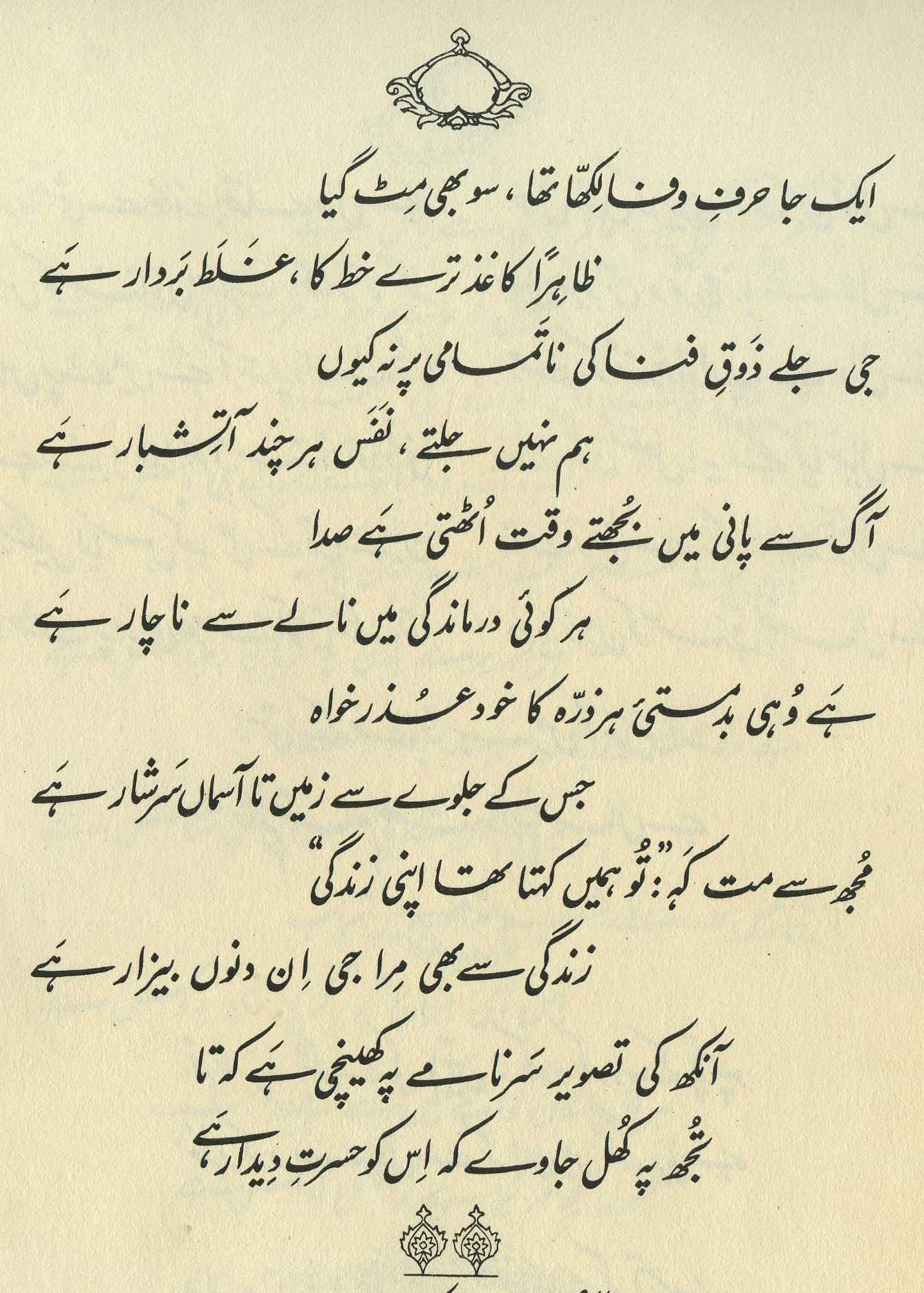
The meaning of is that there is more pleasure in exactly that, and that to drink to one's heart's content must be achieved in that way. If the Cupbearer were there, then he would have served it one swallow at a time. (196)
== Nazm page 196

He says, oh wine-worshipers, even after waiting for the Cupbearer, it was still necessary to drink wine with one's lips pressed against the cask; if one day the Cupbearer would not be present in the gathering, then so be it. That is, if there were a Cupbearer, then he would fill flagons and decanters from the cask, and from the flagons and decanters he would pour wine into glasses and present it. If in his absence drank with our lips pressed against the cask, then what was wrong with that? (254)
The rakish ones [] are waiting for the Cupbearer. How could Mirza bear to wait? He rose, and pressed the cask of wine to his lips. And he says to the other wine-lovers, 'Come on, you drink too, it's the most enjoyable way. If one day the Cupbearer isn't here, would we not drink wine? Look-- for once, we drank to our heart's content. If one day the Cupbearer isn't here, then so be it. Drink wine. As if the drinkers would wait for the Cupbearer!' (344)
For discussion of , see 175,1 .
Continuing the trend of the ghazal, this third verse too is extremely idiomatic. The phrase (with the colloquially omitted) literally means 'only [in a state of] having placed, became'. Only 'having placed' the cask of wine against their mouth, did the drinkers finally -- 'become', meaning to be completed or perfected, be content, be in good order, etc. ; see the definition above for even more of the complexities of this multivalent little verb; and see 191,8 for discussion.
But the idiomaticness doesn't end there, for this verse is also a clever textbook case of the doubleness of . I've tried to show the two possibilities in the translation. It can be restrictive ('only with'), meaning that the drinkers are very demanding and will be content only if they are able to place their lips directly against the cask itself; they will not be satisfied with lesser substitutes like glasses and flagons. Or it can be intensive ('with only'), meaning that the drinkers are not demanding but are modest in their desires: they don't require the presence and services of a Cupbearer and the formal elegance of glasses and flagons, but can be content with only access to the wine-cask itself.
Needless to say, both senses of work elegantly (though of course differently) with the acceptance of the Cupbearer 's absence expressed in the second line.
The vision of the drinkers with their mouths pressed to the cask, oblivious to all else, also has enjoyably (and amusingly) erotic overtones: think of 116,1 , in which the lover mischievously demands that a kiss be explained 'with the mouth' []. For other amusing wine-cask examples, see 133,2 .
graphics/winecask.jpg