Verse 51816aakahe;N jise
G3
1
it is hidden, through/like the longing for sight/vision, in a wet eye--
2
the unbridled/'broken-reined' ardor that they would call a sea/river
'The sea; the waters; a large river (the com. signification in India)'.
| References | |
|---|---|
| Arshi, Imtiyaz Ali | Ghazal# 178 |
| Raza, Kalidas Gupta | 261-62 |
| Nuskhah-e-Hamidiyah | 274-275 |
| Asi, Abdul Bari | 270-271 |
| Gyan Chand | 394-395,553 |
| Hamid Ali Khan | Open Image |
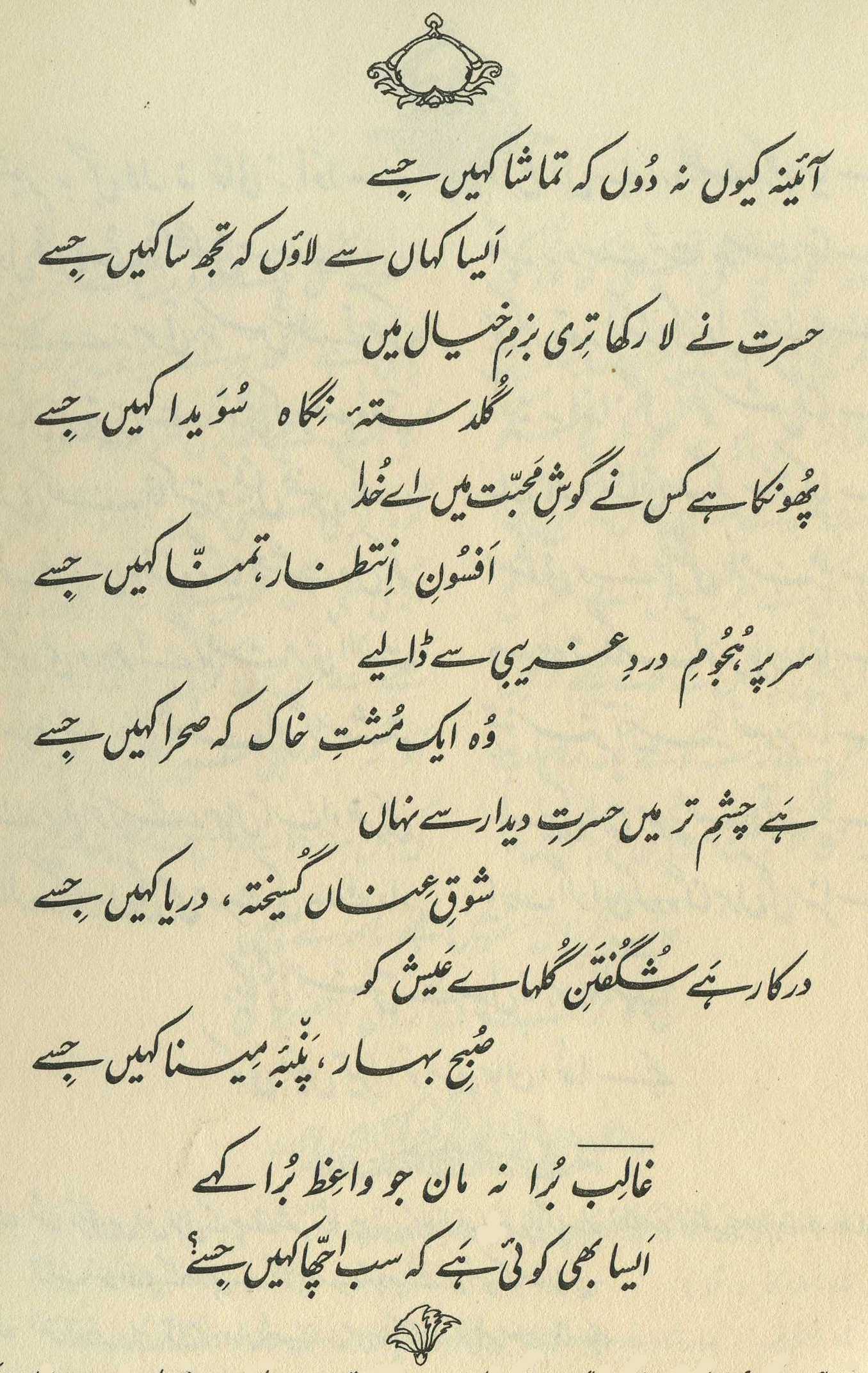
In this verse is not a word-- he has added a diamond. When there would be such power over the words of another language [like Persian], then sometimes to bring them into one's own language adds beauty. And by is figuratively meant a turmoil of tears, because ardor is a cause of weeping; he has, figuratively, given the cause in place of the result. (258)
== Nazm page 258

He says, in my wet eye, because of the longing for vision, is hidden such a full turmoil of tears that they can without exaggeration call it a sea/river. (315)
Do we take to refer to the sea, or to a river? Either is quite possible (see the definition above). Nazm and Bekhud Dihlavi choose the former reading: the eye is round and full of liquid like the sea, especially when it's wet with tumultuous tears of passion. Bekhud Mohani chooses the latter reading: he sees a flow of tears falling steadily and swiftly from the eye, like a river.
If we turn to the second line for more interpretive help, we at once run into the fancy Persianism , literally 'rein-broken'. It's more evocative than the English 'unbridled', because it suggests also something like a horse that has 'taken the bit between its teeth'-- or, in this case, broken its reins or bridle-- and dashed away at full gallop. As Nazm makes clear, this newly-imported construction is a ' fresh word '-- in fact he admires it as 'a diamond'.
But how do we make the necessary connection between this image and that of the hiding in a wet eye? The most specific analogy would be between the 'reins', imagined as a long thin cord streaming out wildly as the runaway horse tosses his head, and a swiftly-flowing 'river' of tears. That seems a bit far-fetched to me, and nothing else in the verse encourages us to make that connection. In fact the idea of 'hiddenness' in the eye actively discourages us.
But if we don't make that connection, what's left? Apparently just the general idea that the runaway, 'rein-broken' ardor is turbulent, and so is the sea. But as an evocation of mere 'turbulence', a fancy, specific description like 'rein-broken' remains isolated from the rest of the verse. In its great length and elaborate foreignness it calls excessive attention to itself, it demands to be the interpretive key to the verse. But apparently it's not, at least in terms of imagery. (For in fact if the flood of tears is so wildly out of control, how does it remain discreetly 'hidden'?) Presumably what Nazm admires about it is its sheer newness-- along with its rhythm, its sound, the elegant way it gives shape to the second line.
To see the weakness of the present verse, compare the marvelous 27,1 , where the connection is between ardor being confined in the small space of the heart, and the confinement of 'the sea in a pearl' (and in that verse we can clearly tell that is a sea rather than a river). Compare also 27,7 , in which it is the 'glance/gaze' that's juxtaposed, also at least somewhat plausibly, to the tidal 'inflow and outflow' of the sea.
Note for grammar fans: In the first line could be read either as the normal postposition ('from, with, by means of'), or else as a short form of ('in the manner of'). It definitely makes a difference which we choose, but since I have trouble connecting with this verse in any case, I can't really get excited about slicing and dicing the various possibilities.
graphics/tearriver.jpg