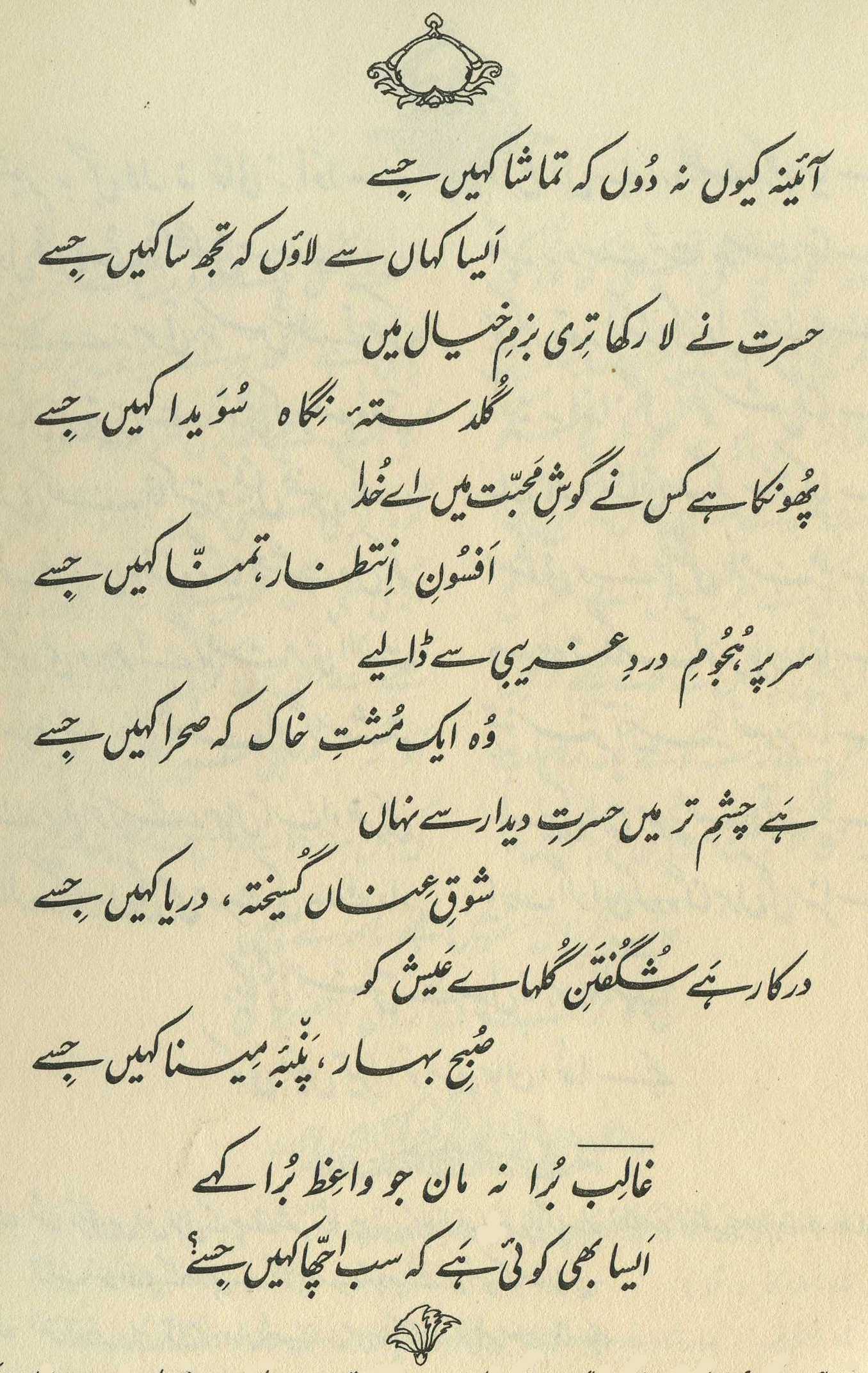
Verse 41816aakahe;N jise
G3
1
on the head, because of an onrush of sorrows of strangeness/wretchedness, throw/fling
2
that single/particular/unique/excellent handful of dust, such that they would call it a desert
'Assault, attack; effort; impetuosity; --crowd, throng, concourse, mob; a swarm'.
'Foreignness, strangeness; --poverty, indigence, wretchedness; meekness, mildness, lowliness, humility'.
'(- ), To throw dust (on); to bury, to conceal (an affair, or anything disgraceful); --to heap curses (on), to execrate'.
'To throw dust, to raise a dust; to wander, roam; --to make a stir or commotion; to defame'.
| References | |
|---|---|
| Arshi, Imtiyaz Ali | Ghazal# 178 |
| Raza, Kalidas Gupta | 261-62 |
| Nuskhah-e-Hamidiyah | 274-275 |
| Asi, Abdul Bari | 270-271 |
| Gyan Chand | 394-395,553 |
| Hamid Ali Khan | Open Image |
is in the sense of 'countrylessness' [], and this suggests that this person is intending to be a wanderer in the desert and wilderness, and the pain of countrylessness is upon him, and after wandering about [] he realizes extremely clearly that he considers the desert to be a single handful of dust. (258)
== Nazm page 258

He says, the troubles of countrylessness have made me such a madman that my inner self wants to put dust on my head the way madmen do. But that dust would not be more than a single handful-- but it would be such that people would call it a desert. That is, that people would consider that 'He's picked up the dust of the whole wilderness and put it on his head!'. (315)
He wishes to put the kind of handful of dust on his head that people call a 'desert'. These words tell us that however many difficulties of exile from one's homeland there may be, every one of them has fallen on this wander in foreign parts. Up till now, there was still some strength of self-control. Patience and fortitude and steadfastness kept him company. But now the strength of endurance has taken its leave. Now his inner self wants to wander about []-- and in such a way that it would 'throw up the dust' in the whole desert. (471-72)
[See his commentary on Mir's M 203,5 .]
To 'put/throw dust on one's head' [] is a customary expression of grief and mourning. In addition, to 'throw dust on' something also has two wonderfully apposite idiomatic meanings (see the definition above): 'to bury or conceal (something disgraceful)'; and 'to heap curses on, to execrate'. The wretched, isolated speaker might well wish to 'bury' his own disgrace and troubles in the dust, and/or to 'curse' his ill fortune.
The commentators also suggest that the verse evokes the idiomatic expression 'to fling up dust' [], which means, most appropriately, 'to wander, roam' or 'to make a stir or commotion' (see the definition above).
The addressee (who may well be the speaker, counselling himself) is assaulted by a whole onrush of sorrows; in the second line we learn that his reaction should be 'one' handful of dust-- but what a handful! It may well be a particular, unique, even excellent one.
For the second line is devastating. What is to be thrown onto the head is one very specific 'handful' of dust. It is that particular one [] that's such that they-- the unspecified 'they', meaning 'people in general'-- would call it a 'desert'. Meaning what exactly? As usual, we're allowed, and also required, to decide for ourselves. Here are some possibilities:
=The handful of dust would be vast, potent, and dusty enough to fool 'them' into thinking it's a desert, even though it's not.
=The handful of dust would be vast, potent, and dusty enough to actually become a desert, so that 'they' would be right to give it that name.
=That special handful of dust would be big enough to bury and finish off the lover, so that the place where he had been would now look like an uninterrupted stretch of desert.
=What the lover would pick up and throw would be what 'they' would call a desert; but to him it's so unimpressive that he considers it no more than a handful of dust.
My own favorite of the above readings is the final one. It reminds me of the puniness and vulnerability of the desert in 5,4 .
For another 'dust on the head' verse, see 172,5x .
graphics/sandstorm.jpg