Verse 71816aakahe;N jise
G3
1
Ghalib, don't take it badly, if the Preacher would speak badly about you
2 a
is there anyone, after all, such that all would call him good?
2 b
there's someone, after all, such that all would call him good!
'To speak ill (of), to pronounce or call (one) bad, evil, wicked, &c.; to vilify, abuse'.
'To say yes; to pronounce or call good; to speak well of)'.
| References | |
|---|---|
| Arshi, Imtiyaz Ali | Ghazal# 178 |
| Raza, Kalidas Gupta | 261-62 |
| Nuskhah-e-Hamidiyah | 274-275 |
| Asi, Abdul Bari | 270-271 |
| Gyan Chand | 394-395,553 |
| Hamid Ali Khan | Open Image |
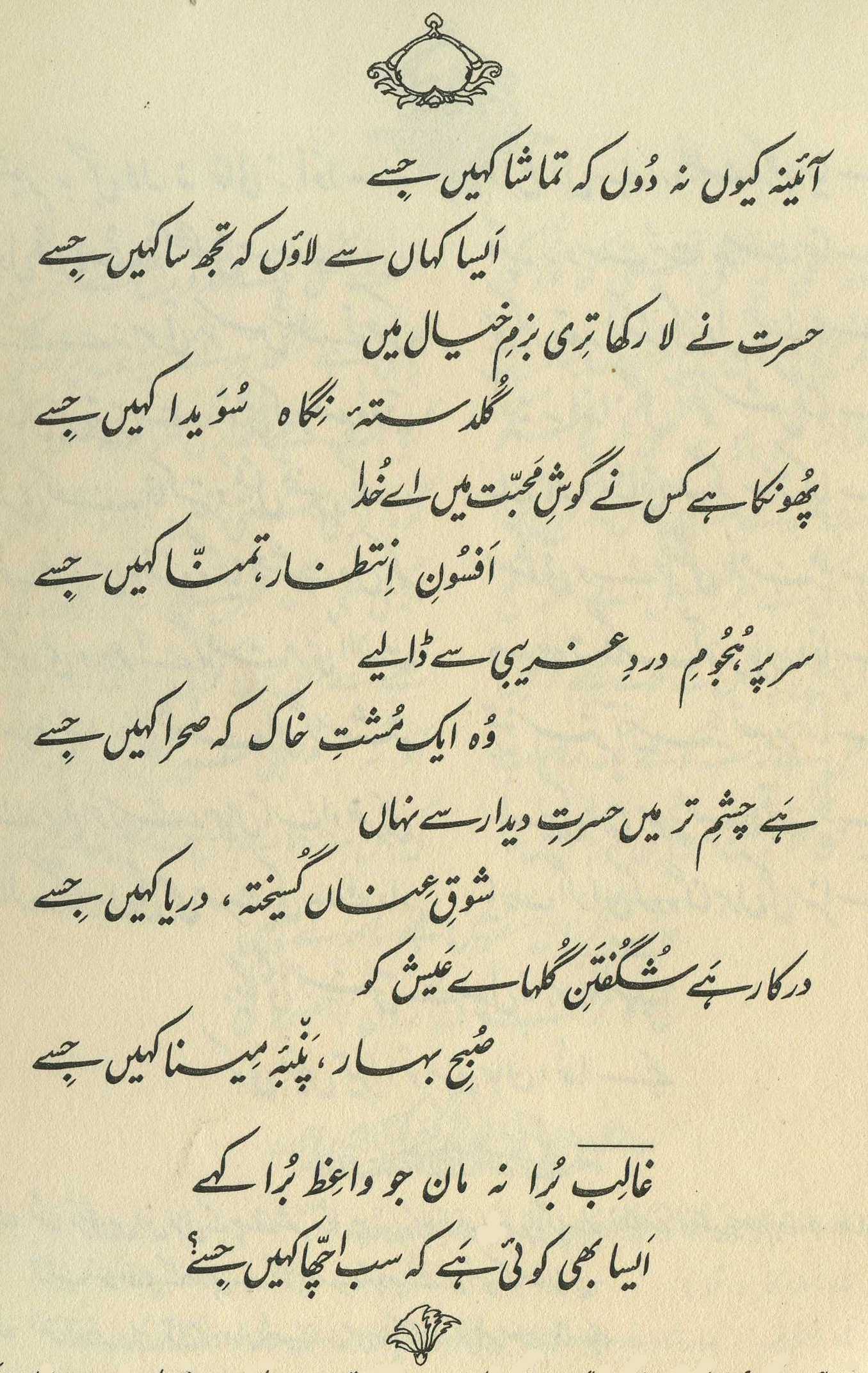
[1866, to Siyah:] Don't take it badly. Because if I am bad, then he told the truth. And if I am good, and he said bad things about me, then place him in the custody of the Lord:
[Ghalib, don't take it badly, if enemies would speak badly about you
is there anyone, after all, such that all would call him good?]
==Urdu text: Khaliq Anjum vol. 2, p. 568
==another trans: Daud Rahbar , pp. 244-455
If a single Preacher vilifies you, what of it? All the rakish ones [], after all, call you good. (259)
== Nazm page 259

He says, 'Oh Ghalib, if the Preacher considers you a rakish one and vilifies you, then why do you take it amiss? There won't be any man in the world whom the whole age will call good.' The custom of the age is that if ten men call someone good, then one man also calls him bad. (315)
Ghalib, if the Preacher vilifies you, then why do you take it amiss? There's no one such that everyone calls him good. That is, except for the Preacher everyone else calls you good. (473)
Another point is that since in the world there's no one such that everyone would call him good, not everybody calls the Preacher good either. Some people vilify the Preacher. From this it also follows that the man whom not everybody calls good-- if he would vilify someone else, then how reliable are his words?
== (1989: 362) 2006: 390
Faruqi makes an enjoyable point about the implications of the second line: if there's nobody whom everybody calls good, then it follows that the Preacher isn't such a person either-- so how bothered should one be about his opinion?
The commentators, including Faruqi, read the second line as if there were a in front of it, to mark it as a yes-or-no question-- a rhetorical question, of course, in this case (2a). That's a perfectly satisfactory thing to do. But why should we entirely ignore the straightforward grammar of the line, which is that of a flat factual statement (2b)? Why should we settle for only one meaning, when the verse clearly offers us two?
And the second meaning is piquant in its own way. It looks to be religious, but not explicitly so. Doesn't it seem to suggest that the speaker is comforting himself with thoughts of the Prophet or the members of his family, such as Hazrat Ali? The contrast with the Preacher in the first line is thus made, on this reading, highly meaningful: the Preacher may condemn Ghalib, but there's someone else, someone far higher and better, who is his refuge and who will not join in the vilification. On this reading, we're back to the battle between the 'external' religion of (hypocritical) appearance, and the 'internal' religion of mystical intoxication, that is so deeply part of the terrain of the ghazal. This possible second meaning is certainly a subordinate one; it's not rhetorically foregrounded the way the primary meaning is. But still, it seems worth mentioning, as a small extra pleasure of the verse.
graphics/durer.jpg