Verse 11816aakahe;N jise
G3
1
why would I not give/offer a mirror, so/such that they would call it a spectacle?
2
from where would I bring such a one, [such] that they would call that one 'like you'?
| References | |
|---|---|
| Arshi, Imtiyaz Ali | Ghazal# 178 |
| Raza, Kalidas Gupta | 261-62 |
| Nuskhah-e-Hamidiyah | 274-275 |
| Asi, Abdul Bari | 270-271 |
| Gyan Chand | 394-395,553 |
| Hamid Ali Khan | Open Image |
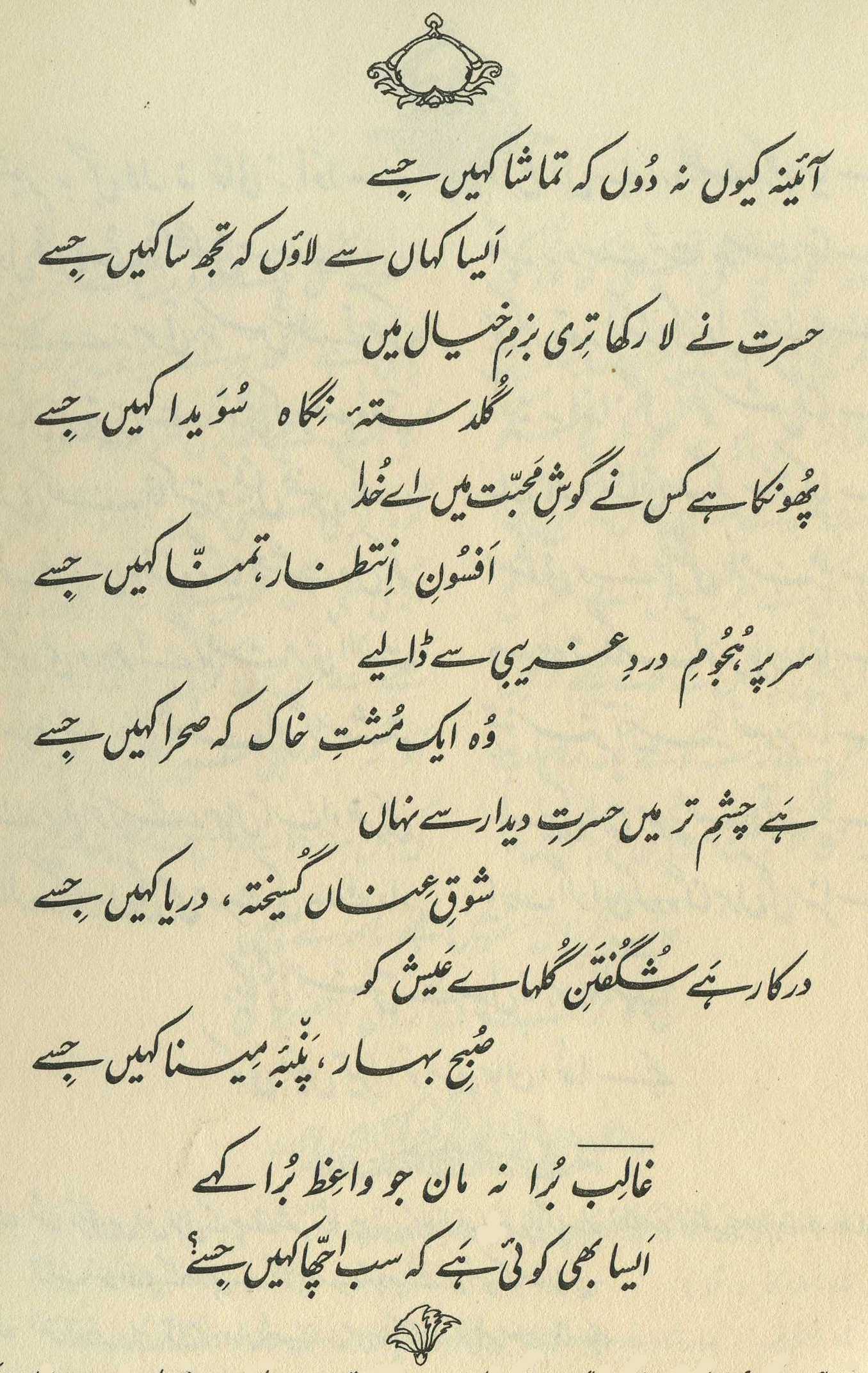
For comparison with you, where would one as beautiful as you be available? Perhaps/but [] I will give you a mirror, so that having looked at it, your amazement would become a spectacle for people. (258)
== Nazm page 258

He says, 'Why wouldn't I present a mirror face to face with you, so that having looked at it, you would become amazed, and your amazement would become a spectacle for the people? From where would I produce another such beautiful one, such that people, seeing her, would call her like you?' (314)
What is to be said is that there's no equal to you in the world. In order to say this, the poet has created a new style of expression.... On this occasion, what a pleasurable mischievousness he has created! (470-71)
Here's a classic 'A,B' verse, in which we have to decide for ourselves what relationship exists between the two basically parallel-looking lines. The first line, thanks to the versatility of that little , has two possible readings:
=Why would I not give a mirror, so that they would call the mirror, or the giving of it, a 'spectacle' (with the clause taken as stating a desired effect)?
=Why would I not give a particular kind of mirror-- the kind of mirror that they would call a 'spectacle' (with the clause taken as describing the kind of mirror)?
In order to resolve the possible readings of the first line, we turn to the second line-- and as so often, it starts afresh in terms of grammar and vocabulary. For once, the second line is a little more straightforward than the first; but it's still not exactly clear what connection exists between the two. Both lines are questions, and thus the verse is as as it can possibly be.
Above all we must decide, to what does the 'such a one' [] refer? If we interpret it in the light of the first line, it might very well be the mirror-- which, depending on our reading, is either a mirror in general, or a particular kind of mirror. Or, in the light of the second line, 'such a one' could be any (grammatically masculine) entity that some 'they' (unspecified) would declare to be 'like you'.
If both lines are taken as describing the same basic situation, then the reason the speaker wouldn't give a mirror is that he can't find one: the 'mirror' would then be a 'mirror-image' of the beloved, such that people would consider it a great 'spectacle' to see the two of 'you' face to face-- except that such a spectacle is impossible to arrange. On this reading, the speaker doesn't have the 'mirror-image' of the beloved.
If the two lines are taken as describing different situations, then the first line might be a counsel of despair-- the speaker might as well go ahead and give them a mirror, and let them have their frivolous enjoyment of such trivial kinds of 'spectacle' as it can offer. For after all, the realest kind of beauty-- a peer of the beloved-- is quite impossible to provide. On this reading, he does have a mirror, but he doesn't have an equal of the beloved.
Who are the 'they' who do the spectacle-viewing and the judging of likeness? Since no antecedents are at hand, presumably they're people in general. In this verse, the masculine plural verbs cannot refer either to the speaker (who identifies himself as 'I') or to the beloved (who is addressed as an intimate ).
graphics/mirror.jpg
graphics/mirror2.jpg