Verse 31855aa))ii
G8
In this meter the first long syllable may be replaced by a short; and the next-to-last long syllable may be replaced by two shorts.
1
for the ground has become, entirely/'head-to-head'
2
a rival/peer/'face-puller' of the expanse of the azure-enamelled sphere
t;h>> : 'Expanse; platform, terrace, flat roof (of a house); surface'.
'Of enamel, enamelled'.
'Heaven, paradise; the sky, the azure vault; --a blue colour; --a false gem of a blue colour; a glass globule or bead;... enamel'.
| References | |
|---|---|
| Arshi, Imtiyaz Ali | Ghazal# 232 |
| Raza, Kalidas Gupta | 459-60 |
| Hamid Ali Khan | Open Image |
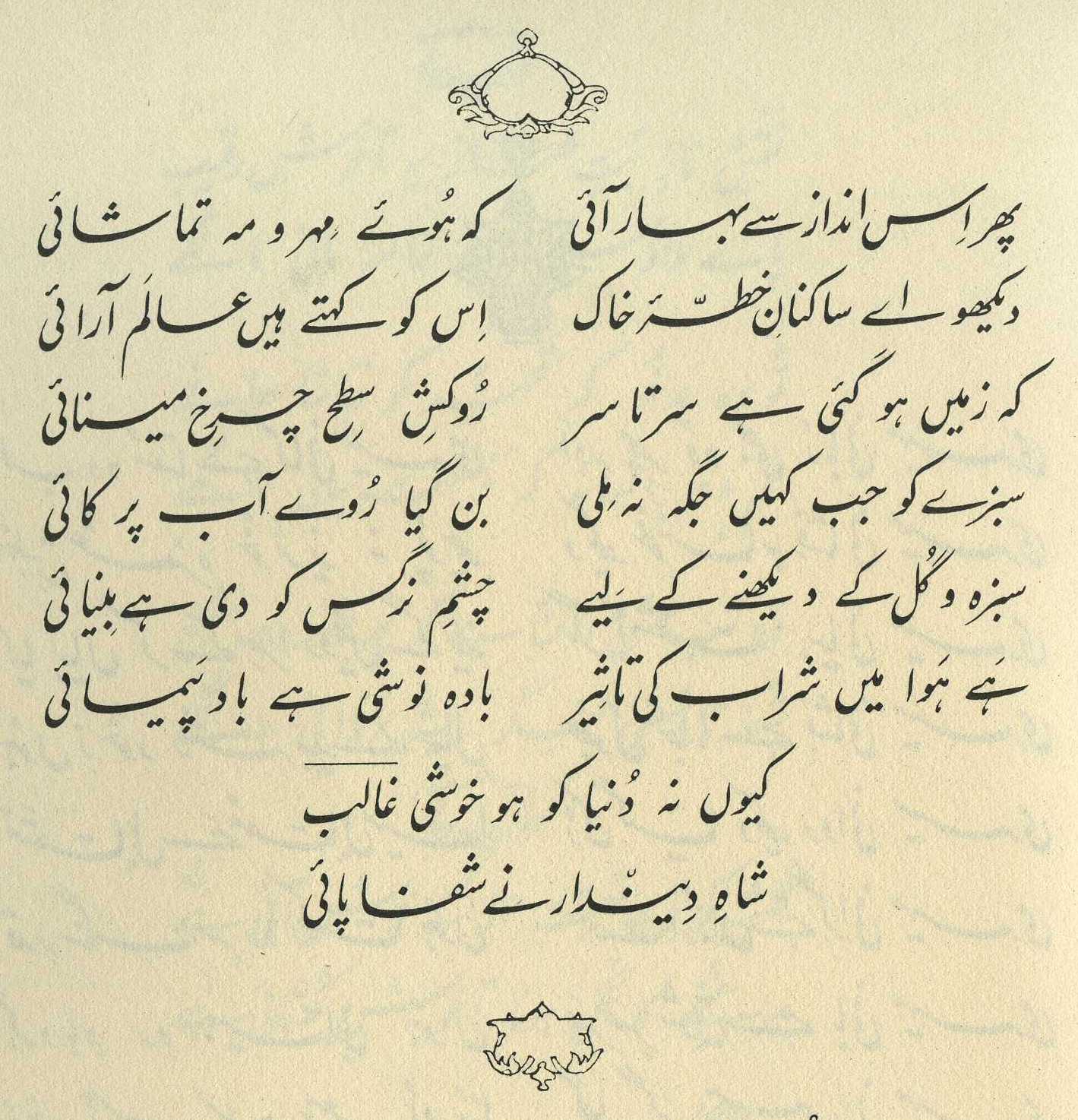
That is, on the earth greenery and roses have grown to such an extent that the earth has become equal to the cover of the surface of the enamel-colored sphere. (263)
So that the whole earth and sky have become equal to enamel-work. (360)
= 'making ashamed' [] . (406)
That is, the earth, from beginning to end, with the enamel-color from the spring, is making the sky ashamed. (306)
This whole ghazal has an unusual degree of internal coherence; for discussion, see 181,1 .
This verse strongly presupposes the prior presence of 181,2 , since it begins with 'for', or 'since' or 'in that' []-- which makes fine sense if we think of it as continuing the thought of {181,2}, and makes no sense at all otherwise.
The 'enamelled' (or perhaps 'azure') sphere is the sky, with its brilliant shades of blue, white clouds, and silvery stars. Since the earth is now all green-- see the next verse, 181,4 , for confirmation-- it's an equal or rival in its vivid, pervasive coloring.
As a rule I rely on Platts, supplemented by Steingass, and rarely do they mislead. But apparently they do mislead in this case, so I'm recording their definitions just to show that nobody's perfect. Platts offers, : 'Having or presenting an exterior different from the interior; --anything whose exterior and interior differ; --cover of a mirror' (602). Steingass agrees: 'Anything whose exterior and interior differ' (596). Not only do modern dictionaries tend to offer for , as Tahira Naqvi and other members of the Urdulist have pointed out, definitions like 'rival', but the commentators seem broadly to agree. And when I checked with S. R. Faruqi, he agreed too, and said (Dec. 2005) that that meaning is common in Persian too; he observed that the definition by Platts and Steingass was apparently based on another definition, as 'lining', given in the early Indo-Persian dictionary . Apparently the idea is of 'pulling' or 'drawing' one's face up to confront someone as an equal.
Other verses for comparison: 15,12 ; 112,8 .
graphics/bluedomeisfahan.jpg