Verse 11855aa))ii
G8
In this meter the first long syllable may be replaced by a short; and the next-to-last long syllable may be replaced by two shorts.
1
again/then spring came with {this kind of / such a} style/manner
2
that sun and moon became spectacle-viewers
| References | |
|---|---|
| Arshi, Imtiyaz Ali | Ghazal# 232 |
| Raza, Kalidas Gupta | 459-60 |
| Hamid Ali Khan | Open Image |
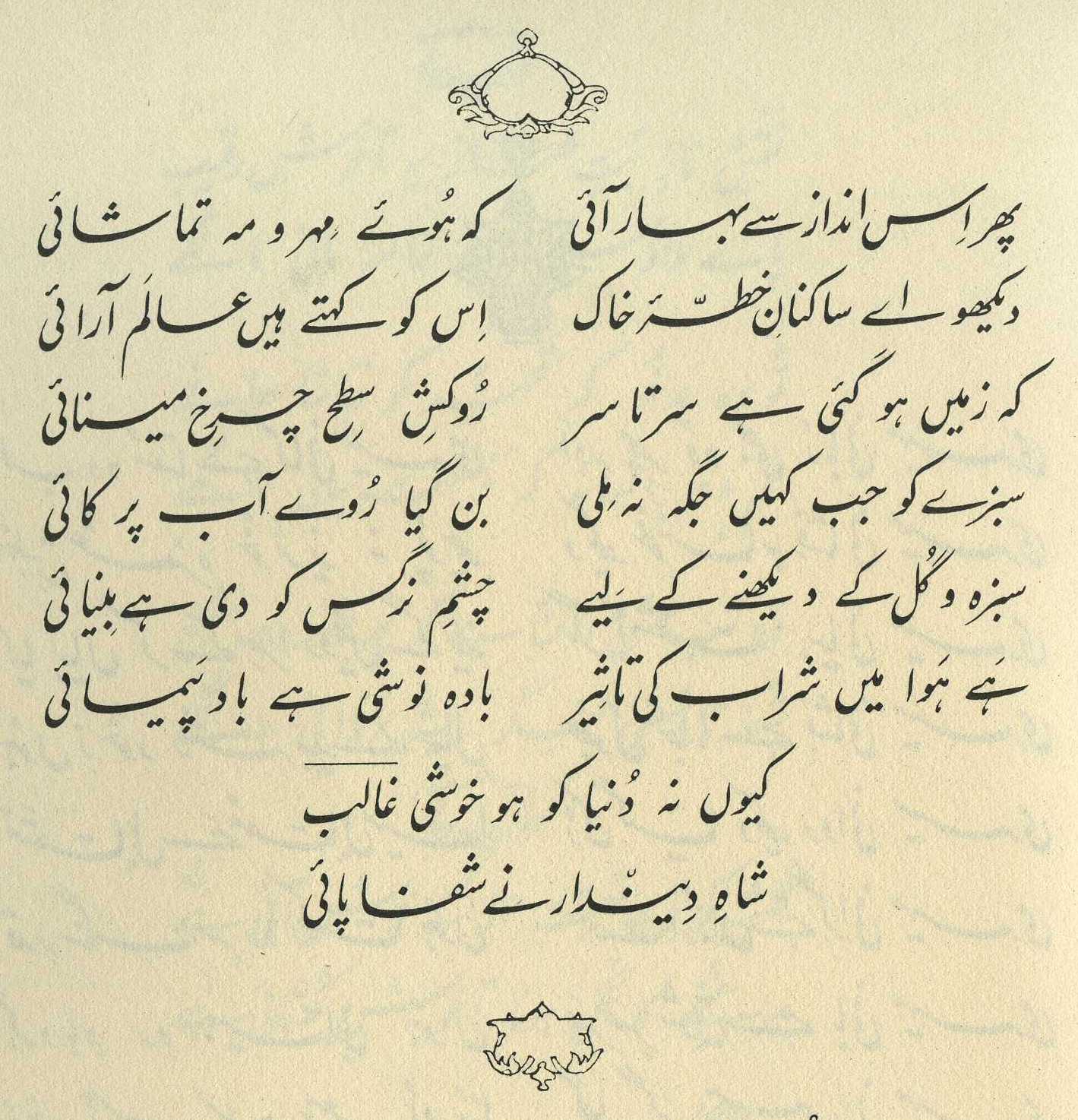
[Commenting on the whole ghazal:] In this season the air, like wine, creates intoxication. Now, what need is there to drink wine? (204)
== Nazm page 204

He says, 'Once again the spring season has come with such a fine style that sun and moon have become its spectacle-viewers'. (262-63)
Again spring came in such a way that the sun and the moon became absorbed in the spectacle. (360)
This is not a ghazal; rather, it's a verse-set or an opening-verse expressing happiness at the companionship of Zafar Shah. (406)
The commentators tend to treat this as something like a verse-set , though most of them don't use the term. Many of them present all the verses together, and comment on them as a group. Bekhud Dihlavi identifies the ghazal as including a verse-set that begins with the second verse (263). Shadan actually asserts that it's not a ghazal; Chishti pointedly refers to it as a 'poem' [] (730), while Mihr calls it a 'solid/fixed poem [], with all its verses continuous' (599). It's easy to see why they do so, since the whole ghazal obviously does have an unusual degree of unity. To me the whole ghazal certainly feels like a verse-set; but Arshi doesn't mark it as such, so apparently Ghalib didn't either. S. R. Faruqi describes it (Dec. 2005) as a continuous ghazal.
In terms of continuity, this ghazal has a sense of something even more than flowingness -- a sense in fact of rushing along, of a continued strong, eager flow of thought and feeling from one verse to the next. The ghazal wants to be read as a whole, and that desire simply oozes out of it, no matter whether we officially call it a verse-set or not. The meter is short, and the verses, if taken one by one, are quite un-Ghalibianly simple and plain.
In some ways it's reminiscent of 49 , which with its unifying 'wave of wine' has a similar feeling of thematic unity and of rushing along from verse to verse. But many verses of {49} are individually powerful and brilliant, while none of the verses in the present ghazal have as much force. It can perhaps best be compared with the verse-set beginning with 162,4 ; though that one too seems to have somewhat more striking individual verses.
Obviously, it culminates in rejoicing at the King's restored health, in 181,7 . So perhaps, since the whole cosmos joins in celebration, it should be considered a form of ode to the King in his restoration to health. And in that specificity of context it can be compared to the elegy for Arif, 66 ; and to the more generalized elegy that is 139 .
graphics/sunmoon.jpg