Verse 2after 1821aa;Nnah puuchh
G3
1
helpless(ly), one should endure the longing even/also of/for friendlessness
2
the difficulty of the road, and the tyranny of the road-sharers-- don't ask!
'Someone, somebody, anyone, one; a person, a man, an individual'.
'Forlorn state, friendlessness, destitution'.
| References | |
|---|---|
| Arshi, Imtiyaz Ali | Ghazal# 129 |
| Raza, Kalidas Gupta | 224-25 |
| Asi, Abdul Bari | 204-206 |
| Gyan Chand | 316-318 |
| Hamid Ali Khan | Open Image |
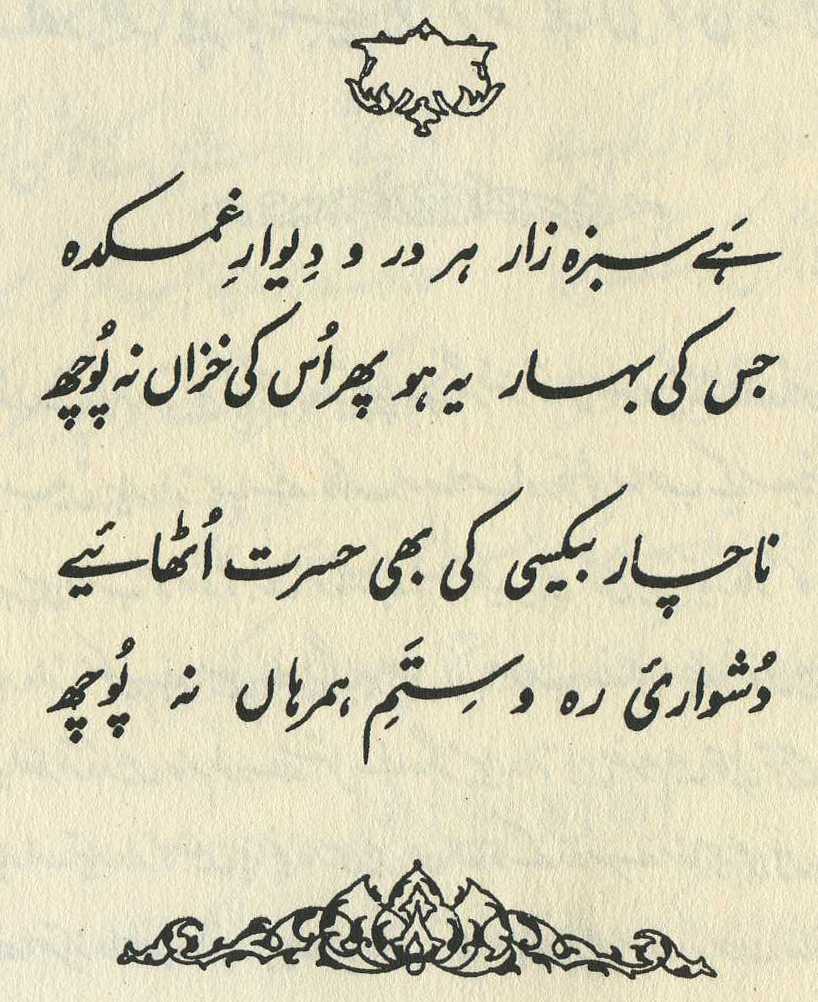
That is, the cruelty practiced upon us at the hands of the fellow-travelers-- to endure that trouble is a difficult path; don't even ask about its difficulty! Our longing is, if only we were friendless and alone! (138)
== Nazm page 138 ; Nazm page 139


He says, 'Don't ask me about the difficulties of the road and the tyrannies of the fellow-travelers. It has reached such a limit that I've been forced to resolve that it's now necessary to endure the longing for friendlessness and solitude.' And in such a difficult passage along the road, the company of such cruel ones is not good. (194)
In this rough road, it is necessary to endure such difficulties at the hands of the companions that, uncontrollably, my inner self wishes that I were alone. That is, out of compulsion I am forced to feel the longing for friendlessness. (259)
In classic mushairah style, the first line alone is not only vague, but actively misleading. For might well lead us to think of a longing generated by friendlessness-- the way 21,10 and 71,1 , which both speak of the sound 'of' breaking, mean the sound generated by breaking. The longing 'of' friendlessness would be a perfectly natural reading, since friendlessness is such an undesirable state that we would expect a semi-personified 'Friendlessness' to long for companionship or support of some kind. This possibility is reinforced by , 'helpless(ly)', since in the ghazal world (and outside it too, for that matter) the connection between friendlessness and helplessness is very strong (consider the meanings of ).
Only at the last possible moment, at the end of the second line, do we finally learn that along with the general 'difficulty of the road', the 'tyranny of the fellow-travelers' (literally, of the 'road-sharers') is a particularly unbearable part of the speaker's travails. Because the road is difficult anyway, one would wish for reliable companions. But to have cruel and treacherous companions is worse than to be alone! Things have reached such a pass that, reluctantly and 'helplessly', the speaker is forced to wish for a state of 'friendlessness'. Only now, retrospectively, can we understand the in the first line.
The word itself, like , illustrates the strong negative value attached to aloneness. For literally, the simply negates , the Persian word for 'someone, anyone' (see the definition above); thus is the state of being without anyone. It is conventionally construed as having no friends or companions around, but this verse reminds us pointedly that it also means having no enemies or persecutors around. It makes us remember the little three-verse riff on the beauties of the hermit's life: 127 .
graphics/hardroad.jpg