Verse 5xafter 1821aa;Nnah puuchh
G3
1
I am the heedlessness-merchandise of a pan of the balance-scale of justice
2
oh Lord , an account of the harshness of the heavy/painful/valuable dream/sleep-- don't ask!
'Unmindfulness, forgetfulness, neglectfulness, negligence, neglect, inattention, heedlessness, inadvertence, remissness, carelessness; —soundness (of sleep), unconsciousness, drowsiness, stupor, insensibility, a swoon'.
'Merchandise; goods, chattels, furniture; clothes, effects; utensils; valuables'.
'The tray of a pair of scales'.
'A balance, pair of scales'.
'Hardness, stiffness, rigidity, firmness; tightness; stinginess; obduracy, obstinacy; intenseness, intensity, vehemence, severity; harshness, asperity; sternness, austereness; violence, atrocity; cruelty; grievance, hardship; adversity, indigence, distress, difficulty, evil, calamity'.
'Heavy, weighty, ponderous; great, important, momentous; difficult; burdensome, grievous; —precious, valuable; dear, expensive'.
| References | |
|---|---|
| Arshi, Imtiyaz Ali | Ghazal# 129 |
| Raza, Kalidas Gupta | 224-25 |
| Asi, Abdul Bari | 204-206 |
| Gyan Chand | 316-318 |
| Hamid Ali Khan | Open Image |
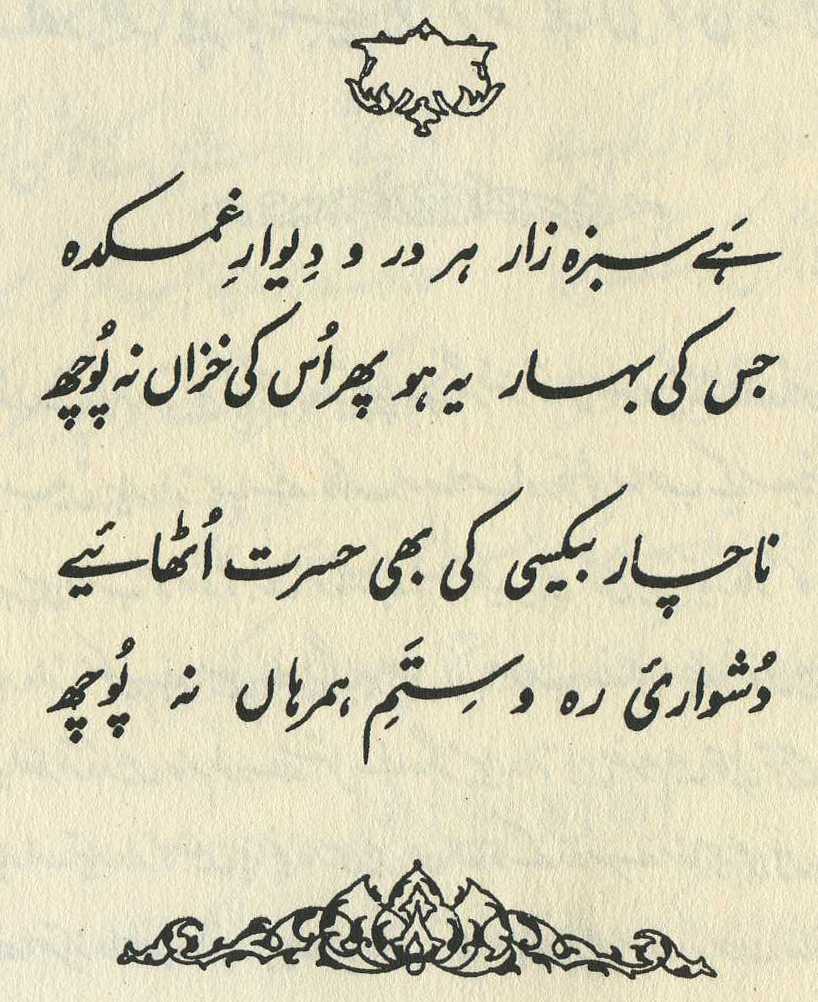
'Oh my Lord, don't take into account my 'heavy' sleep and my fathomless heedlessness, because in the balance-scale of justice, in my balance-pan instead of virtuous deeds there is only heedlessness and more heedlessness. So how can an account even be taken? Here, nothing at all is present except for heedlessness.'
== Asi, p. 205
The poet is being asked, in the court of Judgment Day, about his deeds. In answer he says, 'I was in a heavy sleep, my eyes were closed, I didn't at all see whatever is to happen today. As to why it was like that-- don't ask. Enough-- now whatever merchandist I have, is the merchandise of heedlessness. Weigh it up!'.
== Zamin, p. 308
Oh Lord, if you will weigh my deeds in the scale of justice, then I will turn out to have only the capital of heedlessness. I slept a sleep of great heedlessness. Don't ask for an account of its harshness!
== Gyan Chand, p. 318
For background see S. R. Faruqi's choices . For more on Ghalib's unpublished verses, see the discussion in 4,8x .
The grammar seems to require to be a noun compound, the 'goods or 'merchandise' that consist of 'heedlessness' or 'unconsciousness'. For more on such noun compounds, see the next verse, 129,6x .
When merchants settle their 'accounts', they need to weigh up different commodities in the two pans of the balance-scale-- either against fixed weights, or simply against each other. In the divine balance-scale of justice, one of the two pans contains the speaker's only merchandise: himself as a sort of incarnation or essence of 'heedlessness' or 'unconsciousness'.
If the speaker and his essential property of 'heedlessness' are in one pan of the scale, what's in the other? A verse like 79,2 would suggest that there ought to be some equilibrium in the 'account': he's been guilty toward the Lord, but the Lord also owes him a similarly large amount of recompense. So perhaps the speaker has been afflicted, during his sleep (?) of 'heedlessness', with painful, harsh, violent dreams; perhaps this 'weight' of suffering has weighed down the other pan enough to compensate for the (also heavy) 'heedlessness' in the speaker's pan.
Or perhaps the speaker and his heedless dream/sleep are in fact 'merchandise' of great value? Perhaps his dream is genuinely 'momentous' or even 'precious' (see the definition of above); on this reading, it would be in his pan of the scale, not the other. The contents of the other would be determined by divine 'justice'. Does the speaker perhaps dream the universe, or (re)constitute it in his mind during his 'heavy' nights of dreaming? Compare 98,10 .
For another 'balance-scale' verse, see 263x,4 .
A traditional Indian balance-scale, with its two pans and its measuring-weights:
graphics/mizan1.jpg
graphics/mizan2.jpg