Verse 11816aadahrakhte hai;N
G9
In this meter the next-to-last long syllable may be replaced by two shorts.
1
the age/world is severely/violently torment-lacking, by/toward the life of Asad
2
otherwise-- well, we do expect/desire more
'Time, period, duration; season; a long time; an age; .. —the world; the heavens; fortune, destiny'.
'Very, intensely, violently, severely, excessively, extremely'.
'Sickness, disorder, disease, infirmity; trouble, affliction; injury, outrage'.
'To entertain or have hope, to hope; to expect, to look (for); to desire'.
| References | |
|---|---|
| Arshi, Imtiyaz Ali | Ghazal# 94 |
| Raza, Kalidas Gupta | 207 |
| Nuskhah-e-Hamidiyah | 155-156 |
| Asi, Abdul Bari | 170-171 |
| Gyan Chand | 273-275,539 |
| Hamid Ali Khan | Open Image |
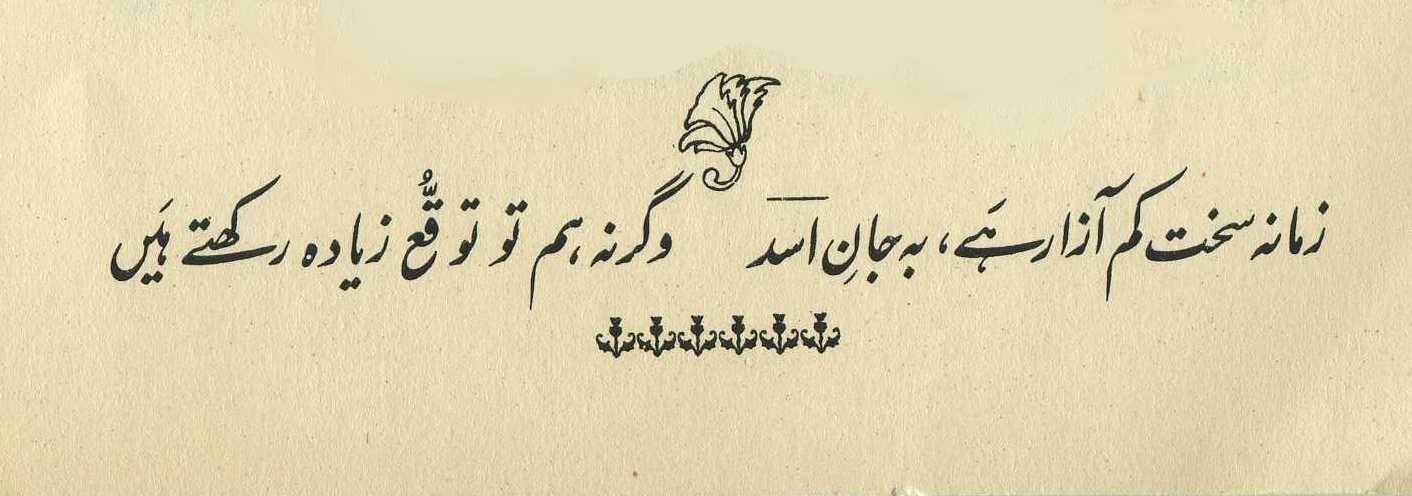
He has sworn an oath: he says that the extent of torment that comes to him at the hands of the age is extremely little-- otherwise, we long to endure more tyranny. The use of with the meaning of 'very much' is a Persian idiom; in Urdu it is very little used. (114)
== Nazm page 114

He says, the extent to which the age delivers torment to me is extremely little. Swearing by the life of Asad, he says that we long to endure from it more tyranny than this. (165)
We swear by the life of Asad, that the age torments us very little. Otherwise, we hope to endure from it much more tyranny than this. That is, the age does not torment us as it ought to. We are ready for even more. (216)
This was originally the closing-verse of a ghazal. Ghalib chose to omit the rest of the verses from his published divan . The whole ghazal is discussed on this website.
As so often, the commentators go in for a lowest-common-denominator prose paraphrase; but in a verse like this one, that approach is particularly damaging. This verse is crammed and jammed with wordplay, and the commentators notice (or at least acknowledge) absolutely none of it.
In the first line, the phrase is a treat in itself. It has the flavor of something like 'harshly/painfully torment-lacking'. This weird sequence glows in the dark, it absolutely demands our attention and further thought (as does 'simple-clever' in 108,8 ). And then of course we have , with the double meaning of a very common form of oath ('[we swear] by the life of Asad'), and the prepositional meaning of 'with' or 'toward' (the age is harshly torment-lacking toward the life of Asad'). This latter meaning is especially apt, since the complaint is being made that the torment is insufficient-- it's not deadly enough to threaten Asad's life.
Then the second line, in addition to providing a 'more' [] to go with the 'less' [] in the first line, has an amusing colloquial charm of its own. There's an untranslatable delicate suggestiveness in it, a polite hint of benefits expected; it's what the courteous but slightly aggrieved petitioner says as a reminder to a perhaps dilatory benefactor-- 'Well, uh, we do have hopes for more'. The word 'more', like 'better' (as in 'I expected better from you'), acts as an all-purpose evocation of good things. Automatically we find themselves hearing or reading the line in just this way. But then, of course, we do (literally) a double-take, and realize that here the 'more' refers to more torment, more violence, more suffering. The speaker wants 'more' of what has been 'lacking' ('less') in his life so far.
We can call all this wordplay, but we need to call it meaning-play as well. And what would the verse be without it? As you can see from the commentators' accounts (all translated in their entirety), the answer is-- dullsville.
graphics/torment.jpg