Verse 4x1816aadahrakhte hai;N
G9
In this meter the next-to-last long syllable may be replaced by two shorts.
1
with the aspect/'color' of a shadow we offer, in servitude, acceptance/prostration
2
{since / in that} we maintain/'keep' a heart-wound, with a cheerful/subjugated/'open' forehead
'Shadow, shade; shelter, protection'.
'Saluting, greeting; salutation, obeisance, homage, touching the ground with the fingers and then making ; health, security; ... surrender, resignation; conceding, acknowledging, granting; assenting to, accepting'.
'Opened, uncovered, disclosed, discovered, detected, revealed, expanded, spread out, displayed, drawn forth; taken, subjected, subdued; open, ... ; free, frank, cheerful, glad, happy; serene, clear'.
| References | |
|---|---|
| Arshi, Imtiyaz Ali | Ghazal# 94 |
| Raza, Kalidas Gupta | 207 |
| Nuskhah-e-Hamidiyah | 155-156 |
| Asi, Abdul Bari | 170-171 |
| Gyan Chand | 273-275,539 |
| Hamid Ali Khan | Open Image |
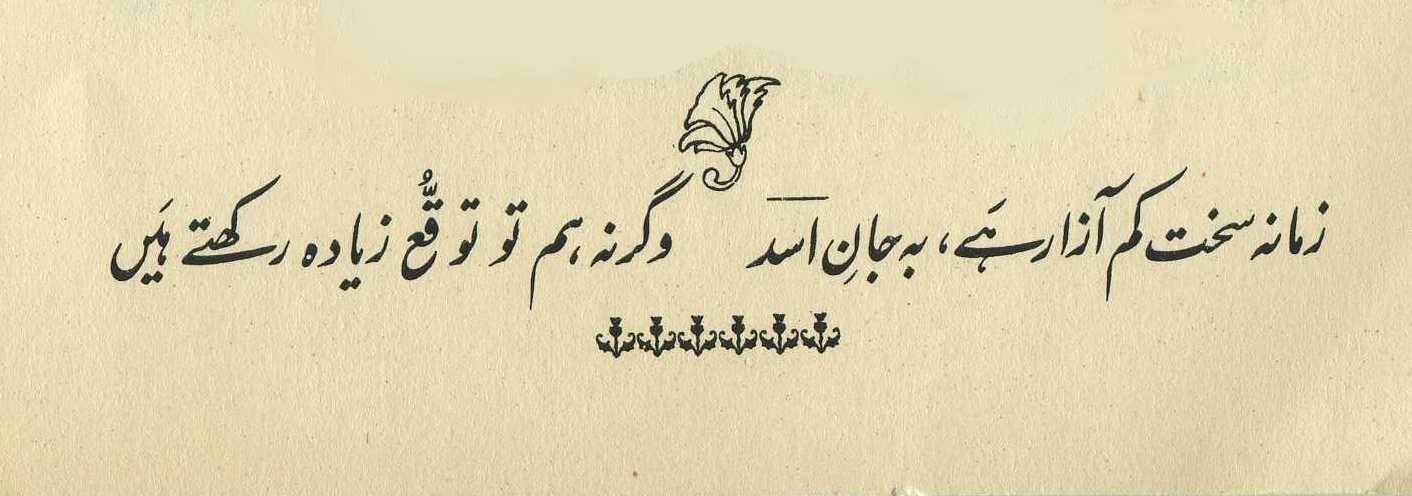
Like a shadow, in servitude we have maintained a temperament of submission and acceptance; and the way that on the 'open' forehead of a shadow there is a single wound of submission, in the same way we too willingly have taken with an 'open' forehead the wound of the heart. The 'open' forehead of a shadow is that place where the shadow would fall, and is that ground for which an 'open forehead' is an extremely harmonious and suitable simile .
Or else this: with an 'open' forehead we maintain the wound of our heart, the way a shadow keeps the scar/wound of slavery on its forehead. This latter meaning is more suitable and plausible.
== Asi, p. 170
That is, the way a shadow is entirely a wound (prostration), which is a symbol of servitude, in the same way our heart-wound too has appeared on our 'open' forehead, which is a token of submission (servitude). = we have given ourselves over to servitude. This usage of is contrary to Urdu idiom.
== Zamin, p. 251
From servitude, a wound falls upon the heart. An 'open' forehead is a sign of cheerfulness. The meaning of the second line is not that we duplicated the wound in the heart on the open forehead; rather, it means that along with an open forehead we maintain a wound in the heart. A shadow is the servant of its shadow-caster, and it wholeheartedly accepts this relationship. We too have very cheerfully accepted the wound of servitude on our heart.
== Gyan Chand, p. 274
For background see S. R. Faruqi's choices . For more on Ghalib's unpublished verses, see the discussion in 4,8x .
A shadow 'prostrates' itself at the shadow-owner's feet, because the end of the shadow always touches the shadow-maker's feet, and because the rest of the shadow lies on the ground. The speaker's surrender, or acceptance, or prostration, in servitude is like that of a shadow in its absoluteness (since the shadow can't imagine any other form of life). Depending on how we read (see the definition above),
=the speaker keeps a 'cheerful, happy' face that belies the presence of a wound in his heart.
=the speaker keeps a 'subjugated, subdued' face that shows the presence of a wound in his heart.
=the speaker keeps a face that is is 'open, revealed', while the wound in his heart remains hidden.
The verse thus elegantly explores the various possibilities of ; the protean grammar of also plays its part in assuring flexibility.
Moreover, the itself cleverly does double duty, since the forehead or face is a primary means for revealing (or concealing) emotion, and is also the part of the body involved in literal prostration like that of a shadow (as a sign of humility, sometimes even literally marked by contact with the ground, as in 91,10 ). The face is also prominently involved in gestural acts of symbolic prostration (as in the courteously deferential greeting of ).
Note for grammar fans: It's of course grammatically inviting to read: 'we keep a wound in our heart that has a cheerful, happy expression' (or 'a subjugated, subdued expression'). But the effort required in endowing the heart-wound with a 'forehead' or a 'face' seems too distracting to be poetically effective.
graphics/shadow.jpg