Verse 11816arhai aaj
G3
1
in the garden the arrangement/'binding-and-fastening' is of a different style/'color' today
2
the Ring-dove 's neck-ring is the 'circle outside the door' today
' 'Binding and fastening'; plan, organization, management, administration; arrangement, disposition, method, order, system; settlement (of revenue), regulation'.
'Colour, colouring matter, pigment, paint, dye; colour, tint, hue, complexion; beauty, bloom; expression, countenance, appearance, aspect; fashion, style; character, nature; mood, mode, manner, method; kind, sort; state, condition;... --a place of public amusement or for dramatic exhibition, theatre, stage; dancing; singing; acting; sport, entertainment, amusement, merriment, pleasure, enjoyment'.
'A turtle-dove; a ring-dove'.
tauq>>: 'A neck-ring; a collar (of gold, &c., for ornament; or of iron, &c., for punishment; or worn as a badge of servitude); a necklace; a yoke'.
'A circle, a ring, hoop, link, loop, button-hole; the collar (of harness); a company (of people), assembly, fraternity; a circle, a circuit (of a village, &c.); a boundary line which includes all the lands and dwellings of a village or hamlet; knocker (of a door)'.
'Without, on the outside, out ( = baahar )'.
| References | |
|---|---|
| Arshi, Imtiyaz Ali | Ghazal# 54 |
| Raza, Kalidas Gupta | 174 |
| Nuskhah-e-Hamidiyah | 92-93 |
| Asi, Abdul Bari | 103-105 |
| Gyan Chand | 180-183 |
| Hamid Ali Khan | Open Image |
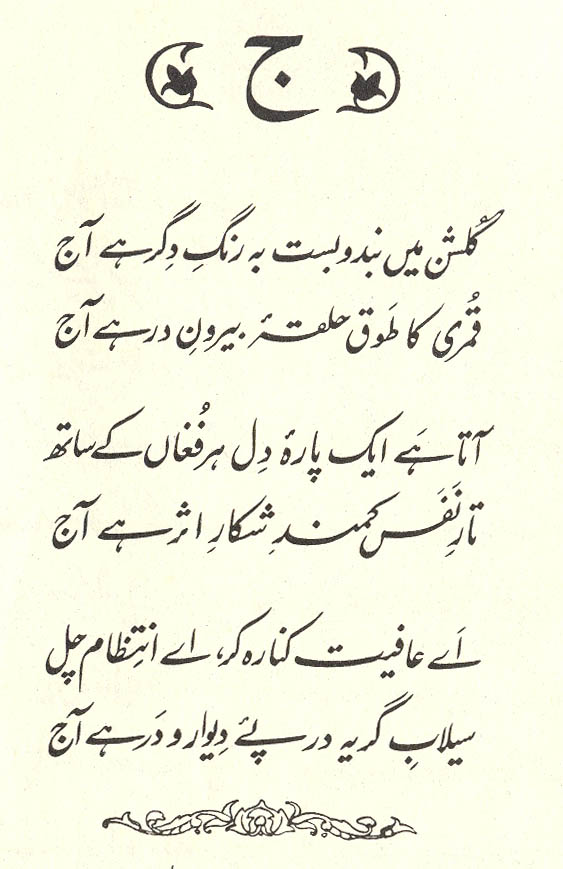
Someone who is not invited into the gathering, and is kept outside, they speak of metaphorically as 'the circle outside the door'. The meaning is only that today in the garden there's an arrangement such that not even the Ring-dove can pass. And this theme -- that is, being barred from entering the garden and complaining about it-- is constantly used by the poets. (49)
== Nazm page 49

The 'circle outside the door'-- that is, a link in the chain outside the door. Our beloved is about to come for a stroll in the garden; for this reason, nobody is allowed to enter the garden. (52)
'The circle outside the door' refers to the niche of the door. Mirza Sahib says, springtime has come to the garden, so a different arrangement has been made. And that is that the circle outside the door-- that is, the niche of the door-- has become the Ring-dove's neck-ring. Today, anyone who comes for a stroll in the garden will be imprisoned by the garden like a Ring-dove. By convention, in the spring season there's the ebullience of madness. Nowadays, the garden's atmosphere and a stroll in the garden are madness-inducing. (94)
Today in the garden the arrangement is of some other style entirely. The Ring-dove's neck-ring has become a circle outside the door-- that is, today not even he, who is born of the garden and for whom the garden exists, is allowed to set foot inside the garden....
Remark: If we look at it with the death of the sultanate in mind, then this verse is a picture of the destruction and helplessness of the Mughal dynasty, and a sketch of the grip of the East India Company, and Ghalib's foreseeing of the essence of events. (119-20)
Today, in the garden of the mystery of the world, God knows what secrets are being discussed between the Seeker and the Sought, such that for others the entry is barred. (129)
The commentators disagree quite radically about the idiomatic meaning of -- literally, the 'circle outside the door'. Their divergent views show that the phrase may have been something people heard or read but never used in their own conversation. Perhaps the phrase was obscure to Ghalib's own contemporaries as well-- and perhaps even to the poet himself.
Ghalib experimented with the same idiom in 54,4x , which didn't make it into the divan -- but was chosen for Gul-e ra'na (c.1828), while the present verse was not.
And perhaps Ghalib even meant the idiom to be obscure. For doesn't the mysteriousness of its meaning add to the effect? It links too many domains; it offers an embarrassment of interpretive riches; it remains unresolvable. Its (self-conscious) esotericism is reminiscent of 29,2 , in which polish-marks on a metal mirror are called 'a wounded parrot'.
Surely something mystical and powerful is going on here, something that is, as we learn from the first line, far outside the ordinary. But what can it be? Or rather, how can we tell which of many possible exclusions or seclusions or imprisonments or intimacies is taking place? The excellent wordplay among as 'binding', the as a 'collar', and the as a 'circle' (of a chain? of people?), gives us plenty of raw material for speculation.
And compare Mir's version of a 'difference in the garden' verse: M 1627,5 .
ABOUT THE NECK-RING: The ' ring-necked dove ' does indeed wear a 'neck-ring' (see the picture below). The complex and contradictory possibilities of the word 'neck-ring' [] (see the definition above), too, are surely no accident. The neck-ring or collar can be a sign either of heavy servitude, or of lavish adornment. For other examples of how multivalently the word can be used, see 113,9 // 240x,1 ; 307x,2 ; 354x,2 .
And here's an example from Mir , M 208,8 :
[through your silence, Ring-dove, was the turmoil of madness disgraced
just sway even/also your neck-ring, cruel one-- create a commotion in the garden!]
graphics/qumri.jpg