Verse 91852aambahut hai
G13
1
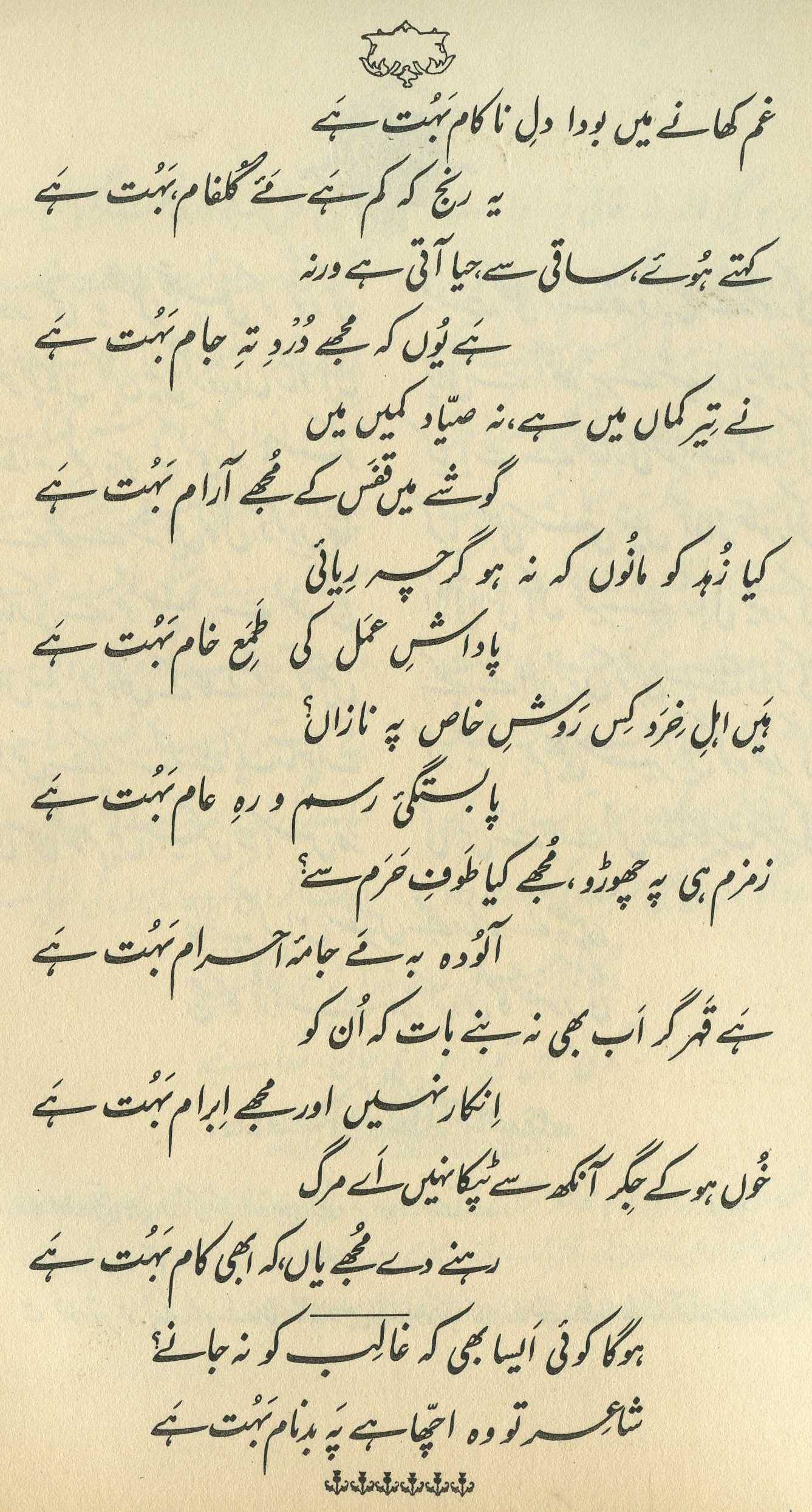
will there be any such person at all, who wouldn't know Ghalib?
2
as a poet, he's good; but he's very disreputable/'bad-named'
'Of bad repute, disreputable, infamous, ignominious; defamed, calumniated'.
| References | |
|---|---|
| Arshi, Imtiyaz Ali | Ghazal# 225 |
| Raza, Kalidas Gupta | 428-29 |
| Hamid Ali Khan | Open Image |
[No commentary offered.]
== Nazm page 263

He says, will there be any unfortunate individual who wouldn't recognize Ghalib? As good a poet as he is, he's exactly that much [ill-]famed. (321)
In Mirza's time there were some black-and-empty-hearted [] critics who called him a 'faulty poet'; and today too there are many such gentlemen who, not to speak of a unique Ustad , don't even call him a poet. In addition, they've also made Mirza's rakishness notorious. (493-94)
There's no one who wouldn't know Ghalib. He's certainly a good poet, but he's also very disreputable (he's a great wine-drinker). (513)
Apart from the good/bad wordplay, the truly clever and enjoyable thing is that Ghalib has provided himself with universal recognition: some people will know him because he's a good poet, while others will know him because he's notorious or disreputable (he has, literally, a 'bad name'). The secondary, equally clever implication is that the two groups are perhaps quite separate: the censorious gossips on the one hand, and the poetry connoisseurs on the other.
The speaker seems to be (ruefully?) acknowledging, with a show of balance, the claims of both sides. The colloquial word order in the first half of the second line creates a delightful effect of judiciousness (more like 'as a poet, he's good' than like 'he's a good poet'). Then the intervening 'but' prepares us for the concessive tone of the rest of the line. The only conclusion to be drawn, apparently, between these two balanced perspectives, is that everybody knows him. In view of both his poetic fame and his general notoriety, there can hardly be anybody who doesn't!
Compare the similarly witty, amusing blend of praise and criticism in the second line of 20,11 .
Note for grammar fans: Here's a case where has a special, untranslatably idiomatic flavor, and doesn't really mean its usual 'even/also'. Compare the exclamatory sense of 158,5 . Or even more strikingly, there's Mir 's line in M 967,1 : [out of amazement we are silent; you speak, dear], where it's clearly just emphatic. The first line is also one in which a strongly interrogative effect is created, but without the presence of or any other question marker; for a few other such examples, see 15,10 .
graphics/mfhusainghalib.jpg