Verse 51852aambahut hai
G13
1
about what/which special gait/path are the people of wisdom proud/coquettish?!
2 a
there is much foot-fixedness in the common 'custom and road'
2 b
foot-fixedness in the common 'custom and road' is much/plenty
'Motion, walk, gait, carriage; practice, custom, fashion, usage; rule, institution, law; conduct, behaviour; order, course, proceeding, procedure; manner, method, mode, way; --a garden-walk, path, avenue, passage, gallery'.
'Sporting, toying (as lovers); --giving oneself airs, being conceited (about), being proud; strutting, swaggering'.
| References | |
|---|---|
| Arshi, Imtiyaz Ali | Ghazal# 225 |
| Raza, Kalidas Gupta | 428-29 |
| Hamid Ali Khan | Open Image |
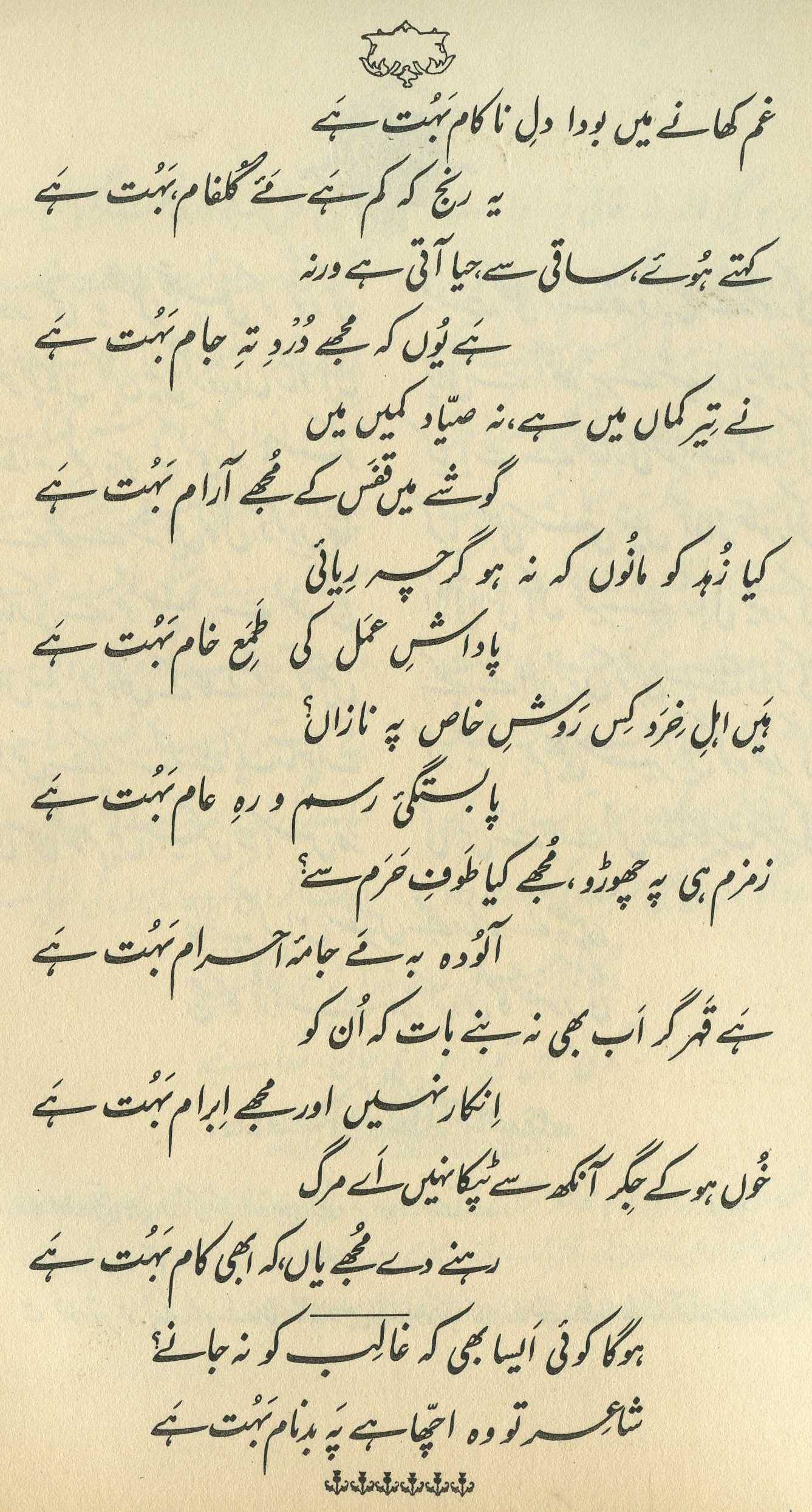
Is this what's called intelligence, that people would remain attached above all to common customs? Is this what's called a 'special gait/path', that people would greatly revere common customs? The style of this verse-- on this special gait/path if the author would have pride/coquetry, then it's appropriate. (263)
== Nazm page 263

He says, which special custom and path is it, over which wiset people feel pride/coquetry? Although these people are the farthest ahead of all others, in adhering to common customs! And the enjoyable thing is that then they claim to use a special gait/path. (320)
After all, about which special style of theirs do wise people feel pride/coquetry, while we see that they have established adherence to the common people's customs and ways as indispensable for themselves? Is this a 'special gait/path'? The claim of wisdom was that they should have done just that which perfect wisdom commanded. (491)
The commentators agree on the reading I call (1a), a reading that sneers at intellectuals for being bogged down in common styles of thought and behavior-- even while they plume themselves on their special innovativeness and unique insights.
I hadn't even initially thought of that reading, because (1b) struck me as so obvious. It sneers at intellectuals for a kind of empty pretentiousness: they devote themselves to special little gaits and paths that actually have nothing particular (other than preciousness and obscurity) to recommend them. While the truth is that it's plenty much of an achievement just to manage to follow the traditional norms of behavior, to be a good person in an 'ordinary' way (with overtones of the ' philosophia perennis ').
Perhaps I thought first of (1b) because becoming a pretentious intellectual is an occupational hazard for professors, so I was especially attuned to it. My students tended to share the commentarial reading; one of them (Mohamad Khan) pointed out that tends to have a negative sense, and that an avoidance of the well-trodden path is a very Ghalibian value. This is of course true. But then, an even more Ghalibian value is to contrive to offer more readings instead of fewer. And in 232,5 , the use of to mean 'plenty, enough' is clear. Still, I do concede that (1a) is the dominant reading, while (1b) is secondary.
The verse also has some excellent wordplay among 'gait', 'foot', and 'path', and the opposition of 'special' and 'common'. But in my view the two readings of the second line, both bouncing off the first line in their own different directions, give the verse its real kick.
graphics/roads.jpg