Verse 21852aambahut hai
G13
1
saying it to the Cupbearer , I feel shame; otherwise
2
it's like this: to me, the dregs at the bottom of the cup/glass are much/plenty
'Sediment, dregs, lees'.
| References | |
|---|---|
| Arshi, Imtiyaz Ali | Ghazal# 225 |
| Raza, Kalidas Gupta | 428-29 |
| Hamid Ali Khan | Open Image |
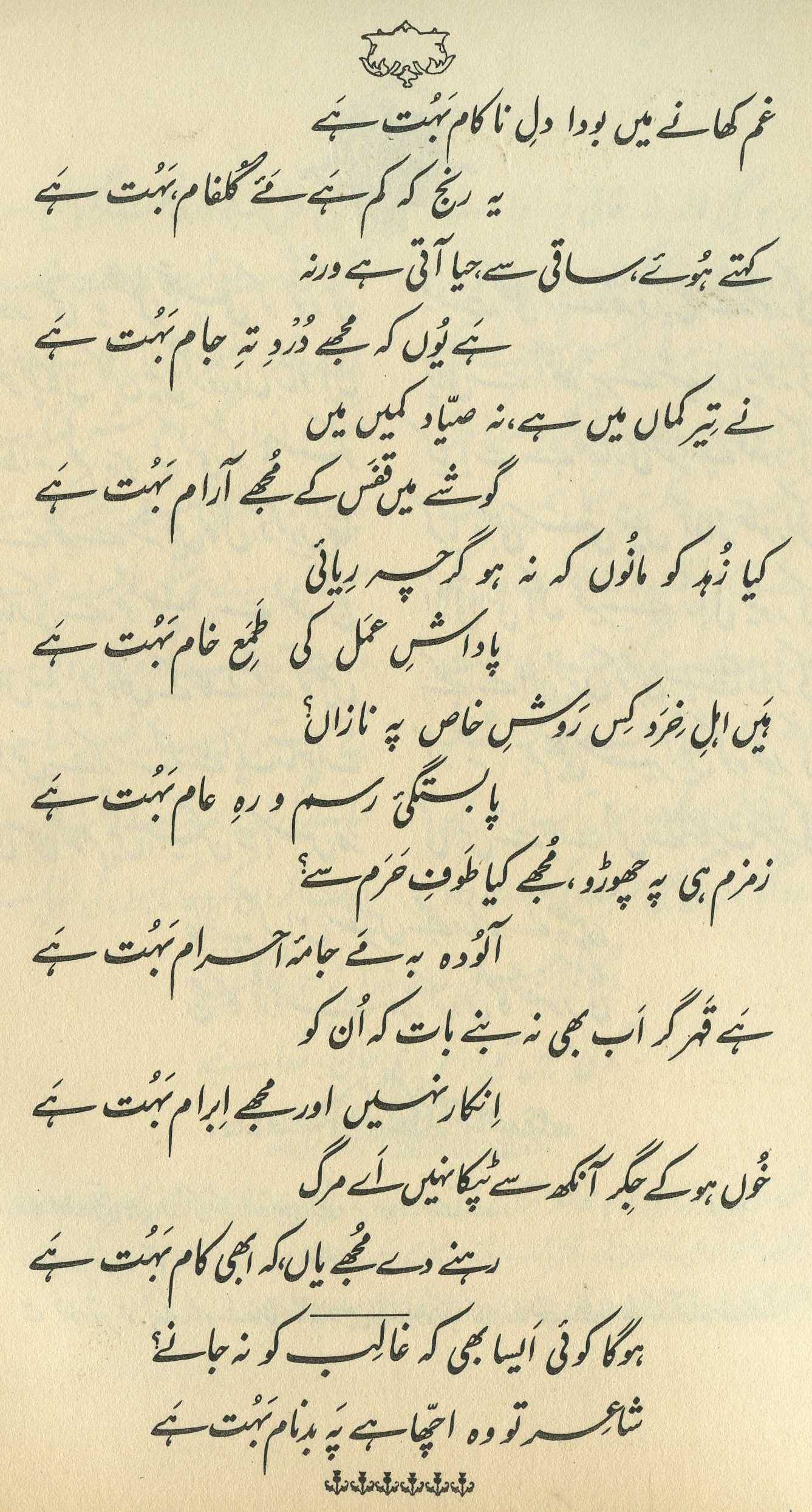
That is, I'm so easily contented that the lees of the wine are enough for me, but fear that the Cupbearer would consider me base and lacking in courage and contented with trifles, doesn't permit me to express this to him.
==Urdu text: Yadgar-e Ghalib , p. 166
In expressing the desire for wine, the poets have emptied the cask; but this theme has always remained unexhausted. Look at this verse-- how sense-stealing is its theme, such that no expression of the desire for wine can go beyond it! (262)
== Nazm page 262

The shame comes because the Cupbearer will consider me of base temperament, or will consider that it's as if I too am pursuing his beauty. The point is that if not enough wine would remain, or if it's not for giving to me, then so be it-- what the hell, let him give me the lees! From saying such a thing, the restlessness of the ardor of the rakish one is also revealed. (490)
There could be at least three reasons for the speaker's sense of shame, depending on the prior circumstances.
=If we imagine that the speaker, like the other drinkers, is presently being given normal glasses of wine, then he would feel shame at saying he doesn't need (or even want?) as much as everybody else is getting. To declare himself satisfied to settle merely for the dregs, would be to mark himself out as a more humble, less entitled person.
=If we imagine that the speaker is now not getting any wine at all, then he would feel shame at asking, in what would inevitably be a humiliating way, for the mere dregs or leftovers. The request would turn him into a beggar pleading for scraps.
=If we imagine that the speaker is asking for the dregs from the Cupbearer's own cup, then we have Bekhud Mohani's suggestion: the Cupbearer would conclude-- perhaps rightly-- that a new admirer of his beauty was seeking to ingratiate himself; the speaker feels ashamed to incur the Cupbearer's scorn.
Or perhaps there's even a fourth possibility. The 'dregs' (or 'lees') is a sediment that has settled to the bottom of the glass, and thus it could be considered much more concentrated than the ordinary wine. Perhaps asking for only the lees would be a sort of 'cut to the chase' request? Might it imply that the speaker had no concern with the wine's flavor and bouquet, or with sociability and the other elegant pleasures of the gathering, but was intent on immediate, powerful (Divine?) intoxication?
The only other verse in the divan that mentions 'dregs' is also an ambiguous one: 100,8 .
graphics/winedregs.jpg