Verse 11816aa((-ejalvah hai
G1
1
careless beauty is the buyer of the property/goods of glory/appearance
2
the mirror is the knee of thought of the inventing/devising of glory/appearance
'Heedless, careless, unconcerned, without reflection, thoughtless; fearless, intrepid; at ease, independent; fearlessly, boldly'. (Platts p.202
'Manifestation, publicity, conspicuousness; splendour, lustre, effulgence; displaying a bride (to her husband) unveiled and in all her ornaments'.
'Inventing; devising; invention; discovery; introducing'.
| References | |
|---|---|
| Arshi, Imtiyaz Ali | Ghazal# 168 |
| Raza, Kalidas Gupta | 263-264 |
| Nuskhah-e-Hamidiyah | 254-255 |
| Asi, Abdul Bari | 262 |
| Gyan Chand | 381-383 |
| Hamid Ali Khan | Open Image |
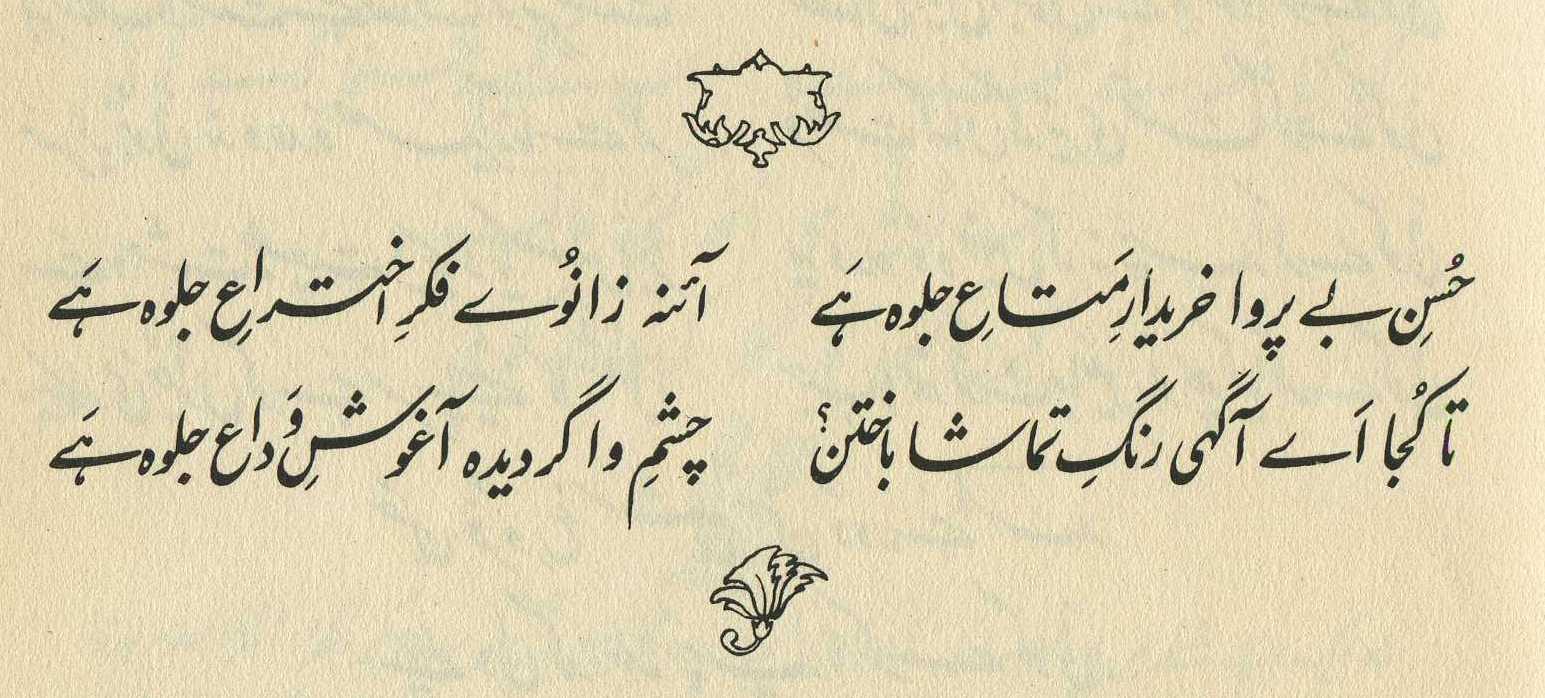
He says that beauty, although it is independent and careless, nevertheless always longs for adornment and self-display, and for it the mirror is the knee of thought. That is, in adornment the thought of invention and devising always takes place in the mirror. In the state of thought, to be 'head on knee' [] has become habitual; for this reason, in the literature of the Persian-users [] the 'knee of thought' is among the affinities , and to call the knee a 'mirror' is a well-known thing. Here the author has in fact called the mirror a 'knee'; that is, the 'knee of thought' of beauty is the mirror, because beautiful ones always have a relationship with the mirror, and in the mirror they think of adornment. (241)
== Nazm page 241

He says, although beauty is independent and careless, nevertheless it always has a longing and desire for outward adornment and glory/appearance. And in this connection the mirror does the job of the 'knee of thought'. That is, in the adornment of beauty, the thought of the invention of many new devices takes place only while looking in the mirror. (299-300)
In this verse Mirza has shown a picture of the beloveds' adorning themselves, and in the blink of an eye being inclined from one kind of glory toward another, and themselves adoring their own coquetries. (433)
The refrain of makes full use of the remarkable word (see the definition above). It's one of the few words for which I've been unable to contrive a basic single-word English translation, so that I'm stuck with the clumsy 'glory/appearance'. The word seems to fuse both these ideas in an inextricable way. It's not just 'glory', but a sudden appearance of glory. And it's not just any 'appearance', but a glorious, radiant one. Its use to mean 'displaying a bride (to her husband) unveiled and in all her ornaments' is thus a perfect illustration.
'Beauty' is described in the first line as 'careless', 'unconcerned', 'independent' [] (see the definition above)-- and then the first line itself seems to go on to show that it's no such thing. It's not 'careless, unconcerned' because it's quite careful and concerned about arranging the necessities for its own enhancement. And it's not 'independent' because it doesn't generate the wherewithal of beauty within itself: rather, it has to 'buy' the necessary 'property/goods' from outside. Such dependence is necessarily humiliating; see 18,4 for a clear statement of the case. So one reading is a teasing one: the beloved who acts so aloof and indifferent has really taken a lot of trouble over her appearance.
Another, and very mystical, reading would be sequential: primal divine Beauty is first 'unconcerned' and 'independent', but then at a later point it decides to equip itself with the requisites for visibility in the material world. Thus it acquires or 'buys' the ornaments (or veils?) of the phenomenal world, as external manifestations of what would otherwise be invisible.
The second line describes the 'mirror' as 'the knee of thought of the inventing of glory/appearance'. While usually the 'knee of thought' suggests a posture of concentration and meditative innerness, with the body drawn up and the head bent, here the lowered eyes are looking directly into a reflection of their own image. (For more on the role of the knees [] in sitting (on the ground, see 32,2 .) Does that constitute a parody of thought, or simply a different form of thought? Does the use of a mirror make the 'inventing of glory' artificial and derivative, or is the mirror simply an essential condition of the process of invention? See for example 47,1 , in which the garden is an indispensable (though 'impure') mirror that makes the spring breeze visible. Is the 'inventing' of glory a valuable and desirable way for glory to come about, or is there something meretricious about it?
Each line is ambiguous in itself; and of course we also have to decide for ourselves what the relationship is between them. Should one be taken as a cause, and the other as a consequence or result? (And if so, which way should the causality go?) Or should they be considered as parallel statements of the same situation, or of parallel situations-- or even of situations that are non-parallel in some suggestive way? We're led to raise these questions; but as so often, we aren't given any way to resolve them. So the verse itself becomes, and remains, a meditative experience.
Compare 42,5 , another verse in which the 'knee of thought' is linked to concentration on a mirror.
graphics/mirror.jpg