Verse 21816aa((-ejalvah hai
G1
1
until where/when, oh Awareness, the losing/bestowing of the color/mood of spectacle?!
2
the having-become-open eye is the 'embrace of leave-taking' of glory/appearance
'How far? whither? how long?'. (Steingass, p.276)
'Colour, colouring matter, pigment, paint, dye; colour, tint, hue, complexion; beauty, bloom; expression, countenance, appearance, aspect; fashion, style; character, nature; mood, mode, manner, method; kind, sort; state, condition'.
'To play; to lose at play; to give, to bestow'. (Steingass, p.136)
'Become, changed; surrounded; tumbled down, revolved'. (Steingass, p.1082)
| References | |
|---|---|
| Arshi, Imtiyaz Ali | Ghazal# 168 |
| Raza, Kalidas Gupta | 263-264 |
| Nuskhah-e-Hamidiyah | 254-255 |
| Asi, Abdul Bari | 262 |
| Gyan Chand | 381-383 |
| Hamid Ali Khan | Open Image |
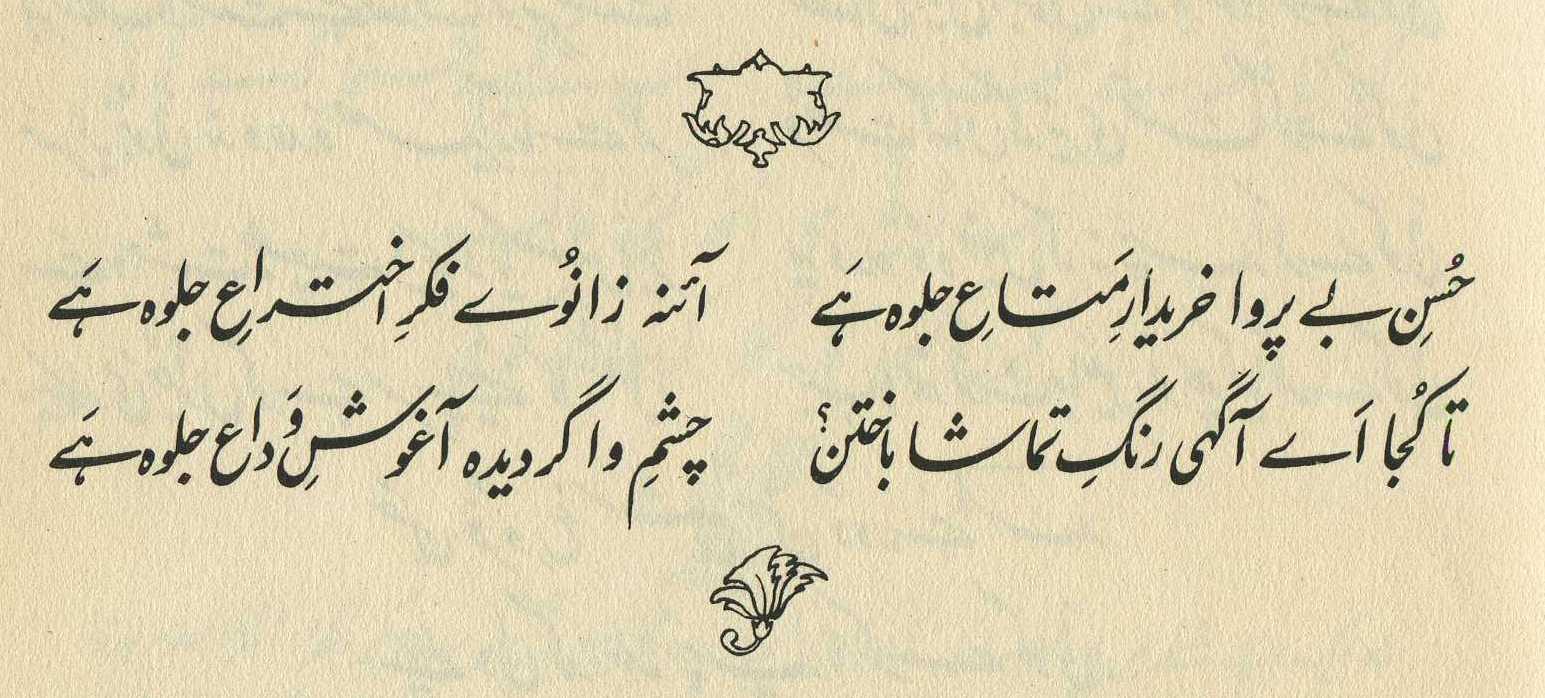
and have the meaning of ['to change the color', or 'for the color to change'], and by 'spectacle' is meant the spectacle of the world. He says, 'Oh perception and awareness, for how long will you continue to have taken on the mood/color of spectacle, and to what extent will you remain absorbed in strolling around the world? Understand this: that to open the eye to the insubstantial world is as if to open to it an 'embrace of leave-taking'. That is, for the glory/appearance of the world there is extremely little stability and duration. (241-42)
== Nazm page 241 ; Nazm page 242


Oh Awareness, after all, how long will your face keep losing its color with the pallor of a spectator? Don't you know that the open eye is the 'embrace of leave-taking' of glory/appearance? That is, oh heedless one, how long will you remain absorbed in the spectacles of the world? Here, no spectacle has either stability or duration. What you have considered to be an opened eye, is an 'embrace of departure'. (434)
This theme has been taken to a great extent from Mir : M 178,3 ....
In fact, Ghalib has not used the idiom [meaning 'for the color to depart']. He has used with the meaning of 'value and worth', or 'strength and situation'; and has used as an infinitive, in its common meaning: that is, 'to waste', 'to lose', 'to destroy'. Thus the meaning of the line is, oh Awareness, how long will you keep wasting the value and worth, the strength and situation, of the spectacle? The verse thus means that if it would be looked at with an open eye, then the value and worth of glory/appearance becomes wasted/lost. The true method of seeing is that the outer eye would be closed, and it would be seen with the eye of the heart.
== (1989: 338-39) 2006: 367-68
The verse is another of those limit cases of ambiguity; it's like the previous verse 213,1 , only even more so. Its elements are so systematically multivalent that it will make sense to look at them one by one:
='Until where/when' establishes the line as markedly ; it can be read either as a genuine question or as a rhetorical question or exclamation-- either an affirmative one that expresses approval, or a negative one that expresses disgust. (This is a variant of the 'kya effect'.)
='Awareness' is addressed, but it's not clear whether this personified entity has, or should have, any power or responsibility for action; perhaps the speaker is simply meditating, talking to his own mind and pointing out to it certain general truths.
=The 'color/mood of spectacle' could be either something felt by the beholder, or else something inherent in the spectacle itself; and the many possible meanings of (see the definition above) add to the complexities.
=Then, can mean either 'to lose' or 'to bestow' (see the definition above). Although the verb is Persian, both meanings are obviously present in Urdu as well: the former is attested by Bekhud Mohani's idiomatic sense (of losing the color in one's face) and the latter by all the uses of in the sense of something given or bestowed. Since the agent who is doing the losing or bestowing is not at all clear, the possibilities can hardly help but be manifold, and will inevitably include direct opposites of each other.
=The 'having-become-open eye', and the sense of as 'revolved, tumbled down', raises the possibility of a decline in state as well. So the verse juxtaposes two possible states: what might be 'seen' in some (mystical) sense by the unopened eye; as compared to what might be seen by the eye after it has opened. Moreover, contains, in a brilliant bit of wordplay, the word , meaning either 'eye' or 'sight'.
=The 'embrace of leave-taking' is a moment of maximum intimacy and closeness-- and one that directly precedes and initiates the moment of separation and increasing distance. This 'embrace' also of course makes a rounded shape, like an eye. In the context of the verse, is the 'embrace of leave-taking' a benefit (because it heralds the coming of a better state), or a loss (because something cherished will depart)? And is the opened eye's 'embrace of leave-taking' brought on by the brevity of the time available for sight (as when the bud opens and at once becomes an imminently-doomed rose), or by a superior new insight (the eye no longer chooses, or is able, to see its previous illusions)? For more on the rich possibilities of the 'embrace of leave-taking', see 57,6 .
=Finally of course the glory/appearance-- is it the entity that's doing the departing? Or is it the entity that's doing the embracing? Either is grammatically possible. And does the term refer to the 'appearance, manifestation' of the physical world with all its cherished loveliness, or to the ineffable 'glory, radiance' of the Divine realm?
In short, since in the first line it's not even clear whether the color/mood of spectacle is being 'lost' or 'bestowed', and since either possibility could be read in such various tones, with various views of the 'opened' or 'closed' eye, and the nature of who or what is giving and receiving the 'embrace of departure', and to what effect, I don't see how we can escape the conclusion that Ghalib has arranged this verse as a do-it-yourself 'meaning-generator', to give a workout to our minds and imaginations.
graphics/openeye.jpg